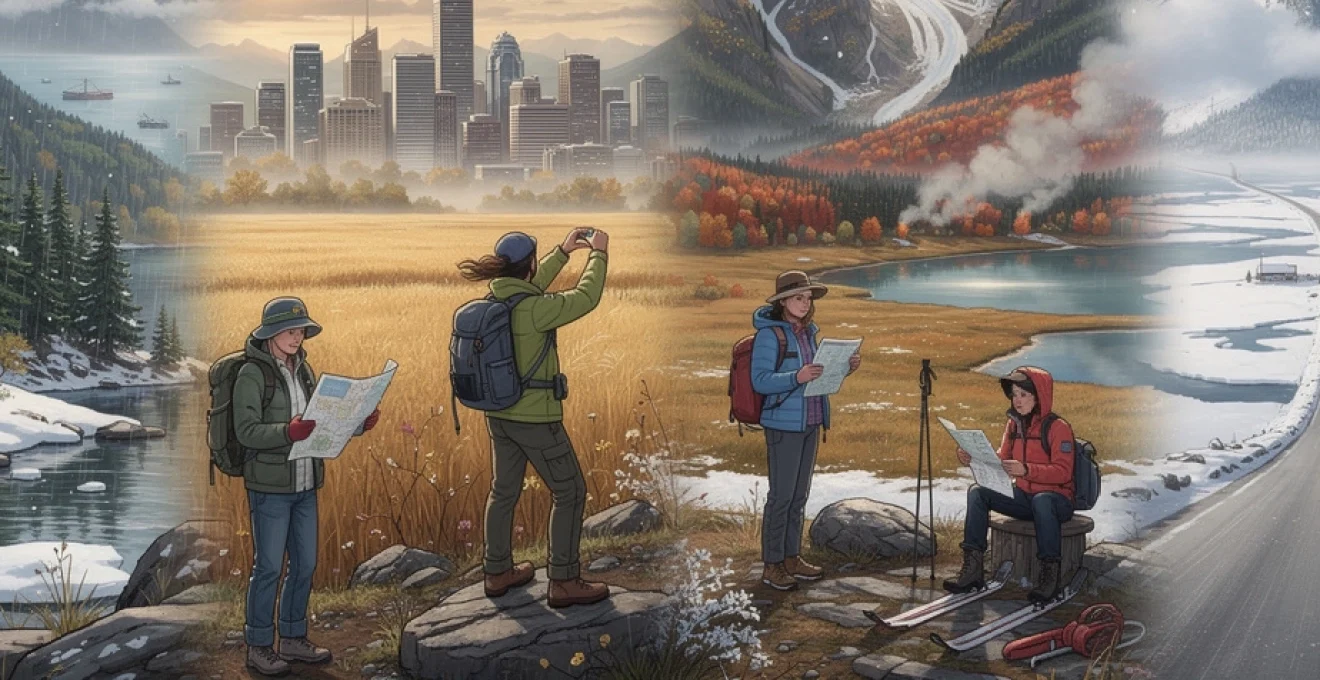
# A Traveler’s Guide to Seasonal Weather in Canada
Canada’s vast geography stretches across five time zones and encompasses climates ranging from temperate rainforests to Arctic tundra, creating a patchwork of weather patterns that can dramatically transform your travel experience. Understanding these regional variations isn’t merely academic—it determines whether you’ll witness cascading waterfalls swollen with spring melt, navigate through choking wildfire smoke, or find yourself stranded by unexpected early-season snowfall in mountain passes. With temperature differentials exceeding 60°C between coastal British Columbia in January and interior Yukon during the same period, seasonal planning becomes the cornerstone of successful Canadian exploration. This guide dissects the intricate weather patterns across Canada’s diverse landscapes, equipping you with the meteorological knowledge to time your journey perfectly, whether you’re chasing autumn foliage in the Laurentians or experiencing the midnight sun in Dawson City.
Understanding canada’s four distinct climate zones: from maritime to arctic
Canada’s immense landmass hosts four primary climate classifications that govern everything from vegetation patterns to infrastructure design. These zones don’t follow neat provincial boundaries but rather respond to latitude, proximity to major water bodies, and topographical features like mountain ranges that act as thermal barriers. Grasping these fundamental divisions helps you anticipate not just temperature ranges but also precipitation types, storm frequency, and seasonal transition timing that varies by weeks or even months between regions.
Pacific maritime climate: vancouver and british columbia’s coastal rainfall patterns
The Pacific maritime zone, dominated by the moderating influence of the Pacific Ocean, experiences Canada’s mildest winters and coolest summers. Vancouver’s January temperatures typically hover between 0°C and 6°C—a stark contrast to the bone-chilling conditions prevailing simultaneously across most of the country. This thermal moderation comes with a trade-off: relentless precipitation. Coastal British Columbia receives 1,000-3,000mm annually, with the bulk concentrated between October and March when atmospheric rivers—long, narrow corridors of concentrated moisture—slam into the Coast Mountains. During peak winter months, you might experience 20-25 days of measurable rainfall in Vancouver alone, transforming the region into a verdant landscape but challenging outdoor itineraries. The orographic effect intensifies precipitation dramatically on windward mountain slopes; locations like Tofino on Vancouver Island’s west coast can receive double the rainfall of sheltered eastern communities just 50 kilometres away.
Continental climate characteristics: toronto, montreal, and the great lakes effect
Central Canada’s continental climate zone exhibits pronounced seasonal extremes absent from coastal regions. Toronto and Montreal experience the full four-season cycle: frigid winters averaging -5°C to -14°C, warm summers reaching 25-28°C, and dramatic spring and autumn transitions. The Great Lakes profoundly influence this region’s weather through lake-effect mechanisms. When cold Arctic air masses traverse the relatively warm lake surfaces during autumn and early winter, they absorb moisture and heat, generating intense, localized snowfall bands downwind. Communities on the eastern shores of Georgian Bay and Lake Huron regularly accumulate 300-400cm of snow annually—double or triple the amounts received just 40 kilometres inland. Summer brings its own lake-effect phenomena: daytime onshore breezes moderate temperatures within 10-15 kilometres of shorelines, creating thermal refuges during heat waves when inland areas swelter above 30°C. Humidity levels in this zone spike during summer months, with humidex values—the perceived temperature combining heat and moisture—frequently exceeding actual air temperatures by 5-10 degrees, transforming a 28°C afternoon into a 35°C experience that tests even acclimatized residents.
Prairie climate variability: calgary, edmonton, and chinook wind phenomena
The Prairie provinces occupy a continental interior position that generates extreme temperature variability and dramatic weather transitions. Winter temperatures routinely plunge to -20°C to -30°C, yet Calgary experiences a meteorological phenomenon virtually unknown elsewhere in Canada: chinook winds. These warm, dry föhn winds descend the eastern slopes of the Rockies, compressing adiabatically and warming at approximately 10°C per 1,000 metres of descent. A chinook event can elevate temperatures by 15-20°C within hours, transforming a -15
°C deep freeze into a startlingly mild +5°C afternoon. For visitors, this can feel like someone flipped a seasonal switch: snowbanks slump, sidewalks turn slushy, and locals shed parkas for light jackets in a single day. Edmonton, further from the Rockies, experiences fewer chinooks and therefore endures longer stretches of stable cold, with clear skies often accompanying deep freezes due to dominant Arctic high-pressure systems. Summers across the Prairies trend hot and dry, with daytime highs frequently climbing above 30°C and severe thunderstorms rolling in during late afternoons, delivering hail, strong winds, and occasional tornadoes that can disrupt driving plans and outdoor events.
Arctic and subarctic conditions: yukon, northwest territories, and nunavut temperature extremes
Canada’s Arctic and subarctic zones, encompassing much of Yukon, the Northwest Territories, and Nunavut, present some of the most extreme weather conditions on the planet. Winter temperatures in communities like Iqaluit and Yellowknife routinely plunge below -30°C, with wind chill values making it feel closer to -40°C or lower—levels at which exposed skin can freeze in minutes. The long polar night, where the sun barely crests the horizon or disappears entirely for weeks, compounds the cold with psychological effects, while clear skies on cold nights offer peak aurora borealis viewing opportunities for those prepared with proper gear. Summers in these regions are short but surprisingly mild, with daytime highs reaching 10-20°C and the midnight sun providing continuous daylight that can disorient travellers but maximizes sightseeing time.
Precipitation in Arctic Canada is generally low, often less than 250mm annually, classifying many areas as polar deserts despite the persistent snow cover. However, what little snow does fall tends to linger, as cold temperatures inhibit melt and sublimation becomes the primary loss mechanism. Sea ice dynamics play a crucial role in coastal weather: as ice forms and breaks up across Hudson Bay and the Arctic Ocean, it alters local wind patterns, fog frequency, and even marine wildlife migration—factors that can affect expedition cruises and remote lodge access. For travellers, understanding this climate zone means appreciating that even in July you may encounter freezing winds on exposed tundra plateaus and that flights to remote communities are highly weather-dependent, with fog, crosswinds, or blowing snow frequently causing delays.
Spring weather patterns across canadian provinces: march through may
Spring in Canada is less a single season and more a staggered procession that unfolds from south to north and from coastal areas to interior plateaus. While cherry blossoms might be blooming in Vancouver by late March, snowbanks can still dominate streetscapes in Winnipeg and Quebec City, and lakes across the Canadian Shield remain locked in ice. This transitional period is characterized by freeze-thaw cycles, rapidly changing conditions, and region-specific hazards like flooding and avalanches. For travellers, March through May offers shoulder-season advantages such as lower prices and fewer crowds, but it also demands flexibility, layered clothing, and careful attention to local forecasts.
Maple syrup season and freeze-thaw cycles in quebec and ontario
Maple syrup season is one of the most distinctive spring phenomena in eastern Canada, particularly across Quebec and Ontario’s mixed hardwood forests. The sap flow that fuels this seasonal industry depends on a delicate balance of nighttime freezing (around -5°C) and daytime thawing (above 0°C), typically occurring from late February through early April depending on latitude and elevation. During these weeks, sugar shacks—or cabanes à sucre—open their doors to visitors, offering hearty meals, sleigh rides, and demonstrations of traditional syrup-making, making this an atmospheric time to visit even if lingering snow covers forest trails. Think of the maple tree as a natural pump: freeze-thaw cycles create internal pressure changes that move sap up and down the trunk, much like a heart beating in response to temperature pulses.
Travel-wise, this period in Quebec and Ontario can feel like seasonal whiplash, with slushy roads, patches of black ice in the mornings, and muddy shoulders as snowbanks recede. Urban centres such as Montreal, Ottawa, and Toronto see average March temperatures ranging from -5°C to 5°C, rising into the 10-18°C range by May as patios reopen and parks turn green. However, rain remains frequent, and river levels often peak during spring freshet, which can lead to localized flooding along the Ottawa and St. Lawrence rivers. If you’re planning a spring road trip to experience maple festivals and early hiking in places like Gatineau Park or the Niagara Escarpment, waterproof footwear and flexible daily plans are essential to adapt to soggy trails and sporadic downpours.
Avalanche risk and shoulder season in the canadian rockies
In the Canadian Rockies, spring is synonymous with shoulder season—a meteorologically complex phase where winter conditions linger in the high country while valley bottoms begin to thaw. March and April bring increased avalanche risk as solar radiation and rising temperatures destabilize snowpacks weakened by winter storm layers and persistent weak interfaces. Parks such as Banff, Jasper, and Yoho see a spike in wet loose and slab avalanches on sun-exposed slopes, especially during warm afternoons following clear, cold nights. For backcountry travellers and ski tourers, this is both a prime time for powder at higher elevations and a period demanding avalanche training, proper equipment, and strict adherence to regional avalanche bulletins.
At lower elevations, many trails remain snow-covered or transition into icy, muddy conditions that can be treacherous without traction aids. Iconic routes like the Icefields Parkway can still experience full-blown winter storms in April, with visibility dropping rapidly and temporary closures enacted during severe weather or avalanche control work. Yet, this same period often delivers spectacular scenery: frozen waterfalls hang from canyon walls, mountain peaks remain snow-capped, and tourist volumes are significantly lower than in midsummer. If you’re considering a Canadian Rockies trip in spring, you should think of it as a hybrid season—ideal for late-season skiing in resorts like Lake Louise and Sunshine Village, but premature for most high-altitude hikes.
Ice breakup season along the st. lawrence river and hudson bay
As spring advances, one of the most dramatic transformations occurs along major waterways like the St. Lawrence River and Hudson Bay. The ice breakup season, typically spanning April to early June depending on latitude, marks the transition from frozen winterscapes to navigable shipping lanes and wildlife-rich coastal ecosystems. On the St. Lawrence near Quebec City, you can watch massive ice floes drift seaward, grinding against each other with a low roar as currents and tides tear apart the winter ice cover. This dynamic process can create temporary ice jams upstream, elevating flood risk in low-lying communities and prompting emergency measures when water levels rise quickly.
Further north along Hudson Bay, breakup generally occurs later—often in June—ushering in a brief but intense period of ecological activity as marine mammals, migratory birds, and coastal communities respond to the return of open water. For travellers venturing to places like Churchill in spring, timing is critical: arrive too early, and sea ice may still restrict boat access; arrive a bit later, and you may witness beluga whales entering river estuaries under nearly continuous daylight. Shipping schedules, small-plane flights, and expedition cruise departures all hinge on ice conditions, which vary year to year with broader climate patterns. In practical terms, planning a spring trip to these regions means building in contingency days, closely following local ice reports, and working with operators experienced in navigating these volatile transitions.
Late snowfall events in atlantic canada: nova scotia and newfoundland
Atlantic Canada experiences some of the most unpredictable spring weather in the country, with Nova Scotia and Newfoundland particularly prone to late-season snowfalls. Even as crocuses emerge in early April, powerful nor’easters can still sweep up the Eastern Seaboard, delivering heavy, wet snow and strong winds that disrupt ferry schedules, flights, and coastal driving. St. John’s, for instance, often records measurable snowfall into late April, and occasional flurries can appear in May when cold North Atlantic air masses collide with lingering continental systems. This meteorological tug-of-war can make packing for a spring visit feel like preparing for two seasons at once.
On the plus side, these late snow events are often short-lived, quickly melting under strengthening spring sun angles and rising temperatures. By May, average daytime highs in Halifax and St. John’s climb into the low teens Celsius, and coastal trails begin to shed their icy coatings, opening up scenic walks along headlands and harbourfronts. However, fog becomes an increasing factor as warmer air passes over cold ocean surfaces, especially along Newfoundland’s Avalon Peninsula and parts of coastal Nova Scotia. For travellers, the key is to remain flexible: you might experience a classic « four seasons in one day » scenario, moving from flurries to sunshine to drizzle and back again. Booking refundable tickets and choosing accommodations within walking distance of urban attractions offers a buffer against these rapid shifts.
Summer climate variations: june to august temperature ranges and humidity levels
Summer in Canada, typically June through August, is when most international visitors arrive, drawn by long days, accessible national parks, and festival-packed city calendars. Yet even during this seemingly straightforward season, weather patterns vary enormously between temperate rainforests, prairie grasslands, and Arctic tundra. While Toronto might be sweltering under a humidex of 35°C, coastal Vancouver can feel almost spring-like under marine cloud and 20°C highs, and Dawson City basks in midnight sun with crisp, dry evenings. Understanding these summer climate variations allows you to choose not just the right month, but the right region for your preferred balance of warmth, sunshine, and crowd levels.
Midnight sun phenomenon in dawson city and whitehorse
In northern communities such as Dawson City and Whitehorse in Yukon, as well as Inuvik and parts of Nunavut, summer is defined less by temperature alone and more by the astonishing experience of near-constant daylight. Around the June solstice, regions above the Arctic Circle experience the true midnight sun, when the sun never fully sets and twilight merges seamlessly with dawn. Even in Whitehorse, just south of the Arctic Circle, civil twilight can extend through the night, allowing you to hike, canoe, or simply stroll historic streets at 11 p.m. under what feels like afternoon light. For travellers, this extended daylight window is a double-edged sword: it maximizes sightseeing hours but can disrupt sleep patterns if accommodations lack blackout curtains.
Temperatures during these northern summers are surprisingly comfortable, with daytime highs often ranging from 18°C to 24°C and cool nights that can dip toward single digits Celsius. Mosquitoes, however, can be prolific near wetlands and rivers, especially in June and July, so packing insect repellent and lightweight, long-sleeved clothing is as important as bringing sunglasses. The midnight sun also accelerates snowmelt in surrounding mountains and permafrost thaw in lowlands, occasionally leading to muddy trail conditions and higher river levels that affect backcountry travel. If you’ve ever wanted to experience a hike that begins after dinner and ends under a glowing horizon at 2 a.m., northern Canada in summer offers a surreal, almost dreamlike version of outdoor exploration.
Humidex ratings and heat waves in southern ontario’s golden horseshoe
In stark contrast, southern Ontario’s Golden Horseshoe region—which includes Toronto, Hamilton, and Niagara—often contends with high humidity and significant heat waves during July and August. Daytime temperatures regularly reach 27-30°C, but the humidex, which combines air temperature and humidity to express perceived heat, can push conditions into the 35-40°C range during multi-day hot spells. This is when city streets radiate warmth well into the night, public splash pads and lakeshore parks fill with residents seeking relief, and air-conditioned indoor attractions become appealing midday refuges. For travellers used to dry heat, the moisture-laden air can feel like wearing an invisible wet blanket, slowing walking pace and increasing fatigue.
These elevated humidex values are more than a comfort issue; they also have practical implications for sightseeing strategies. Midday outdoor activities, such as climbing the CN Tower’s exterior stairs or touring vineyards in the Niagara Peninsula, are best shifted to early morning or late afternoon, when sun angles are lower and pavement has not yet reached peak temperatures. Thunderstorms often build along cold fronts that break these heat waves, delivering intense but brief downpours, frequent lightning, and localized flooding in poorly drained urban areas. If you’re planning to visit southern Ontario in high summer, factoring in heat management—hydration, sun protection, and periodic indoor breaks—can transform a stifling day into a manageable and enjoyable experience.
Wildfire season conditions in british columbia’s interior and boreal forests
Across British Columbia’s interior and much of Canada’s boreal forest belt, summer also brings heightened wildfire risk. From late June through August, prolonged dry spells, heat waves, and lightning storms can ignite wildfires that range from small, quickly contained blazes to large, complex incidents spanning thousands of hectares. Regions such as the Okanagan Valley, Cariboo, and parts of northern Alberta and Saskatchewan have seen increasingly active fire seasons in recent years, sometimes prompting evacuation orders, highway closures, and widespread smoke that drifts hundreds of kilometres. For travellers, a clear mountain vista one week can morph into a hazy, amber-tinted landscape the next, with air quality advisories advising limited outdoor exertion.
Wildfire season conditions can dramatically affect visibility, photography, and even respiratory comfort, particularly for those with asthma or other sensitivities. Planning a summer road trip through affected regions now often involves checking provincial wildfire dashboards and air quality indices alongside standard weather forecasts. Because fire behaviour is highly variable and weather-driven, it’s wise to maintain flexible itineraries that allow detours to less impacted areas or coastal zones where marine air moderates smoke concentrations. While it might sound daunting, many travellers still enjoy their trips by adjusting expectations—swapping high-intensity hikes for lakefront relaxation days, or focusing on urban and wine-country experiences when nearby backcountry trails are closed.
Coastal fog banks and marine layer effects in halifax and victoria
On Canada’s Atlantic and Pacific coasts, summer brings its own subtle weather quirks in the form of fog banks and marine layer effects. In cities like Halifax and Victoria, relatively cool ocean waters interact with warmer air masses to create low stratus clouds and fog, especially during calm mornings and evenings. This marine layer can sit over harbours and headlands like a soft blanket, muting colours and obscuring distant views, only to burn off by late morning under strengthening sunshine. For travellers hoping to photograph lighthouses, bridges, or skyline panoramas, timing becomes crucial: early risers may find themselves in a grey cocoon, while those who wait until midday often enjoy crisp blue skies and expansive visibility.
These coastal fog events can also influence temperatures, keeping summer highs in the 18-22°C range even when inland areas sweat under 30°C heat. In Halifax, sea breezes can make a light jacket welcome on July evenings along the waterfront, while Victoria’s Inner Harbour sometimes feels almost autumnal when the marine layer persists. Ferry schedules generally operate regardless of fog, thanks to radar and navigation systems, but flights in and out of smaller regional airports may experience occasional delays or diversions when visibility drops. If you’re structuring a coastal itinerary around whale-watching trips or scenic coastal drives, building in a buffer day and remaining flexible about exact tour times helps ensure you don’t miss key experiences when fog lingers longer than expected.
Autumn foliage season and weather transitions: september to november
Autumn in Canada is a season of striking contrasts, when blazing foliage, crisp air, and thinning crowds combine to create some of the most rewarding travel conditions of the year. From early September to mid-November, temperatures fall rapidly, daylight hours shrink, and the first frosts signal the end of the growing season across much of the country. Yet this period also offers stable weather windows, especially in September, when lingering summer warmth collides with lower humidity to produce clear, comfortable days ideal for hiking, road trips, and city exploration. As you move north and inland, the window for peak colour and mild temperatures narrows, requiring more precise timing than a high-summer visit.
Fall colour peak timing: algonquin park, laurentians, and cape breton highlands
Some of Canada’s most famous autumn destinations—Algonquin Park in Ontario, the Laurentians in Quebec, and Cape Breton Highlands in Nova Scotia—each follow a slightly different foliage timetable. In Algonquin, sugar maples typically reach peak colour from late September to early October, painting ridgelines in vivid reds and oranges that reflect off countless lakes and wetlands. The Laurentians, with their mix of maples, birches, and conifers, often peak in a similar window, though higher elevations can turn a week earlier than valleys. Cape Breton Highlands, influenced by the Atlantic Ocean, generally sees peak colours around early to mid-October, coinciding with the popular Celtic Colours International Festival that draws travellers along the Cabot Trail’s coastal vistas.
Because autumn colour progression depends on temperature swings, rainfall, and even summer drought patterns, specific peak dates vary from year to year by a week or more. Many provincial and national parks now publish fall colour reports, allowing you to refine your timing or adjust your route in real time. For example, if Algonquin’s maples are already past their prime, you might shift focus to lower-elevation areas around the Kawartha Lakes or head east toward Mont-Tremblant where colours are still building. Accommodation near iconic viewpoints can book out well in advance during these weeks, so combining early reservations with flexible daily routes offers the best chance of catching forests at their most photogenic.
First frost dates and indian summer occurrences across provinces
As September progresses into October, first frost dates march steadily south and west across Canada, often arriving earlier in interior regions than along moderating coastlines. In cities like Calgary and Winnipeg, ground frost can appear by late September, while Vancouver and Halifax may not see their first freeze until late October or even November in milder years. These early frosts signal a rapid shift in vegetation: gardens wilt, insects vanish, and lakes begin to lose their summer warmth, creating morning mist that clings to shorelines. Yet, in many regions, a pattern known colloquially as « Indian summer » can follow—a brief return of above-average temperatures and sunny skies after the first cold snap.
These Indian summer episodes, often occurring in early to mid-October, provide delightful travel conditions: daytime highs can climb back into the mid-teens or low twenties Celsius, trails dry out, and remaining foliage glows under low-angle sunlight. It’s like getting a short, unexpected encore of summer, but with far fewer mosquitoes and crowds. However, this reprieve is transient; within a week or two, another cold front usually reasserts the seasonal trend toward chillier, windier conditions. For travellers, this means packing with layers in mind—light shirts for sunny afternoons, insulating layers and a windproof shell for brisk mornings and evenings—since you could experience a frosty sunrise and picnic-weather lunch on the same day.
Hurricane season remnants: atlantic storm systems affecting eastern canada
While Canada rarely experiences landfalling hurricanes at full tropical strength, the remnants of Atlantic hurricanes and post-tropical storms can significantly impact eastern provinces from late August through October. Systems originating in the Caribbean or off the U.S. East Coast sometimes curve northward, transitioning into powerful extratropical cyclones that bring heavy rain, strong winds, and coastal storm surges to Nova Scotia, New Brunswick, Prince Edward Island, Newfoundland, and parts of Quebec’s Gaspé Peninsula. These events can topple trees, disrupt ferry services, and cause power outages, particularly in wooded rural areas and exposed coastal communities. Recent high-profile storms have underscored how even « downgraded » systems can produce substantial impacts far from their tropical origins.
For travellers, encountering one of these storm systems can mean a day or two of indoor-focused itineraries, rearranged ferry crossings, or postponed hikes along exposed headlands. The good news is that these events are usually well-forecast several days in advance, giving you time to adjust routes or seek sheltered locations. If you’re planning an autumn road trip through the Maritimes or along Newfoundland’s coasts, monitoring the National Hurricane Center and Environment Canada bulletins becomes as important as checking foliage reports. You might strategically schedule more flexible activities—museum visits, culinary tours, or scenic drives with many pull-off options—during this season, reserving cliff-top treks and boat excursions for calmer weather windows.
Winter weather extremities: december through february snowfall and temperature data
Winter in Canada, from December through February, is when the country’s reputation for cold truly earns its stripes. Across most provinces, this period brings sustained below-freezing temperatures, accumulating snow, and reduced daylight that collectively reshape daily life and travel logistics. Yet winter is far from monolithic: coastal British Columbia sees more rain than snow at sea level, central cities like Toronto oscillate between thaws and deep freezes, and the Prairies and northern territories endure prolonged Arctic air masses interrupted by occasional chinooks or warm fronts. For visitors prepared with appropriate clothing and realistic expectations, winter also unlocks uniquely Canadian experiences, from skating on frozen canals to watching the northern lights dance across crystalline skies.
Lake-effect snow belts: georgian bay, lake superior, and lake winnipeg regions
One of the most distinctive winter phenomena is lake-effect snow, which occurs when cold, dry Arctic air passes over relatively warm, unfrozen lake waters, picking up moisture and depositing it as intense snowfall downwind. Around Georgian Bay and Lake Superior, communities such as Owen Sound, Sault Ste. Marie, and the Snowbelt regions of Grey-Bruce and Muskoka can receive two to three times the snowfall of locations only a short drive away. Similar patterns develop along Lake Winnipeg’s eastern shores, where narrow but intense snow bands can dump 20-30cm in a single event, drastically reducing visibility and creating hazardous driving conditions. For travellers, encountering a lake-effect band can feel like stepping through a weather curtain—from flurries to near-whiteout in minutes.
These snow belts are both a challenge and an asset for tourism. Ski resorts and snowmobile operators often thrive in these zones, leveraging reliable snowfall to extend seasons and maintain deep base depths. However, road closures, school shutdowns, and flight delays are more common during peak lake-effect outbreaks, especially when strong winds cause drifting and blowing snow. If you’re planning winter travel through these corridors, allowing extra driving time, carrying emergency supplies, and checking real-time highway cameras can make the difference between a memorable winter wonderland experience and a stressful slog. On the flip side, timing your visit after a lake-effect event can reward you with postcard-perfect scenery: snow-laden trees, quiet trails, and crystalline air under clearing skies.
Polar vortex events and wind chill factor in the prairies
The Prairie provinces of Alberta, Saskatchewan, and Manitoba are particularly susceptible to polar vortex events—episodes when a lobe of extremely cold Arctic air descends southward, driving temperatures far below seasonal norms. During these outbreaks, actual air temperatures can plunge to -30°C or lower, while wind chill values make it feel closer to -40°C or -45°C, conditions in which exposed skin can freeze within minutes. Wind chill is more than just a « feels like » novelty; it’s a measure of how quickly the body loses heat through convection, and it meaningfully affects how long you can safely be outside without specialized gear. Walking between downtown buildings in Winnipeg during a cold snap can feel like crossing a polar plateau, even if you’re only outdoors for a few minutes at a time.
For travellers, polar vortex episodes necessitate careful planning and a conservative approach to outdoor activities. Layering becomes critical: moisture-wicking base layers, insulating mid-layers, and windproof outer shells, combined with insulated boots, mitts, and face protection, help maintain comfort and safety. Many attractions in prairie cities, such as Edmonton’s indoor river valley funicular access points, Calgary’s enclosed +15 skywalk system, and extensive shopping complexes, are designed with these extremes in mind, allowing you to experience local culture without prolonged exposure. If you’re visiting during mid-winter and a polar vortex is forecast, you might pivot from outdoor ice festivals or cross-country skiing days toward museum visits, culinary exploration, and short, well-planned excursions to illuminated ice castles or winter markets.
Ice road season: yellowknife’s dettah ice road and winter road networks
In Canada’s North, winter also unlocks an unconventional but vital transportation network: ice roads built over frozen lakes and rivers. Yellowknife’s Dettah Ice Road, for example, provides a seasonal link between the city and the community of Dettah across Great Slave Lake, typically operating from late December to late March depending on thickness and temperature trends. These routes are engineered and monitored to ensure safe load capacities, with ploughed lanes, speed limits, and regular inspections that might surprise first-time visitors expecting improvised tracks. Driving on a frozen lake, with ice cracking and groaning below, offers a surreal experience akin to travelling on a temporary highway written directly onto the landscape.
Beyond Yellowknife, extensive winter road networks connect remote First Nations, mining operations, and small settlements across the Northwest Territories, northern Manitoba, and northern Ontario. These roads are lifelines for transporting heavy equipment and bulk supplies that would be prohibitively expensive to fly in during other seasons. Climate variability has introduced new uncertainties, however, with warmer winters shortening operational windows and raising safety concerns about ice thickness. For adventure travellers, limited opportunities exist to join guided tours that incorporate ice roads into broader northern itineraries, but it’s crucial never to venture onto unofficial routes or unverified ice conditions. Treat these seasonal highways with the same respect you would give to mountain passes: essential, impressive, and unforgiving if misjudged.
Ski season conditions: whistler blackcomb, banff, and mont-tremblant snow accumulation
For many visitors, Canada’s winter is synonymous with ski season, and marquee destinations like Whistler Blackcomb in British Columbia, Banff and Lake Louise in Alberta, and Mont-Tremblant in Quebec each offer distinct snowfall and temperature profiles. Whistler Blackcomb, benefiting from Pacific storm tracks, often records 10-12 metres of cumulative snowfall at higher elevations over a season, with a base that typically builds from November and persists into May. Lower mountain elevations can see wetter, heavier snow and occasional rain events near the village, especially during warm spells, but upper alpine zones usually retain excellent powder conditions. Banff and Lake Louise, by contrast, experience drier, colder continental snow, with mid-winter temperatures frequently below -15°C yet boasting light, low-moisture powder prized by many skiers.
In eastern Canada, Mont-Tremblant and other Laurentian resorts rely on a mix of natural snowfall and extensive snowmaking infrastructure to maintain reliable coverage from December through March, even when freeze-thaw cycles encroach. Average seasonal snow totals are lower than in the West, but efficient grooming and cold nighttime temperatures often ensure good conditions for groomed runs and family-friendly skiing. Choosing the best time to ski in Canada depends on your priorities: early season (late November to mid-December) offers quieter slopes but more variable coverage; mid-winter (January-February) guarantees cold, consistent snow but harsher conditions; and spring skiing (March to early April) pairs softer snow with longer days and a more relaxed, festive atmosphere. Regardless of region, staying attuned to short-term forecasts—particularly temperature swings that affect snow quality—and avalanche advisories in off-piste areas remains key to an enjoyable and safe ski holiday.
Regional microclimates and weather anomalies: from okanagan valley to bay of fundy
Beyond the broad climate zones, Canada is riddled with microclimates and localized weather anomalies that can make a 100-kilometre drive feel like crossing into another country. These pockets arise from a mix of topography, water bodies, elevation, and prevailing winds, creating conditions that defy provincial stereotypes. Understanding a few of these standout regions helps you fine-tune your itinerary—seeking out warmth in otherwise cool seasons, or escaping humidity and storms when the broader forecast looks challenging. It’s a bit like zooming in on a weather map and discovering hidden chapters in Canada’s climatic story.
The Okanagan Valley in British Columbia, for example, sits in the rain shadow of the Coast and Cascade mountains, producing one of Canada’s warmest and driest summer climates. Cities like Kelowna and Penticton regularly see July and August highs in the high 20s to low 30s Celsius, with relatively low humidity and abundant sunshine that fuel a thriving wine and orchard industry. Just a few hours’ drive west, Vancouver may be under cloud and drizzle while the Okanagan basks in blue skies—a stark reminder of how mountain barriers sculpt local weather. In shoulder seasons, this valley can offer an early start or late extension to « summer-like » conditions, making it an attractive alternative when coastal or mountain regions are still emerging from winter.
On the opposite side of the country, the Bay of Fundy between New Brunswick and Nova Scotia creates another set of unique weather characteristics, driven by the world’s highest tidal range. Rapidly rising and falling waters influence fog formation, coastal wind patterns, and local temperatures, particularly in spring and early summer when cold bay waters meet warming air. Towns like Saint John and Parrsboro can experience swift shifts from sun to dense fog as tidal currents and onshore breezes reconfigure air masses throughout the day. For visitors exploring coastal trails, sea caves, and tidal bore viewing areas, this means packing layers and being prepared for visibility changes that can transform a broad panorama into a mysterious, fog-shrouded scene in under an hour.
Other microclimates dot the Canadian landscape: the mild, almost Mediterranean-like pocket of southern Vancouver Island; the Chinook corridor along the eastern Rockies foothills; the relatively temperate Niagara Peninsula moderated by Lake Ontario; and even urban heat islands in major cities where concrete and asphalt store daytime warmth. When planning Canadian vacations and deciding which regions to prioritize, it’s worth thinking beyond provincial labels and looking at these finer-grained weather patterns. Doing so lets you match your preferences—whether that’s crisp, dry winter days, arid summer heat, or cool, misty coastal mornings—to the specific corners of the country that deliver them, turning Canada’s climatic diversity from a planning challenge into one of its greatest travel rewards.