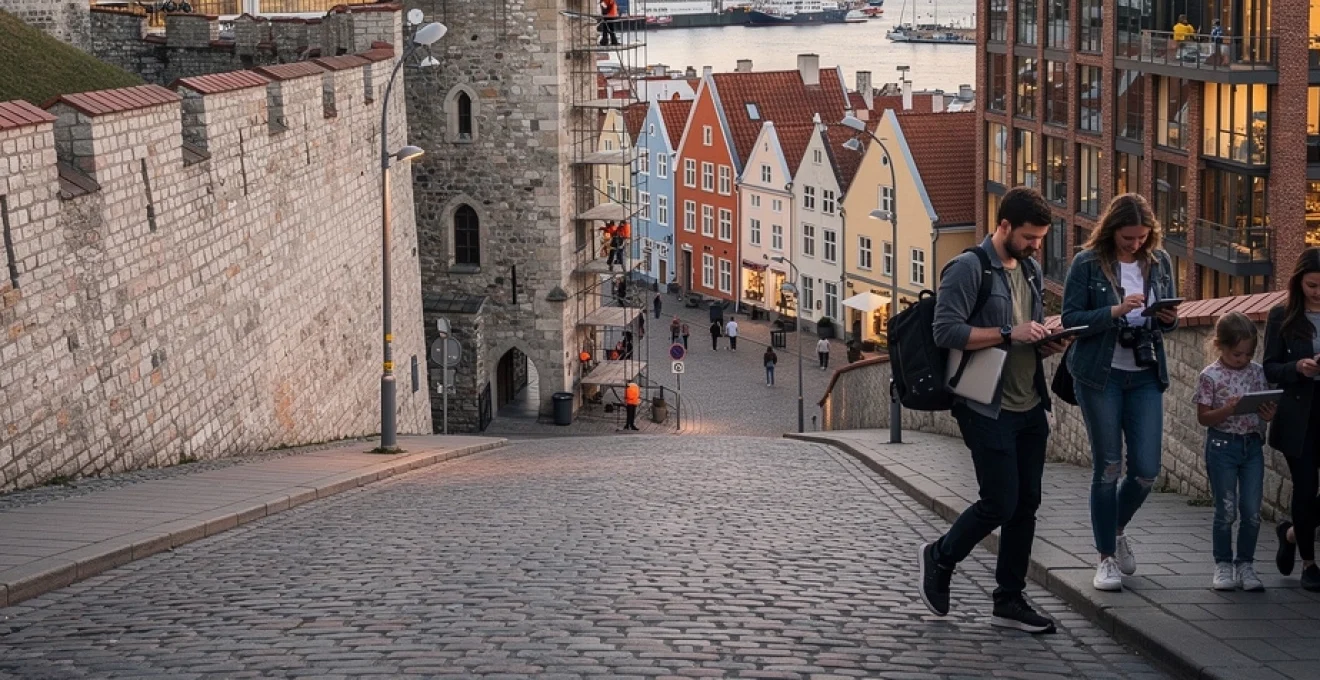
Estonia’s capital city presents one of Europe’s most fascinating urban paradoxes, where cobblestone streets laid out in the 13th century coexist seamlessly with cutting-edge digital infrastructure. This remarkable synthesis of old and new has transformed Tallinn into a unique destination that challenges conventional notions of what a historic city can achieve in the modern era. The Estonian capital demonstrates how medieval preservation and technological innovation can complement rather than compete with each other, creating an urban environment that serves both cultural heritage and contemporary needs.
The city’s approach to balancing historical authenticity with forward-thinking development has earned international recognition, positioning Tallinn as a model for other European capitals grappling with similar challenges. From its UNESCO World Heritage Old Town to its status as the birthplace of Skype, Tallinn exemplifies how cities can honour their past while embracing the future. This duality extends beyond mere aesthetics, penetrating deep into the city’s infrastructure, governance, and cultural identity.
Medieval architecture preservation within UNESCO world heritage site parameters
Tallinn’s Old Town stands as one of Northern Europe’s most complete medieval urban complexes, with preservation efforts that extend far beyond surface-level restoration. The city’s approach to maintaining its historic architecture operates within strict UNESCO guidelines while incorporating innovative conservation techniques that ensure structural longevity. These preservation efforts involve collaboration between international heritage experts, local craftspeople, and advanced materials science specialists who work together to maintain authenticity whilst addressing modern safety and accessibility requirements.
Toompea castle’s strategic integration of 13th-century fortifications
The fortress complex atop Toompea Hill represents a masterclass in historical preservation that spans eight centuries of continuous occupation. Modern conservation efforts focus on maintaining the structural integrity of the original limestone foundations while accommodating the castle’s current function as the seat of Estonia’s Parliament. Advanced geotechnical monitoring systems track ground movement and structural stress, ensuring that contemporary additions do not compromise the medieval masonry.
Recent restoration work has revealed previously unknown architectural details, including hidden chambers and defensive features that provide new insights into medieval building techniques. The integration of climate control systems within the ancient walls requires careful balance between preserving original materials and creating suitable conditions for both parliamentary functions and artifact preservation. These efforts demonstrate how historic buildings can continue to serve vital civic functions without sacrificing their archaeological value.
Gothic spire restoration techniques at st. olaf’s church
St. Olaf’s Church, once the world’s tallest building, presents unique challenges for preservation specialists working at extreme heights with medieval construction methods. The church’s spire restoration employs traditional materials including oak timber and copper sheeting, sourced and crafted using techniques that mirror 15th-century methods. Modern engineering assessments ensure that these traditional approaches can withstand contemporary weather patterns and seismic activity.
The restoration process involves detailed documentation of every architectural element, creating digital archives that serve both preservation and research purposes. Laser scanning technology captures precise measurements of the Gothic stonework, allowing craftspeople to create replacement elements that match original specifications exactly. This meticulous approach ensures that visitors experience the church much as medieval pilgrims would have encountered it centuries ago.
Cobblestone conservation methods in lower town’s raekoja plats
The town square’s cobblestone surface requires constant maintenance using techniques that balance pedestrian safety with historical authenticity. Traditional limestone blocks are individually assessed and either restored or replaced using stone quarried from the same Baltic sources used in medieval construction. The underlying drainage systems have been upgraded to prevent water damage while maintaining the square’s original topography and appearance.
Modern pedestrian traffic creates wear patterns that medieval stones were never designed to withstand, necessitating innovative approaches to surface treatment. Conservation specialists apply protective sealants that preserve the stone’s natural appearance while increasing durability. Regular maintenance schedules ensure that the square remains accessible to the thousands of daily visitors while preserving its medieval character for future generations.
Defensive wall stabilisation along müürivahe street
Tallinn’s defensive walls represent one of Europe’s most complete medieval fortification systems, requiring ongoing structural intervention to prevent deterioration. The 2.5-kilometre wall system undergoes continuous monitoring using sensors that detect movement, moisture levels, and temperature fluctuations. This data informs targeted conservation efforts that address specific vulnerabilities before
cracks or collapses occur. Along Müürivahe Street, where tourists still walk in the shadow of watchtowers, engineers discreetly anchor weakened sections with stainless steel rods and lime-based mortars compatible with the original stone. Where necessary, unobtrusive glass barriers guide visitors away from fragile areas without disrupting the visual impression of a continuous medieval curtain wall.
To preserve the authentic skyline, new development near the fortifications is tightly regulated in terms of height, materials, and colour palette. Archaeologists accompany every major intervention, documenting each stone that is moved and sometimes uncovering forgotten firing slits, stairways, or repair phases from earlier centuries. For visitors, the result is a rare opportunity to experience a near-complete medieval defensive system, while for residents, it is a reminder that Tallinn’s city walls remain an active part of daily life rather than a frozen relic.
Digital innovation hubs transforming estonia’s capital infrastructure
Beyond its storybook towers, Tallinn has quietly become one of Europe’s most advanced digital cities, with innovation hubs shaping everything from public services to the daily commute. The same mindset that once built impregnable walls now drives experimentation with e-governance, cloud-based infrastructure, and smart-city solutions. Rather than creating a separate “tech district” isolated from historic areas, Tallinn has woven digital tools into the existing urban fabric, allowing visitors and residents to experience a city where medieval vistas coexist with high-speed connectivity.
This digital-first approach is not merely cosmetic; it underpins how the municipality plans transport, manages energy use, and delivers services to citizens. For travellers interested in how technology reshapes historic cities, Tallinn offers a living laboratory, where you can see how concepts like e-Residency, blockchain-based registries, and 5G-enabled sensors work at street level. It raises a compelling question: what happens when a 13th-century plan meets 21st-century code?
Telliskivi creative city’s tech startup ecosystem development
Telliskivi Creative City, once a cluster of decaying railway depots and warehouses, now anchors one of Tallinn’s most dynamic tech startup ecosystems. Over the past decade, curated redevelopment has transformed the area into a mix of coworking spaces, studios, cafes, and accelerators that support hundreds of creative and digital businesses. What began as an experiment in reusing industrial heritage has turned into a blueprint for how Baltic cities can attract talent without erasing their character.
Today, Telliskivi hosts regular hackathons, meetups, and conferences where founders exchange ideas on everything from AI-driven logistics to sustainable urban planning tools. For visitors, this means you can step out of a photography museum and walk straight into a public pitch event or a design sprint in progress. If you are a digital nomad or aspiring entrepreneur, booking a desk in one of Telliskivi’s coworking hubs for a few days can be a practical way to plug into Tallinn’s tech community and experience how a former factory complex became a creative engine.
E-residency programme implementation and digital nomad integration
Estonia’s groundbreaking e-Residency programme has positioned Tallinn as a global hub for location-independent entrepreneurs, even if they never physically move to the city. Launched in 2014, the initiative allows non-residents to establish and manage EU-based companies entirely online, using secure digital identities issued by the Estonian state. By 2024, more than 100,000 e-residents from over 170 countries had joined the programme, collectively creating tens of thousands of businesses.
On the ground in Tallinn, this digital community intersects with the physical city through coworking spaces, legal and accounting services tailored to e-residents, and events designed for remote professionals. Dedicated digital nomad visas and flexible accommodation options make it easier for you to spend a few weeks or months in the city while building a business registered in Estonia. The result is a steadily rotating population of globally minded professionals, adding a cosmopolitan layer to Tallinn’s medieval streets without putting pressure on long-term housing in the same way mass tourism often does.
Blockchain technology adoption in municipal services
While many cities still treat blockchain as a buzzword, Tallinn has quietly embedded distributed ledger technology into its public infrastructure. Core registries—such as those for health records, judicial data, and property ownership—are secured with KSI blockchain, a system developed by Estonian engineers and now exported worldwide. Rather than storing sensitive data on a public chain, the system uses cryptographic hashes to guarantee integrity and detect any tampering with official records.
From a citizen’s perspective, the experience feels unexpectedly simple: you access your medical files or tax information through a single secure portal, with full transparency over who has viewed your data. For visitors curious about how a medieval capital became a cybersecurity pioneer, guided tours and public lectures occasionally explain how Estonia’s “digital backbone” works. It is a striking contrast—walking out of a 600-year-old pharmacy, you might use a smartphone to interact with one of the world’s most advanced e-governance systems, secured by an invisible but robust blockchain infrastructure.
5G network deployment throughout historic districts
Rolling out 5G networks in a UNESCO-listed Old Town presents a unique design challenge: how do you install advanced antennas without visually cluttering centuries-old streetscapes? In Tallinn, engineers and heritage officials collaborate to conceal small cells within existing street furniture, rooflines, and even behind decorative elements on facades. This careful placement ensures that high-speed connectivity reaches cafés, museums, and public squares without competing with Gothic spires or Baroque details for attention.
For residents and travellers, the benefits are immediate—stable video calls from cobbled alleys, real-time AR guides overlaying historical information onto buildings, and seamless mobile payments at markets and festivals. As 5G-enabled sensors gradually feed data into the city’s traffic and environmental monitoring systems, Tallinn can fine-tune services while preserving the human-scale feel of its historic centre. In effect, the Old Town becomes both an open-air museum and a fully connected smart district.
Contemporary urban planning solutions in historic context
Balancing heritage protection with contemporary urban planning is one of Tallinn’s most complex long-term tasks. The city’s master plans aim to prevent the Old Town from becoming a hollow tourist showcase while ensuring that modern infrastructure—transport, housing, public services—remains accessible and efficient. Planners work with layered zoning regulations that respect view corridors towards Toompea Hill and St. Olaf’s Church while allowing denser, contemporary development in adjacent districts like Kalamaja and Ülemiste.
One practical solution has been to treat the medieval core as the “heart” of a polycentric city, rather than its only centre of gravity. New cultural venues, schools, and offices are encouraged in satellite hubs, reducing pressure on the Old Town’s narrow streets. At the same time, investments in public squares, lighting, and street furniture in historic areas prioritise walkability over car access. If you wander through Tallinn after dark, you will notice how discreet lighting highlights stone walls and towers while still meeting modern safety standards—a small example of how design mediates between past and present.
Baltic maritime heritage meeting scandinavian design principles
Tallinn’s waterfront is where its Baltic maritime heritage most visibly meets clean-lined Scandinavian design. Once dominated by shipyards, warehouses, and military installations, the shoreline is now a patchwork of redeveloped quarters, each experimenting with different approaches to adaptive reuse. When you walk from the Old Town towards the sea, you move through layers of history: Hanseatic trading routes, tsarist-era industry, Soviet infrastructure, and contemporary Nordic-inspired architecture.
Rather than erasing the city’s working-port identity, architects often preserve rugged materials—brick, concrete, steel—and pair them with warm woods, glass, and minimalist interiors. The result is a series of neighbourhoods where you can sip coffee in a former submarine hangar, live in a converted shipbuilding warehouse, or attend a design fair on a pier that once handled cargo. This fusion of Baltic pragmatism and Scandinavian aesthetics has become one of Tallinn’s calling cards, particularly in three districts that stand out for visitors.
Noblessner quarter’s industrial conversion to modern residential complex
The Noblessner quarter, a former submarine factory complex founded in the early 20th century, offers a textbook example of how industrial heritage can become a contemporary residential and cultural hub. Instead of demolishing its massive brick halls and steel-framed sheds, developers have retained key structures and inserted modern apartments, galleries, and restaurants with sweeping sea views. The original slipways and cranes remain visible in the urban landscape, reminding residents that their waterfront promenade was once an active shipyard.
Architecturally, Noblessner leans into Scandinavian design principles—large windows, restrained colour palettes, and generous public spaces—while keeping textures and proportions rooted in local history. For anyone considering a long-stay visit, short-term rentals in Noblessner offer a chance to live inside a piece of maritime heritage with all the comforts of a newly built district. The area’s mix of playgrounds, art installations, and quayside bars makes it a popular evening destination, especially when the Baltic sunset reflects off the brick and steel.
Seaplane harbour’s museum architecture blending soviet-era infrastructure
The Seaplane Harbour (Lennusadam) showcases another side of Tallinn’s maritime story, centred on a striking set of early-20th-century concrete hangars once used by the military. These shell-shaped structures, considered an engineering marvel of their time, have been carefully restored and repurposed as part of the Estonian Maritime Museum. Rather than hiding the roughness of the original Soviet and pre-Soviet infrastructure, the renovation highlights exposed concrete, steel beams, and vast open volumes.
Inside, submarines, icebreakers, and interactive exhibits float within a dramatic space illuminated by carefully placed spotlights and natural light from oculi in the domed roofs. For architecture enthusiasts, the Seaplane Harbour is a rare chance to see how historic engineering innovation can be reinterpreted through contemporary museum design. As you explore the decks of ships and walk along suspended pathways, you are constantly aware of the building’s own story—a quiet dialogue between military history and modern cultural reuse.
Rotermann quarter’s glass and steel integration with 19th-century warehouses
Situated between the Old Town and the harbour, the Rotermann Quarter once served as an industrial hub filled with grain stores, mills, and salt warehouses. Today, it has been reborn as an urban design laboratory where glass-and-steel extensions weave between and above restored 19th-century brick structures. Architects here have embraced bold contrasts: sharp angles and cantilevered volumes sit alongside weathered facades, creating dynamic sightlines at every turn.
For visitors, Rotermann feels like a compressed city within a city—narrow passages open onto unexpected plazas, and historic chimneys serve as landmarks amidst contemporary apartment blocks and offices. Cafés, fashion boutiques, and design shops occupy the ground floors, turning the area into a lively meeting point for locals heading to work and travellers exploring the waterfront. If you are interested in how Tallinn negotiates density in a sensitive location, Rotermann offers a walkable case study that is especially striking in the evening when architectural lighting emphasizes the interplay of old and new.
Cultural renaissance through technology-driven arts initiatives
Tallinn’s cultural scene has embraced technology as eagerly as its governance systems, resulting in a flourishing of hybrid arts initiatives that blend digital tools with local storytelling. Theatre companies experiment with projection mapping on medieval walls, while galleries host VR installations that reconstruct lost interiors or forgotten cityscapes. Annual festivals and biennials increasingly feature cross-disciplinary works that invite audiences to interact via apps, wearables, or augmented reality.
This technology-driven cultural renaissance is most visible in districts like Telliskivi and Noblessner, where former factories now host multimedia performances and digital art shows. Institutions such as Fotografiska Tallinn engage visitors with interactive exhibitions and sustainability-focused programming, often supported by online content that extends the experience beyond the physical visit. For you as a traveller, downloading event apps or checking local creative hubs’ digital calendars before arriving can open doors to niche concerts, light festivals, and pop-up installations that might otherwise remain under the radar.
Sustainable transportation networks connecting old town to modern districts
To keep both medieval streets and new districts livable, Tallinn has invested heavily in sustainable transportation networks that prioritise public and active mobility. A well-developed tram and bus system links the Old Town with residential quarters, tech parks, and waterfront areas, reducing reliance on private cars. In recent years, the city has expanded cycling infrastructure, adding clearly marked bike lanes and rental schemes that make it easy to pedal from Toompea to Noblessner or Kadriorg without navigating heavy traffic.
For visitors, the integrated ticketing system and user-friendly journey planners mean you can move between UNESCO-listed alleyways and creative hubs like Telliskivi with minimal planning. Many routes are intentionally designed to pass key cultural and natural landmarks, turning daily commutes into informal sightseeing tours. Looking ahead, proposals for more electric buses, improved rail links, and even autonomous shuttles aim to further reduce emissions while keeping Tallinn’s distinctive mix of medieval and modern districts tightly connected—proving that a city rooted in the 13th century can still move decisively towards a greener future.