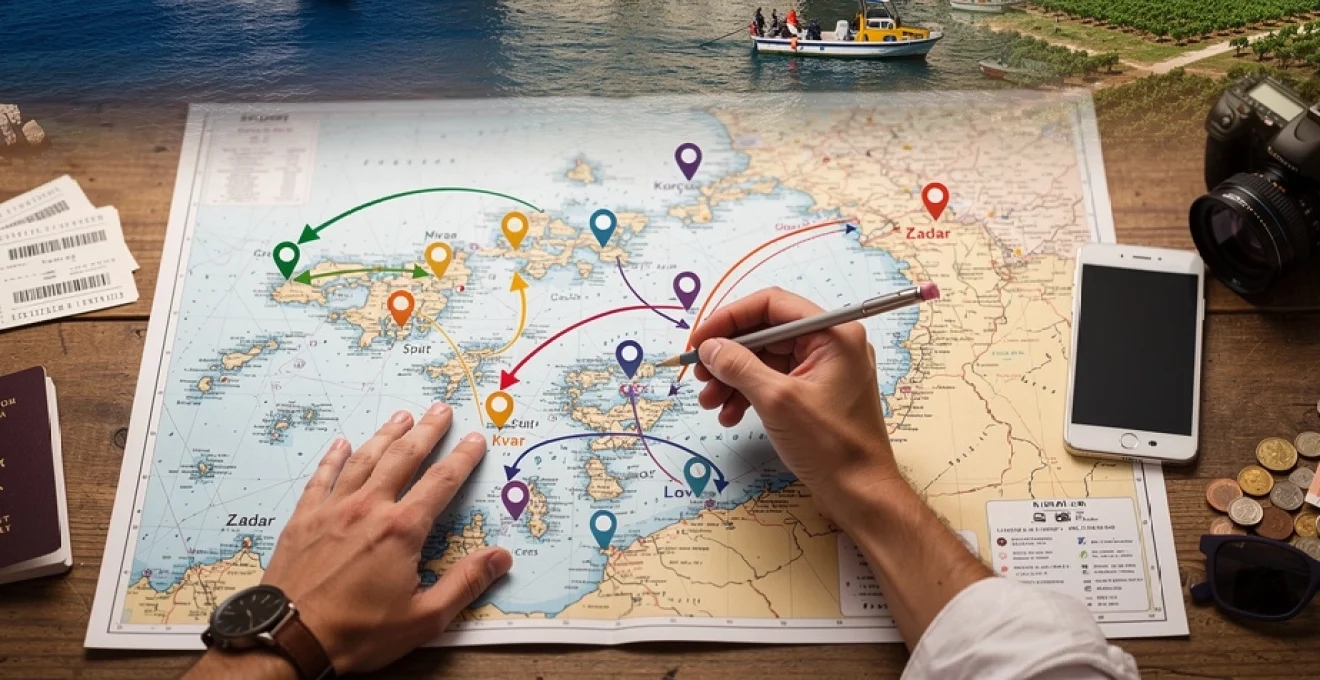
Croatia’s Adriatic coastline presents one of Europe’s most spectacular maritime playgrounds, with over 1,185 islands scattered across crystal-clear waters like precious gems in an azure setting. The country’s unique position at the crossroads of Central Europe and the Mediterranean creates a distinctive cultural tapestry where ancient Roman heritage meets Venetian elegance, and where every island tells its own compelling story. From the bustling party atmosphere of Hvar to the pristine wilderness of Mljet National Park, Croatian islands offer experiences ranging from sophisticated luxury to authentic local encounters that remain untouched by mass tourism.
Planning an island-hopping adventure across this maritime wonderland requires careful consideration of multiple interconnected factors. The complexity of ferry schedules, seasonal variations in weather patterns, and the diverse character of each island archipelago demands a strategic approach that balances spontaneity with practical logistics. Understanding these elements beforehand transforms what could be a stressful juggling act into a seamless journey through some of the Mediterranean’s most captivating destinations.
Strategic route planning for adriatic island archipelagos
The Croatian archipelago divides into distinct regions, each offering unique characteristics and travel experiences that influence your overall itinerary design. Understanding these geographical divisions forms the foundation for creating a coherent route that maximises both travel efficiency and cultural immersion. The northern Kvarner Gulf islands differ significantly from the central Dalmatian cluster around Split, while the southern Dubrovnik archipelago presents yet another distinct personality and logistical framework.
Successful route planning begins with identifying your primary interests and matching them to appropriate island clusters. Adventure seekers gravitate towards the Kornati National Park’s stark beauty, whilst history enthusiasts find themselves drawn to UNESCO World Heritage sites in Split and Dubrovnik. Party-focused travellers typically concentrate on the central Dalmatian triangle, where Hvar’s legendary nightlife provides the perfect counterpoint to Brač’s stunning beaches and Vis’s emerging culinary scene.
Northern dalmatian circuit: zadar to kornati national park
The northern Dalmatian region centred around Zadar offers some of Croatia’s most dramatic and least crowded island experiences. This area particularly appeals to sailing enthusiasts and nature lovers seeking authentic Mediterranean landscapes without the crowds that characterise more famous southern destinations. The Kornati archipelago, comprising 89 mostly uninhabited islands, represents the ultimate escape into pristine Adriatic wilderness where silence is broken only by wind and waves.
Zadar serves as an excellent launching point for exploring this region, with regular ferry connections to Dugi Otok and seasonal services to the Kornati islands themselves. The city’s unique attractions, including the world-famous Sea Organ and Sun Salutation installations, provide compelling reasons to spend additional time before or after your island adventures. Ferry schedules from Zadar operate year-round to major islands, though summer frequencies increase significantly to accommodate seasonal demand.
Central dalmatian triangle: split, hvar, and brač navigation
Split anchors Croatia’s most popular island-hopping region, offering excellent ferry connections to Hvar, Brač, Korčula, and Vis. This central position makes Split the logical starting point for first-time visitors, as Diocletian’s Palace provides both historical context and practical convenience. The airport’s proximity to the ferry terminal streamlines international arrivals, while the city’s accommodation options range from budget hostels to luxury boutique hotels.
The triangular route connecting Split, Hvar, and Brač offers the perfect introduction to Croatian island diversity. Brač delivers stunning beaches including the famous Zlatni Rat, whilst Hvar combines Renaissance architecture with contemporary nightlife. Inter-island connections within this triangle operate frequently during summer months, allowing flexible itinerary adjustments based on weather conditions or personal preferences. Peak season timing requires advance booking for both ferries and accommodation, as this region experiences Croatia’s highest tourist concentrations.
Southern dalmatian route: dubrovnik to mljet and korčula
Dubrovnik’s southern archipelago presents a more relaxed alternative to the central region’s intensity, focusing on natural beauty and medieval heritage rather than party atmospheres. Mljet National Park covers
around one-third of the island and is characterised by pine forests, saltwater lakes and quiet villages that feel a world away from Dubrovnik’s cruise ship crowds. Fast catamarans connect Dubrovnik with both Mljet and Korčula, allowing you to build a linear south Dalmatian itinerary without backtracking to Split. Most travellers spend one or two nights on Mljet focused on cycling around Veliko and Malo Jezero, then continue to Korčula Town for medieval streets, refined dining and local Grk and Pošip wines.
When planning this southern Dalmatian route, pay close attention to seasonal catamaran timetables, as some Dubrovnik–Korčula–Hvar–Split services operate only between late April and October. In peak summer, popular departures can sell out a day or two in advance, particularly at weekends, so pre-booking is wise if you are trying to keep a tight schedule. If you are travelling with a car, note that some of the most convenient Dubrovnik–Korčula car ferry routes run from the Pelješac Peninsula (Orebić) rather than directly from Dubrovnik itself. Building in extra time for road transfers gives you more resilience if sea conditions or crowds disrupt your plan.
Istrian peninsula maritime connections to cres and lošinj
While Dalmatia tends to dominate island-hopping itineraries in Croatia, the Istrian Peninsula and Kvarner Gulf offer a quieter, often better-value alternative. From Pula or Rijeka you can reach islands such as Cres, Lošinj, Krk and Rab via short, frequent car ferry crossings, making this region particularly suitable for self-drive trips. Brestova–Porozina provides the main link between Istria and Cres, while a bridge connects Cres with its greener, more resort-focused neighbour Lošinj.
These northern routes reward travellers who prioritise hiking, wildlife and traditional fishing towns over nightlife and beach clubs. Cres’s Tramuntana forests shelter rare griffon vultures, and Lošinj has marketed itself as a wellness destination since Austro-Hungarian times. Because ferry crossings are shorter and less weather-exposed than some Dalmatian routes, they can be more reliable outside high season. If you are designing a multi-region island-hopping itinerary that includes both Istria and Dalmatia, it often makes sense to start in Rijeka or Pula, loop through the Kvarner islands by car, then drive south along the coast to Zadar or Split.
Seasonal weather patterns and bura wind considerations
Weather is one of the most critical yet overlooked factors when organising an island-hopping adventure in Croatia. The Adriatic enjoys a classic Mediterranean climate, with hot, dry summers and mild winters, but conditions can vary significantly between April and October, affecting everything from ferry reliability to sea temperatures. In late spring and early autumn, you benefit from warm days, cooler nights and far fewer crowds, while peak summer brings maximum ferry frequency alongside higher prices and congestion.
Beyond temperature and sunshine, wind patterns play a major role in maritime logistics. The bura is a cold, dry north-easterly wind that can arrive suddenly, whipping up steep, short waves and forcing the temporary suspension of some catamaran and smaller ferry services. Think of it as pulling the handbrake on the Adriatic: everything still works, but movement slows or pauses until conditions stabilise. Sailors and skippers watch forecasts obsessively, but as a passenger you should also build flexibility into your island-hopping route, avoiding ultra-tight connections and allowing at least one buffer day if you must catch an international flight.
Maritime transportation infrastructure and vessel selection
Croatia’s maritime transportation network is extensive, but it is also fragmented across different vessel types and operators, each with its own booking rules and seasonal patterns. Choosing the right mix of ferries, catamarans, private charters and taxi boats is a bit like assembling a toolkit: each option solves a different problem, and the ideal combination depends on whether you are travelling with a car, how much luggage you carry and how much time versus money you are willing to spend.
Before finalising your island-hopping itinerary, map out not just where you want to go, but how each segment connects in reality. A route that looks logical on a map may require returning to the mainland between islands or staying overnight in a port city to catch an early departure. Checking the latest seasonal timetables and understanding the differences between foot-passenger catamarans and car ferries helps you avoid stranded-on-the-quay scenarios that can derail an otherwise carefully planned trip.
Jadrolinija ferry network coverage and timetable analysis
Jadrolinija is Croatia’s state-owned ferry company and the backbone of the Adriatic’s maritime transport system. Its white-and-blue vessels connect mainland ports such as Rijeka, Zadar, Šibenik, Split and Dubrovnik with most major inhabited islands, operating both year-round “lifeline” services and additional summer routes. For island-hopping travellers, Jadrolinija’s car ferries are particularly important if you intend to bring your own vehicle, as private operators generally carry passengers only.
Timetables are published online and typically divided into winter and summer schedules, with shoulder-season transitions in late spring and autumn. A common mistake is assuming that a July departure time will still exist in September; in reality, frequency may drop from several daily sailings to only one or two. When analysing timetables, look not just at departure hours but also crossing durations, vessel type and port locations—some islands have multiple ports, and arriving in the “wrong” one can add a long bus or taxi ride. Printing or saving PDFs of your planned routes, or keeping screenshots on your phone, provides a useful backup if mobile coverage is weak at the ferry terminal.
Catamaran services: krilo and g&v line operational routes
High-speed catamarans, operated by private companies such as Krilo (Kapetan Luka) and G&V Line, complement the Jadrolinija network by offering faster, passenger-only connections between popular island-hopping hubs. These sleek vessels are the express trains of the Adriatic, linking Split with Hvar, Brač, Korčula, Mljet and Dubrovnik on linear routes that are ideal for travellers without cars. Because they prioritise speed, catamarans often dock in central town harbours, minimising transfer times to accommodation.
However, this convenience comes with a few trade-offs. Catamaran services are almost entirely seasonal, typically operating from late April or May through October, with the densest schedules in July and August. They are also more susceptible to cancellation in rough seas than larger, slower car ferries. When building a Croatia island-hopping itinerary that relies heavily on catamarans, it is prudent to pre-book in high season and have an alternative plan—a slower ferry or an overnight in a mainland port—in case a particular sailing is cancelled at short notice.
Private charter options: motor yachts and gulet specifications
For travellers seeking maximum flexibility, privacy and comfort, chartering a motor yacht or traditional wooden gulet transforms Croatia island hopping into a fully bespoke experience. Instead of adapting your plans to public ferry timetables, you design a route with your skipper, choosing secluded bays for swim stops, lesser-known fishing villages for lunch and quiet anchorages for overnight stays. This approach suits families, groups of friends and special occasions, where the vessel itself becomes part floating villa, part mobile base camp.
When evaluating charter options, pay close attention to vessel specifications and what is included in the quoted price. Motor yachts offer speed and modern amenities but often have less deck space than gulets, which are slower but more spacious and ideal for relaxed sunbathing and alfresco dining. Fuel consumption, port fees, crew gratuities and provisioning can significantly affect the final cost, so it is worth requesting a detailed breakdown rather than relying on headline rates. If you plan to sail during shoulder seasons, ask about heating, stabilisers and cabin insulation—overnights at anchor in April feel very different from balmy August evenings.
Inter-island taxi boat services in split and dubrovnik archipelagos
In addition to scheduled ferries and catamarans, both Split and Dubrovnik archipelagos are served by a web of small taxi boats that can bridge gaps in public transport. Around Split, local skippers offer on-demand transfers to nearby islands such as Šolta, Drvenik Veli or the Pakleni islands off Hvar, as well as custom half-day and full-day tours combining swimming, snorkelling and short town visits. In Dubrovnik, water taxis serve the Elaphiti Islands (Koločep, Lopud and Šipan), often departing directly from the Old Port or Gruž harbour.
Taxi boats are particularly useful if you are travelling in a small group and want to visit quieter coves or time your arrivals to avoid the busiest periods for cruise ship excursions. They also act as a safety valve when last-minute changes in ferry schedules might otherwise strand you. Prices are usually negotiated in advance and depend on distance, vessel size and season. As with any informal maritime service, checking the boat’s safety equipment and the skipper’s willingness to adapt to weather conditions is essential—if a captain seems relaxed about ignoring a strong bura, it is usually wiser to wait for a more cautious operator.
Accommodation booking strategies across croatian islands
Securing the right accommodation mix across multiple islands can be as important as getting your ferries right. On popular islands such as Hvar, Brač and Korčula, choices range from full-service hotels and boutique guesthouses to self-catering apartments and traditional konoba-run rooms. In smaller destinations—think Šipan, Lopud or remote parts of Mljet—options may be limited to a handful of family-run properties that fill quickly in July and August. Because ferry arrival times often fall in the early afternoon or late evening, it pays to prioritise lodgings within walking distance of harbours when you will be carrying luggage.
How far in advance should you book? In peak season, serious planners often secure core stays three to six months ahead, particularly for weekends in Hvar Town or premium seafront rooms in Dubrovnik and Split. Shoulder-season travellers can be more spontaneous, especially on larger islands where inventory is greater. A hybrid strategy often works best: pre-book the first and last nights of your island-hopping itinerary, plus any critical stays in hotspots, and leave one or two intermediate nights flexible to follow good weather or local recommendations. Just be mindful that same-day bookings on small islands can be risky if a festival or wedding suddenly swallows the available beds.
Essential documentation and maritime regulations
Although Croatia is relatively straightforward for visitors, a smooth island-hopping journey still depends on having the correct documentation and understanding key maritime regulations. Most travellers from the EU, UK, North America and many other countries can enter Croatia visa-free for short stays, but passport validity rules still apply; you should ensure at least three to six months’ validity from your planned departure date. If you intend to rent a car and take it onto ferries, you will need a valid driving licence and, if required, an International Driving Permit, along with confirmation from your rental company that island travel is allowed.
For those planning to charter or skipper a vessel, regulations are more complex. Croatia requires skippers to hold an internationally recognised licence (such as ICC or RYA qualifications) and a VHF radio licence, and charter companies will insist on seeing original documents before releasing the boat. Local maritime rules cover speed limits near shore, anchoring restrictions in protected areas and mandatory harbour fees, all of which can vary between national parks and regular waters. Even as a passenger, you should be aware that in extreme weather the harbour master can suspend sailings; no amount of ticket-waving will override a safety closure, so keeping your itinerary flexible and your travel insurance comprehensive is wise.
Budget allocation and cost management for multi-island itineraries
Designing a realistic budget for island hopping in Croatia involves more than adding up ferry fares and hotel rates. Costs can fluctuate notably between regions and seasons: a restaurant meal in central Hvar Town in August may cost significantly more than an equivalent dinner on Šolta in May. As a rule of thumb, accommodation and transport absorb the largest share of the budget, followed by food, activities and incidental expenses such as parking fees and harbour taxes. Because islands often have fewer low-cost supermarket options than mainland cities, self-catering savings may be less dramatic than you expect.
One effective strategy is to set a daily target spend per person that accounts for both fixed and variable costs, then adjust your itinerary to stay within that envelope. For example, if you plan several nights in higher-priced Dubrovnik and Hvar, you can rebalance the budget with longer stays on more affordable islands or mainland bases such as Šibenik or Zadar. Pre-booking major ferry segments and at least some accommodation not only locks in better prices but also shields you from last-minute spikes during festivals or public holidays. And remember to factor in “hidden” line items: baggage storage between check-out and afternoon sailings, city tourist taxes, fuel surcharges on charters and tips for skippers or guides.
Cultural heritage sites and unesco world heritage navigation
One of the greatest advantages of island hopping in Croatia is the way maritime routes naturally connect major cultural heritage sites. As you move between ports, you are essentially travelling along historical trade and pilgrimage routes that have been in use for centuries. Several of Croatia’s most important UNESCO World Heritage sites either sit directly on the coast or are easily reached as day trips from key island-hopping hubs, making it possible to weave a strong cultural thread through an otherwise beach-focused itinerary.
Balancing time between heritage-rich cities and quieter islands can be challenging—how do you ensure you are not simply rushing from one old town to the next? A practical approach is to treat each UNESCO site as an anchor point for one or two nights, then use nearby islands as “breathing spaces” for hiking, swimming and slower exploration. In this way, the historic core of Split, Dubrovnik’s city walls or Hvar’s ancient agricultural plains become not just checklist items, but context for the landscapes and seascapes you experience in between.
Diocletian’s palace split as central hub access point
Diocletian’s Palace in Split is far more than a single monument; it is a living urban organism and the de facto central hub for many Croatian island-hopping routes. Built as a retirement residence for the Roman emperor Diocletian in the 4th century, the complex evolved over centuries into the fabric of the modern city, with apartments, cafes and shops embedded within its ancient walls. For travellers, staying within or near the palace area means you are within easy walking distance of both cultural highlights and the main ferry terminal, streamlining early departures and late arrivals.
Using Split as your logistical and cultural base, you can assemble a wide variety of island circuits. Short loops might include Brač and Šolta; longer routes can reach Vis, Hvar, Korčula and even Mljet when combined with high-speed catamarans. Because the palace area is compact and often crowded in peak season, it pays to book accommodation with clear access instructions and, if arriving by car, defined parking solutions outside the pedestrianised core. In practical terms, think of Diocletian’s Palace as both museum and railway station: a place where Roman history and modern island-hopping infrastructure neatly intersect.
Dubrovnik old town maritime approach restrictions
Approaching Dubrovnik by sea is one of the Adriatic’s great visual experiences, but it is also subject to increasing maritime restrictions designed to protect the fragile Old Town and its harbour. Large cruise ships no longer dock directly beneath the medieval walls; instead, they use the commercial port at Gruž, a few kilometres away. For smaller vessels and private charters, anchoring zones and speed limits are tightly regulated, and access to the Old Port is carefully controlled, especially during high season and major events.
For island hoppers, these regulations primarily affect how and where you disembark. Most scheduled ferries and catamarans also use Gruž rather than the Old Port, so onward transfers by bus or taxi are necessary if you are staying inside the walls. When arranging private transfers or charters that end in Dubrovnik, confirm in advance whether your vessel can enter the Old Port or must use Gruž; this can change the end-of-trip logistics significantly. Regardless of the technicalities, allowing enough time to walk the city walls—ideally early morning or late afternoon—ensures that your maritime approach culminates in a full appreciation of Dubrovnik’s layered history.
Stari grad plain hvar agricultural landscape exploration
Beyond its famous nightlife and harbour-front glamour, Hvar harbours one of Croatia’s most remarkable cultural landscapes: the Stari Grad Plain. This UNESCO-listed site preserves an ancient Greek agricultural cadastral system that has remained in continuous use for over 2,400 years. Low stone walls divide the plain into rectangular plots planted with vines, olives and lavender, creating a patchwork that looks almost like a living archaeological map when viewed from surrounding hills.
Visiting the Stari Grad Plain adds depth to a Hvar-focused island-hopping itinerary, shifting the narrative from beach clubs to enduring rural traditions. You can explore the area by bicycle, on foot or via guided tours that combine wine tasting at family-run estates with visits to small chapels and dry stone shelters. Because the plain lies between Stari Grad town and Jelsa, it integrates easily into a day spent cycling across the island or driving from one harbour to another. In effect, the site acts as a bridge between Hvar’s contemporary tourism economy and the ancient agrarian systems that shaped the island’s identity.
Plitvice lakes national park mainland extension options
Although not part of the Adriatic island chain, Plitvice Lakes National Park often features in broader Croatia itineraries that include island hopping. This UNESCO World Heritage site, with its tiered turquoise lakes and travertine waterfalls, lies inland between Zagreb and Zadar and can be reached in roughly two to three hours by car or bus from either coast. Many travellers treat Plitvice as a mid-trip reset between northern and central Dalmatian island circuits, using Zadar or Šibenik as staging points.
When integrating Plitvice into an island-hopping adventure, timing and energy management are key. The park’s wooden walkways and viewpoints are best experienced early in the morning or late in the afternoon, when crowds thin and light is softer for photography. A practical pattern is to finish a stretch of coastal or island travel in Zadar, drive or bus to Plitvice for one or two nights, then continue to Split or Rijeka for your next maritime segment. In this way, Croatia’s inland and coastal UNESCO sites complement rather than compete with each other, creating a multi-layered journey that moves fluidly between sea, karst and forest.