Barcelona pulses with an energy that few European cities can match. Whilst iconic landmarks like Sagrada Família and Park Güell draw millions of visitors annually, the city’s true soul reveals itself in unexpected moments—through the passionate strumming of a flamenco guitar echoing off medieval walls, the silent intensity of a human statue holding an impossible pose, or the spontaneous applause of strangers gathered around a street performer. These unscripted encounters often transform a pleasant holiday into an unforgettable journey, creating memories that outlast any photograph of a famous monument. For travellers seeking authentic cultural immersion, Barcelona’s street performance scene offers something rare: genuine artistry accessible to anyone willing to slow down and pay attention.
The distinction between observing street art and experiencing it becomes clear the moment you pause long enough to truly engage with a performance. Unlike ticketed entertainment venues where expectations are predetermined, busking creates intimate, democratic spaces where art happens in real time, unfiltered and immediate. The performers who populate Barcelona’s public spaces—from classically trained musicians to experimental artists—contribute to an urban tapestry that makes the city feel perpetually alive, a quality that residents and visitors alike treasure.
Stumbling upon la rambla’s busking scene: an unplanned encounter
La Rambla stretches 1.2 kilometres from Plaça de Catalunya to the Christopher Columbus Monument at Port Vell, functioning as Barcelona’s theatrical spine. This tree-lined boulevard operates as a continuous stage where performance art, commerce, and daily life intersect in ways both enchanting and chaotic. Recent statistics indicate that over 150,000 people traverse La Rambla daily during peak tourist season, creating an audience density that attracts performers from across Europe and beyond. The pedestrian thoroughfare’s width—approximately 30 metres at its broadest points—provides ample space for multiple simultaneous performances without acoustic interference, a rare urban feature that has made this location synonymous with Barcelona’s busking culture.
Walking La Rambla for the first time overwhelms the senses. Flower stalls burst with colour, news kiosks display publications in two dozen languages, and every twenty metres presents a new spectacle demanding attention. The challenge lies not in finding entertainment but in choosing where to direct your focus amidst the sensory abundance. First-time visitors often struggle with what experienced travellers understand instinctively: the most memorable encounters require surrendering rigid itineraries and allowing curiosity to guide your steps.
The acoustic guitar virtuoso near liceu metro station
The area surrounding Liceu metro station, positioned roughly midway along La Rambla, attracts particularly skilled musicians. The acoustics created by surrounding nineteenth-century buildings provide natural amplification, whilst the station’s passenger flow ensures consistent audience turnover. Classical guitarists favour this location, where the architectural grandeur of the nearby Gran Teatre del Liceu opera house creates an appropriate backdrop for sophisticated performances. On any given afternoon, you might encounter interpretations of Francisco Tárrega compositions or contemporary pieces by composers like Leo Brouwer, performed with conservatory-level technique.
These musicians typically position themselves strategically, angling their open guitar cases toward pedestrian flow to maximise visibility without explicitly soliciting contributions. The unspoken etiquette surrounding street performance in Barcelona dictates that quality speaks for itself—a philosophy that separates genuine artists from opportunistic buskers. Many guitarists performing near Liceu hold formal credentials from institutions like Escola Superior de Música de Catalunya, choosing street performance as both supplemental income and artistic expression rather than financial desperation.
Navigating the human statue corridor along pla de la boqueria
La Rambla’s human statue tradition represents perhaps its most distinctive performance category. The Pla de la Boqueria section, adjacent to the famous market, hosts the highest concentration of these living sculptures. Barcelona’s municipal regulations permit approximately 140 licensed statue performers across the city, with roughly 30-40 operating simultaneously along La Rambla during peak hours. The permitting process, implemented in 2010, requires artists to demonstrate costume quality, originality, and the physical stamina necessary to maintain poses for extended periods—typically 45-minute intervals.
The artistic range spans from straightforward interpretations (Egyptian pharaohs, Roman centurions
philosophers, and baroque angels) to more surreal creations involving recycled materials and elaborate mechanical props. Some performers maintain absolute stillness until a coin drops into their container, at which point they reward the donor with a slow, exaggerated movement or a photo-ready gesture. Others weave micro-performances into their stillness, subtly interacting with passers-by through eye contact or a barely perceptible nod. As you walk this corridor of living statues, you become part of an ever-shifting audience, co-creating a silent theatre in the middle of Barcelona’s most crowded street.
For visitors, the key is to discern intention behind the glitter and makeup. Look closely at costume details, the precision of makeup application, and the discipline of posture: these are the tell-tale signs of a serious practitioner rather than a casual imitator. Taking a few minutes to observe the same statue from different angles can be surprisingly revealing; you notice the strain in a shoulder, the careful placement of fingers, the way weight is distributed to allow for long periods of stillness. This form of street performance in Barcelona may seem simple at first glance, but it demands physical endurance on par with professional dance and an actor’s understanding of character work.
Street theatre dynamics in plaça reial’s arcaded square
Just a short detour off La Rambla, Plaça Reial functions as an outdoor theatre framed by neoclassical arcades and palm trees. The square’s architecture creates a natural amphitheatre: sound ricochets off colonnades, and the central space becomes a shared stage for jugglers, mime artists, acrobats, and small theatre troupes. On warm evenings, restaurant terraces fill with diners while performers occupy the open stone expanse, negotiating invisible boundaries between tables, walkways, and performance zones. The result is a layered soundscape where clinking glasses, laughter, and theatrical dialogue blend into a uniquely Barcelonian ambience.
Street theatre here often follows a predictable arc designed for a transient, international audience. A performer starts small—perhaps with a single prop or a simple gag—to gather a nucleus of onlookers. As the crowd thickens, the routines become more ambitious: fire juggling, acrobatic pyramids, or improvised sketches involving audience volunteers. You might notice how performers “work the circle,” constantly adjusting their position to maintain a 360-degree view line and keep latecomers engaged. This choreography of bodies and attention is as much about crowd psychology as it is about artistic expression, revealing the business-savvy side of street performance in Barcelona.
The catalonian sardana dance circle at portal de l’àngel
If La Rambla showcases Barcelona’s globalised spectacle, the Sardana at Portal de l’Àngel reveals something more rooted and local. On weekends and festival days, you may encounter circles of dancers—often older Catalans, sometimes joined by curious visitors—holding hands in a ritualised formation. Accompanied by a cobla ensemble of traditional wind instruments, the Sardana unfolds in measured, deliberate steps, its complexity hidden beneath a deceptively gentle rhythm. Where flamenco is fiery and individualistic, the Sardana is communal and understated, embodying a different layer of Catalan identity.
For an outsider, joining a Sardana circle can feel like stepping into a living museum. Yet this is not a performance staged solely for tourists; it is a social dance practised for generations, a quiet assertion of cultural continuity in a rapidly changing city. If you pause to watch, you will see dancers counting under their breath, eyes lowered in concentration as feet trace precise patterns on the pavement. Eventually, someone may extend a hand in invitation. In that moment, you are no longer just consuming culture—you are participating in it, allowing Barcelona’s street performance tradition to imprint itself on your own memory of the city.
The flamenco guitarist who transformed my barcelona experience
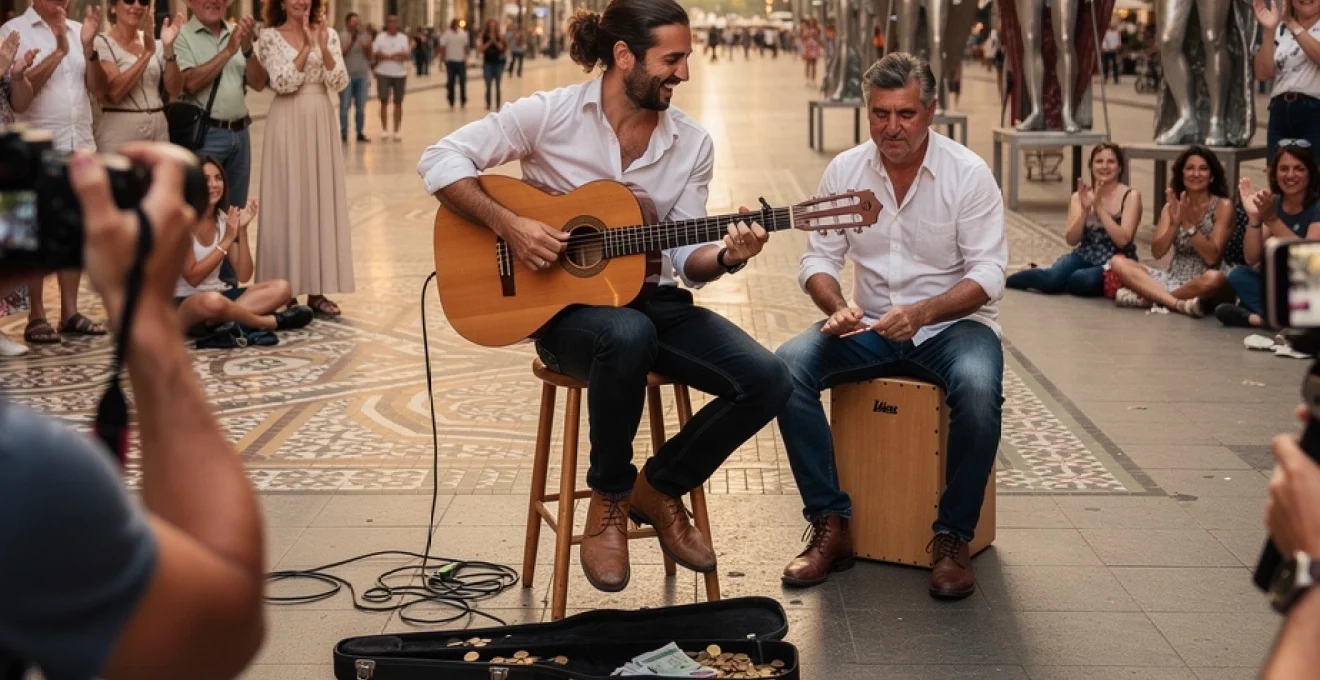
Among the many performers I encountered, one flamenco guitarist on a side street off La Rambla became the unexpected highlight of my Barcelona trip. It was late afternoon, the kind of golden hour when the city seems to soften around the edges, and I heard the first notes before I saw him. The sound cut through the background noise of traffic and conversation—crisp, percussive, and strangely intimate. Following the music, I found a modest setup: one man, one guitar, a cajón player seated beside him, and a semicircle of strangers sharing the same spellbound expression.
What made this performance different from the dozens of others I had passed that day? Part of it was technical brilliance, certainly, but there was also a sense of vulnerability—a feeling that we were witnessing something more personal than a standard tourist show. Over the next forty minutes, as day shifted gradually into evening, this flamenco guitarist managed to compress centuries of Andalusian and Catalan musical history into a set that felt both spontaneous and meticulously crafted. It was here, on a worn stretch of stone pavement, that street performance in Barcelona changed from background entertainment to the emotional centrepiece of my journey.
Paco de Lucía-Inspired rumba catalana techniques on display
Listening more closely, I recognised motifs and techniques associated with legends like Paco de Lucía, adapted into the distinct flavour of rumba catalana. The guitarist alternated between rapid-fire picado runs and fluid rasgueado strumming, his right hand a blur of controlled energy. In between pieces, he explained that he grew up in a family of Gitano musicians in the outskirts of Barcelona, where recordings of de Lucía and Peret played on repeat at family gatherings. That lineage was audible in his phrasing: traditional flamenco structures blended with the more relaxed, groove-oriented patterns characteristic of Catalan rumba.
For anyone interested in understanding flamenco beyond the cliché of tourist shows, moments like this are invaluable. You could spend hours in a museum reading about musical history, but hearing those influences woven live into a street performance in Barcelona makes the learning visceral. The guitarist’s transitions between palos—moving from a melancholic bulería por soleá into an upbeat rumba—felt like shifting emotional gears. It was as if he were turning the pages of an unwritten songbook, each piece a chapter in the evolving story of Iberian guitar music.
The performer’s setup: classical spanish guitar and cajón percussion
From a technical standpoint, the setup was disarmingly simple. The guitarist played a well-worn classical Spanish guitar with nylon strings, its lacquer dulled by years of use but impeccably maintained. A compact battery-powered amplifier sat at his feet, providing just enough volume to rise above the street noise without overwhelming nearby conversations. Beside him, a cajón player provided rhythmic foundation, alternating between deep bass tones on the front panel’s centre and sharper slaps near the edges to mimic a full drum kit.
This minimalist rig illustrates one of the core principles of effective street performance in Barcelona: portability without compromising sound quality. Cables were neatly taped down to avoid tripping passers-by, and the amplifier pointed slightly away from nearby residences—a subtle nod to the delicate balance between public art and urban livability. If you are a travelling musician yourself, there is much to learn here about how to optimise your busking setup: invest in a good instrument, a reliable small amp, and one versatile percussion partner rather than a tangle of gear that slows you down.
Authentic compás rhythms versus Tourist-Oriented performances
What truly distinguished this guitarist was his uncompromising commitment to compás—the intricate rhythmic framework that underpins flamenco. Many tourist-oriented shows on La Rambla simplify these patterns for mass appeal, smoothing out the irregular accents that make traditional palos so compelling. Here, however, you could feel the tension and release of true 12-beat cycles, the off-centre accents creating an almost hypnotic pull. It was the musical equivalent of walking on a winding mountain path rather than a straight, predictable road.
This contrast raises an important question for any visitor: how do you recognise authenticity in a street performance in Barcelona? One clue lies in repetition. Tourist shows lean heavily on familiar hits and predictable crescendos designed to prompt applause at set intervals. Authentic performers, by contrast, are less afraid of silence, of slower builds, of letting a phrase hang unresolved for a few extra bars. As I listened, I noticed how the guitarist and cajón player exchanged quick glances before rhythmic shifts, negotiating changes in real time. That kind of conversational interplay cannot be faked; it is the hallmark of musicians playing with each other rather than merely playing at an audience.
Audience participation through palmas Hand-Clapping traditions
Midway through the set, the guitarist invited us to join in with palmas—the hand-clapping patterns that serve as a kind of communal percussion section in flamenco. At first, our attempts were clumsy, a scattered mix of on-beat and off-beat claps echoing around the square. Patiently, he demonstrated the difference between palmas sordas (muted claps) and palmas claras (sharp, open claps), asking us to alternate between them to create a layered rhythm. Within minutes, the group of strangers around him had transformed into an improvised peña, our collective clapping giving the music a new depth.
This moment encapsulated why that street performance in Barcelona became so memorable. We were no longer passive spectators consuming culture; we were participants contributing to the soundscape. The guitarist smiled as our rhythmic confidence grew, occasionally syncopating his phrases against our clapping as if testing how far he could push us. When the final chord rang out and our hands fell silent, there was a brief, almost sacred pause before the applause. In that shared silence, you could feel a subtle shift: for a short while, a random group of tourists and locals had moved in the same rhythm, literally and figuratively.
Photography and videography techniques for capturing street performance art
As the performance unfolded, I noticed almost everyone around me reaching for a camera or smartphone. Capturing street performance in Barcelona has become a ritual of modern travel, but doing it well requires more than simply hitting the record button. Light conditions shift rapidly between the shaded arcades and sunlit plazas, performers move unpredictably, and crowds can block the perfect angle at the crucial moment. If you want your photos and videos to reflect even a fraction of the atmosphere you felt in person, it helps to approach the task with the same intentionality that the artists bring to their work.
Think of your camera as another audience member: it needs a clear line of sight, enough space to “breathe,” and a respectful distance from the action. Rather than elbowing your way to the front for a close-up, sometimes stepping back a few metres allows you to capture both performer and environment in a single frame. After all, the charm of a street performance in Barcelona lies not only in the artist but also in the way the city itself acts as a backdrop—its Gothic facades, tiled pavements, and passing crowds all contribute to the visual story.
Managing golden hour lighting on la rambla’s Tree-Lined boulevard
The guitarist who defined my trip began his set just as La Rambla slipped into golden hour, when sunlight filters horizontally through the plane trees. This period—roughly an hour before sunset—offers ideal conditions for photographing street performance in Barcelona. The low-angle light softens facial features, enriches colours, and creates pleasing contrasts between highlights and shadows. However, it also introduces technical challenges, such as backlighting and lens flare, especially if you are shooting toward the sun.
To manage this, position yourself at a 45-degree angle to the light source whenever possible. This side-lighting will accentuate textures—wood grain on the guitar, folds in a dancer’s costume, or the metallic sheen of a human statue—without plunging the subject into silhouette. If your camera or smartphone allows, tap on the performer’s face to set exposure and focus, preventing the bright background from washing out the details you care about. Think of the light as another performer you need to choreograph around: by changing your angle slightly, you can turn harsh glare into a natural spotlight that elevates your images.
Candid portrait composition during live flamenco zapateado footwork
Capturing dynamic elements like flamenco zapateado (footwork) requires a balance between anticipation and restraint. Instead of firing off dozens of frames at random, spend a minute simply watching the performer’s patterns. You will start to notice recurring gestures: a raised hand before a heel strike, a head tilt before a turn, a sharp inhalation before a dramatic sequence. These micro-signals are your cues, much like a conductor’s baton guiding an orchestra, helping you time your shots for maximum impact.
For stronger compositions, frame your subject within the urban context: include a fragment of tiled pavement to emphasise the footwork, or a blurred rim of audience heads at the bottom of the frame to convey immersion. Using the rule of thirds, place the performer slightly off-centre, allowing room in the direction of their movement. This technique creates a sense of anticipation, as if the dancer might step out of the frame at any moment. Remember that some of the most compelling images of street performance in Barcelona are not the obvious mid-air jumps but the quieter in-between moments—an intense gaze downward, a hand resting briefly on the guitar strings, a drop of sweat catching the light.
Smartphone stabilisation methods for recording musical performances
For video, stabilisation is crucial. Shaky footage can undermine even the most extraordinary performance, turning what felt magical in person into something unwatchable later. While dedicated gimbals are ideal, you can achieve surprisingly steady results with simple techniques. Plant your feet shoulder-width apart, tuck your elbows against your torso, and hold your phone with both hands, as if you were balancing a filled cup of coffee you cannot afford to spill. This human tripod approach alone can dramatically improve video quality.
Another strategy is to use your environment as improvised support. Lean against a lamppost, rest your forearms on a railing, or sit on a bench with your elbows braced on your knees. Many modern smartphones offer built-in stabilisation and high frame-rate options; enable these features when filming street performance in Barcelona, especially in low light when longer exposure times make hand movement more noticeable. Shorter clips—20 to 40 seconds—are often more engaging than continuous 10-minute recordings and easier to stabilise mentally as you focus on one section of a song or dance at a time.
Respecting performer rights: tipping etiquette and content permissions
In the excitement of capturing the moment, it is easy to forget that street performers are working professionals, not just subjects for our social media feeds. Ethical photography begins with simple gestures of respect. If you plan to film more than a brief clip or take close-up portraits, make eye contact and raise your camera in a silent question; most artists will nod or shake their heads, giving you a clear answer. For children or vulnerable individuals involved in a performance, additional caution is advisable—when in doubt, ask or refrain.
Tipping is where appreciation becomes tangible. As a rule of thumb, if you watch more than one or two minutes of a street performance in Barcelona, consider contributing at least one or two euros. Think of it as a micro-ticket price for a personalised show. If you later upload photos or videos to public platforms, some performers appreciate being tagged by name or having links to their websites or streaming profiles included in the description. This informal credit system mirrors how we cite authors or photographers and acknowledges that the content you are sharing exists because someone invested years in honing their craft.
The cultural anthropology of barcelona’s busking tradition
Beyond individual anecdotes, the busking tradition in Barcelona offers a fascinating case study in how cities negotiate public space, cultural identity, and informal economies. Anthropologists often describe streets as “liminal zones”—threshold spaces where different worlds intersect. On La Rambla or in the Barri Gòtic, this liminality becomes highly visible: tourists and locals, licensed performers and undocumented workers, traditional musicians and experimental artists all converge in a dynamic, sometimes uneasy coexistence. Each street performance is not only entertainment but also a negotiation of who gets to occupy the city’s symbolic centre.
Municipal regulations, permit systems, and designated performance zones attempt to bring order to this complexity, but they also shape which forms of expression thrive. When the city introduced stricter licensing for human statues, for example, it unintentionally created hierarchies among performers—those deemed “professional” enough to stay and those pushed to the margins. From a cultural anthropology perspective, street performance in Barcelona becomes a mirror reflecting broader debates about gentrification, tourism saturation, and the commodification of local culture. Who benefits when sidewalk art becomes a marketing asset for the city, and who pays the price?
At the same time, busking preserves spaces of spontaneity in an increasingly curated urban environment. Unlike official festivals or ticketed events, street performances can erupt with little warning and dissolve just as quickly, resembling pop-up rituals in the everyday flow of life. For residents, these moments can soften the impact of mass tourism, reminding them that the city is not only a backdrop for visitors but also a living stage for their own expressions and traditions. For travellers, engaging thoughtfully with street performance in Barcelona—by listening, tipping, asking questions—offers a chance to step out of the role of passive consumer and into that of temporary participant in the city’s unfolding story.
Comparing la rambla to other european street performance hubs
To fully appreciate Barcelona’s street culture, it helps to compare it with other European cities renowned for performance in public spaces. London’s Covent Garden, for instance, operates almost like an open-air theatre with scheduled acts, auditioned performers, and clearly demarcated stages. While this structure ensures consistently high-quality shows, it also introduces a formality that can make the experience feel curated rather than serendipitous. By contrast, street performance in Barcelona retains a looser rhythm: you might encounter a world-class violinist outside a metro entrance one day and a novice juggler practising drops in the same spot the next.
Paris’s Montmartre and the banks of the Seine present yet another model, where painters and musicians share space with bookstalls and café terraces in a more visually romantic setting. There, the emphasis often falls on individual artists’ brands—caricaturists with signature styles or accordion players with recurring repertoires. Barcelona, on the other hand, places greater weight on the collective atmosphere: multiple performances unfolding simultaneously along La Rambla create a sense of constant motion, like walking through overlapping radio frequencies you can tune into at will. The city’s Mediterranean climate further extends the performing season, allowing outdoor acts to flourish from early spring through late autumn.
Of course, this abundance comes at a cost. Some critics argue that parts of La Rambla have become oversaturated with tourist-centric acts, diluting the authenticity of street performance in Barcelona. Yet even within this commercialised environment, pockets of genuine artistry persist—often just a side street or small plaza away from the main pedestrian torrent. The key, as in any major European hub, is to explore beyond the most obvious hotspots. Seek out smaller squares in El Born, listen for music echoing from church steps in the Barri Gòtic, or follow the sound of a saxophone drifting along the beach promenade in Barceloneta; you may find performances that rival or surpass those in more famous locations.
Creating lasting travel memories through spontaneous cultural immersion
Looking back on my time in Barcelona, it is striking how the moments I remember most clearly were not the ones I had planned. The Sagrada Família was magnificent, of course, but my memory of it is almost indistinguishable from countless photographs I have seen in guidebooks and online. The flamenco guitarist on that side street, however—the texture of his sound, the warmth of the stone under my feet, the collective rhythm of the palmas—remains vivid in a way no postcard image could replicate. That is the quiet power of encountering street performance in Barcelona with an open schedule and an open mind.
Spontaneous cultural immersion does not require dramatic gestures. It can begin with something as simple as pausing when you hear music instead of walking on, or accepting an invitation to join a Sardana circle even if you fear stepping on someone’s toes. Think of your itinerary as a framework rather than a script, leaving deliberate gaps where unplanned experiences can unfold. When you allow yourself to be interrupted by art—by a living statue’s slow bow, a bubble artist’s iridescent spheres, or a late-night jam in a Gothic alley—you give the city room to surprise you.
In the end, the highlight of my trip was not a specific address or attraction but a moment of connection catalysed by a busker with a guitar. It reminded me that travel, at its best, is less about ticking off sights and more about tuning into a place’s rhythms. The next time you find yourself in Barcelona, try this simple experiment: choose one afternoon to wander with no fixed destination, letting sound be your guide. You may discover, as I did, that the city’s most enduring gifts are not purchased, scheduled, or signposted—they are performed, fleetingly, in the streets, then carried home in memory long after the last note fades.