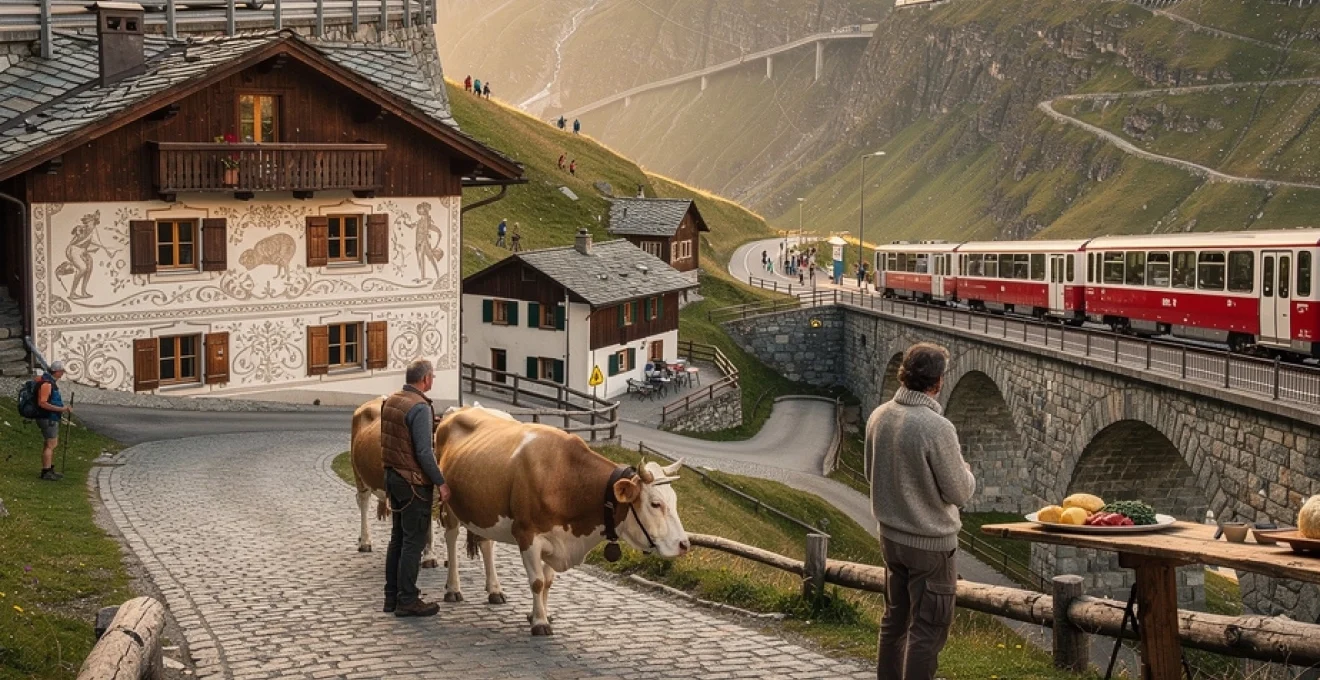
Nestled at 4,700 feet above sea level in Switzerland’s easternmost reaches, the village of Sent represents something increasingly rare in our interconnected world: authentic Alpine culture preserved in its natural setting. With a population of merely 800 residents, this remarkable settlement in the Engadine Valley offers visitors an extraordinary glimpse into centuries-old traditions, architectural marvels, and a way of life that has withstood the test of time. The village’s unique position near the Italian and Austrian borders has created a fascinating cultural fusion that distinguishes it from other Swiss mountain communities.
What makes Sent particularly compelling is its role as a living museum of Romansh culture, Switzerland’s fourth national language, combined with distinctive architectural styles that tell stories of historical migration patterns. The village serves as an exceptional example of how remote Alpine settlements maintain their identity while adapting to modern challenges, from transportation accessibility to environmental conservation.
Geographic isolation and alpine accessibility challenges in remote swiss settlements
The geographic positioning of Sent presents both opportunities and obstacles that have shaped its character over centuries. Located on a hillside plateau in the northern section of the 80-mile-long Engadine Valley, the village enjoys commanding views of limestone peaks that rise dramatically from the narrow river valley below. This elevated position, whilst providing spectacular vistas, also creates significant accessibility challenges that influence everything from daily life to tourism patterns.
The village’s location in what locals call the « valley of the Inn » connects it to a remarkable hydrological journey. Water flowing from these heights eventually reaches the Danube River and terminates in the Black Sea, illustrating the far-reaching geographic connections that extend from this seemingly isolated corner of Switzerland. This geographic reality has historically influenced settlement patterns, trade routes, and cultural exchanges that continue to impact the region today.
Postbus route navigation through bernina pass and julier pass connections
Switzerland’s renowned public transportation network extends its reach into the most remote Alpine settlements through the PostBus system, which serves as a crucial lifeline for communities like Sent. The hourly bus service connecting Sent to the larger town of Scuol demonstrates how Swiss transportation planning prioritises accessibility even for the smallest communities. These routes navigate challenging terrain including the historic Bernina Pass and Julier Pass, pathways that have facilitated human movement through the Alps for millennia.
The PostBus network’s integration with Switzerland’s broader transportation infrastructure exemplifies careful planning that ensures remote settlements remain connected to urban centres. This connectivity becomes particularly crucial during winter months when private vehicle travel becomes hazardous or impossible due to weather conditions.
Seasonal transportation disruptions during Avalanche-Prone winter months
Winter transforms the transportation landscape around Sent dramatically, with snow and avalanche risks creating periodic isolation that residents have learned to anticipate and manage. The village’s elevation and mountain setting mean that road closures and service interruptions become regular occurrences between December and March. Local infrastructure is designed to withstand these challenges, with buildings constructed specifically to handle heavy snow loads and extreme temperature variations.
These seasonal disruptions have historically contributed to the development of strong community bonds and self-sufficiency practices that characterise Alpine settlements. Residents maintain food stores, essential supplies, and backup systems that enable the village to function independently during weather-related isolation periods.
Rhätische bahn Narrow-Gauge railway integration with village infrastructure
The Rhätische Bahn network, whilst not directly serving Sent, provides essential connectivity through nearby Scuol station. This UNESCO World Heritage railway system represents one of Switzerland’s most impressive engineering achievements, with narrow-gauge lines that navigate seemingly impossible terrain to connect isolated valleys with the broader Swiss transportation network. The railway’s impact on regional development cannot be overstated, as it has enabled economic growth and cultural exchange whilst preserving the character of individual settlements.
Local residents utilise the bus connection to Scuol station to access this broader railway network, which opens possibilities for travel throughout Switzerland and beyond. This multi-modal transportation approach demonstrates how small communities can maintain connections to larger economic and cultural centres without compromising their distinct identities.
Hiking trail networks connecting val bregaglia and engadin valley systems
The extensive hiking trail network surrounding Sent provides both recreational opportunities and practical connections to neighbouring
valleys, including paths that link the Engadin Valley to neighbouring regions such as Val Bregaglia. Historically, these trails functioned as trade and migration routes, allowing goods, ideas, and even architectural influences to travel across high passes long before modern roads existed. Today, waymarked paths and suspension bridges enable hikers to follow in the footsteps of merchants, shepherds, and pilgrims, often crossing borders without even realising it. Walking from Sent, you can reach panoramic viewpoints, remote Alpine huts, or cross into Italy in a single day, experiencing how « geographic isolation » in the Swiss Alps has always been relative rather than absolute. In many ways, the hiking trail network acts like an open-air museum of Alpine history, where every pass and pasture tells part of the story.
Traditional romansh cultural preservation in graubünden canton communities
Beyond its dramatic landscapes, what left the deepest impression on me in this small Swiss village was the quiet determination to preserve Romansh culture. In Sent and across Graubünden, language, architecture, cuisine, and local customs are tightly woven together, creating a cultural fabric that feels both fragile and remarkably resilient. At a time when globalisation tends to smooth out regional differences, walking through a Romansh-speaking village is like listening to a rare instrument still being played in tune. You sense that every greeting, every inscription, and every recipe is part of an ongoing effort to keep a minority culture alive in the heart of the Alps.
Sgraffito architectural techniques on historic engadine house facades
The most visible expression of this heritage in Sent is the sgraffito work that decorates many Engadine houses. Instead of the wooden chalets that many visitors imagine when they picture the Swiss Alps, you find robust stone houses covered in plaster and embellished with etched designs. Craftsmen apply several layers of tinted plaster and then scratch patterns through the outer layer to reveal the contrasting colour beneath, a technique that is both practical and artistic. Because sgraffito withstands harsh winters better than paint, some facades retain their designs for over fifty years, with dates and inscriptions telling you exactly when they were last renewed. As you wander the lanes, you discover geometric borders, stylised plants, coats of arms, and even mythical creatures watching silently over doorways.
Many of these facades carry Bible verses or blessings, alongside the initials of the family that built the house and the year of construction, some dating back to the 1600s. This makes each building a kind of stone chronicle, recording not just an architectural style but also the beliefs and social structures of the time. What fascinated me was how new houses in Sent often echo these old motifs, blending modern insulation and windows with traditional sgraffito frames and quotes. In a way, the village itself becomes a textbook of Alpine architectural history, where you can read how prosperity from Italy or changes in farming practices shaped each generation of builders. For visitors interested in cultural travel in the Swiss Alps, taking time to really look at these facades is as rewarding as any museum visit.
Rumantsch grischun language documentation projects by lia rumantscha
Language is another pillar of identity in this corner of the Engadin Valley. Romansh is spoken by roughly 40,000 to 60,000 people across Graubünden, depending on the estimate, and is divided into several regional varieties. To support this vulnerable language, the organisation Lia Rumantscha has been working since 1919 to document, standardise, and promote Romansh on a cantonal and national level. One of its most influential initiatives has been the development of Rumantsch Grischun, a standardised written form intended to bridge the different dialects and provide a common language for education, administration, and media. By publishing dictionaries, schoolbooks, and children’s literature in Rumantsch Grischun, they are quietly reinforcing the linguistic backbone of these Alpine communities.
In Sent, you notice this effort in everyday details: street signs in Romansh first, then German; local notices in the village shop written in Rumantsch Grischun; children greeting you with a cheerful “allegra,” wishing you happiness. Without structured documentation projects, a language like Romansh could easily slip into purely oral use and then gradually fade from public life. Instead, you see a living language finding new forms of expression, from online courses to smartphone apps designed for young learners. For anyone interested in how small communities preserve their culture in the Swiss Alps, following the work of Lia Rumantscha offers a practical lesson in long-term cultural resilience.
Capuns and maluns culinary heritage transmission methods
Cuisine plays a surprisingly central role in how cultural traditions are passed down in these mountain villages. Two dishes you will often hear about in the Engadin Valley are capuns and maluns, both humble yet deeply comforting examples of Alpine home cooking. Capuns are essentially Swiss chard or cabbage leaves wrapped around a filling of spätzli-like dough, often enriched with dried meat or local sausage, then simmered slowly in a creamy broth. Maluns are grated potatoes mixed with flour and slowly roasted in butter until they form soft, golden crumbs, traditionally served with apple sauce or Alpine cheese. Neither dish is flashy, but both speak of a time when food needed to be filling, simple, and based on what the high-altitude fields and cellars could provide.
What struck me is how the transmission of this culinary heritage still takes place mainly in kitchens rather than cooking schools. Grandparents teach grandchildren by doing, often without written recipes, relying on phrases like “just enough flour” or “until it smells right.” In Sent, local restaurants sometimes offer capuns or maluns with a modern twist, yet the core technique remains unchanged, bridging the gap between past and present. If you visit and want a deeper connection with the village, asking a local about where to try authentic capuns can spark a long conversation about family traditions. Food, perhaps more than anything else, ensures that Romansh culture stays not just visible but literally tasted and remembered.
Schellenursli folk character integration in contemporary village festivals
Romansh culture is also kept alive through stories and festivals, and one name you’ll encounter sooner or later is Schellenursli. Originating from a beloved 1945 children’s book by Selina Chönz and Alois Carigiet, Schellenursli is a little boy from a Graubünden village who braves the snow to fetch a big bell for the Chalandamarz spring festival. Over time, this folk character has become an informal ambassador of Romansh identity, appearing in picture books, school plays, and local events. In villages like Sent, the themes of the story—courage, perseverance, and the promise of spring after a long winter—resonate strongly with everyday Alpine life. You see children dressed in traditional costumes, carrying bells and singing, echoing scenes from the book as they move through the narrow streets.
What makes Schellenursli especially interesting today is how seamlessly he has been integrated into contemporary cultural programming. Tourism offices in the Swiss Alps sometimes use his image to explain Chalandamarz to visitors, while local schools incorporate the story into language lessons and art projects. This gives the new generation a playful yet meaningful link to their heritage, at a time when digital media often pulls attention outward to global trends. From a visitor’s perspective, stumbling upon a Chalandamarz procession, with its ringing bells and excited children, is like stepping into the pages of living folklore. It reminds you that in these high-altitude settlements, culture is not just something preserved in archives; it is still performed, shouted, and sung in the streets.
Alpine agriculture and transhumance practices in High-Altitude settlements
Another dimension of life that shaped my impression of Sent is the way agriculture has adapted to the constraints and possibilities of the high Alps. At first glance, you might think these steep slopes and short summers leave little room for farming, but the landscape tells a different story once you start to look more closely. Terraced meadows, scattered barns, and carefully managed pastures reveal a sophisticated system of Alpine agriculture that has evolved over centuries. Central to this system is transhumance, the seasonal movement of livestock between low-lying winter quarters and high mountain pastures in summer. This age-old rhythm still underpins the way land is used and how communities organise their year.
In practice, transhumance in the Engadin Valley means that cows, goats, and sheep graze near villages like Sent in spring and autumn, then move up to remote alps (summer pastures) once the snow has melted. During the warm months, herders live in simple mountain huts, producing cheese and butter on-site while monitoring the health of the herds and the condition of the grass. When you hike above the tree line and hear the sound of cowbells echoing off the rocks, you are listening to an economic system as much as a pastoral idyll. This seasonal movement prevents overgrazing, maintains biodiversity-rich meadows, and keeps lower fields available for hay production to sustain animals through the long winter. In recent years, satellite collars and digital mapping tools have joined the toolkit, but the basic pattern remains strikingly similar to what it was generations ago.
For visitors, understanding this agricultural calendar adds depth to a stay in a small Swiss mountain village. The cheese you buy in the local dairy shop, the yogurt you spread on breakfast bread, or the butter folded into your capuns all carry the flavour of specific pastures and altitudes. You may notice product labels specifying not just the type of milk but also the particular alp where it was produced, a kind of micro-terroir that reflects the nuanced relationship between people, animals, and landscape. At the same time, farmers in Sent and surrounding villages face real challenges: climate change, fluctuating milk prices, and competition from industrial agriculture all put pressure on traditional practices. Yet many continue to farm in ways that prioritise landscape stewardship as much as short-term profit, preserving the open meadows and mosaic of habitats that make the Engadin such a compelling place to explore.
Hospitality infrastructure development in swiss mountain tourism ecosystems
Tourism has become another essential pillar of life in Sent and similar high-altitude villages, and the way hospitality has developed here is one of the reasons the place lingers in your memory. Unlike large ski resorts built around mass tourism, small Engadin settlements have tended to integrate visitors into existing structures rather than build entirely new worlds around them. You find family-run guesthouses in old Engadine houses, holiday apartments carved out of former barns, and a handful of restaurants that double as social hubs for residents and guests alike. This approach allows tourism to support the local economy without overwhelming the scale and character of the village. When you stay in such places, you are less a faceless tourist and more a short-term neighbour, sharing the same bakery and bus stops as everyone else.
Swiss tourism authorities have increasingly recognised that authentic cultural experiences are a key draw, especially for travellers seeking slow travel in the Alps rather than quick ski weekends. This has led to targeted investments in waymarked hiking paths, interpretive panels about sgraffito and Romansh language, and wellness facilities such as the mineral baths in nearby Scuol. Digital booking platforms make it easier to find accommodation in remote locations, yet many hosts still prefer direct contact, seeing each booking as the start of a relationship rather than merely a transaction. For someone arriving from a busy city, this combination of high efficiency and human warmth can be disarming. You sense that tourism here is not about building an Alpine theme park, but about inviting you to temporarily share in a way of life shaped by climate, culture, and community.
Of course, this hospitality ecosystem is not without its tensions. Rising demand for holiday homes can increase property prices, making it harder for young locals to stay, while seasonal peaks stretch limited infrastructure such as waste management and public transport. To manage this, many municipalities in Graubünden have introduced regulations on second homes, zoning rules that protect agricultural land, and collaborative planning between tourism offices and resident associations. When you notice how clean the hiking trails are or how punctual the bus remains even in shoulder seasons, you are seeing the results of these behind-the-scenes efforts. For travellers, choosing locally owned accommodation, travelling by public transport, and respecting local customs are simple ways to support a sustainable tourism ecosystem in the Swiss mountains.
Environmental conservation strategies within UNESCO biosphere reserves
The natural beauty around Sent is not just an aesthetic backdrop; it is the product of intentional conservation policies at regional and national levels. Much of the wider Engadin region, including the nearby Swiss National Park and the UNESCO Biosphere Reserve Val Müstair, is managed under frameworks that balance human use with ecological integrity. While Sent itself is not in the national park, it sits at the edge of this broader protected landscape, and the village’s decisions about land use, tourism, and infrastructure are influenced by conservation priorities. For a visitor, this can feel almost invisible—simply a sense that the valley is unusually intact, with forests, meadows, and wetlands still functioning as complex ecosystems. Yet behind that impression lies a dense network of monitoring programs, zoning regulations, and long-term management plans.
Biodiversity monitoring protocols for endemic alpine flora species
One key pillar of these conservation strategies is the systematic monitoring of biodiversity, particularly endemic Alpine flora that thrive only in narrow altitude bands or specific microclimates. Botanists and citizen scientists in Graubünden regularly survey plots to track the abundance and distribution of plant species such as edelweiss, Alpine pasqueflower, and various saxifrages that cling to limestone cliffs. They often use GPS mapping and photographic records to document subtle shifts in flowering times and altitudinal ranges, which can serve as early indicators of climate change. When you pause by a meadow filled with flowers on a summer hike, you are not just admiring beauty; you are standing in a living laboratory where data is quietly being gathered.
These biodiversity monitoring protocols are often coordinated with universities and environmental agencies, ensuring that local observations feed into national and international research. In some areas, QR-coded information boards along trails invite visitors to contribute through simple reporting apps, turning hikers into occasional data collectors. This participatory approach not only broadens the information base but also deepens people’s appreciation of the fragile Alpine ecosystems they are walking through. It is one thing to know that a plant is rare; it is another to realise that your photograph and location note might help protect it for future generations. Much like a village archive preserves Romansh texts, these databases preserve the ecological story of high-altitude Switzerland.
Sustainable tourism load management during peak hiking seasons
Managing tourism pressure has become a central concern in popular Swiss mountain regions, and the Engadin is no exception. On sunny summer weekends, certain panoramic trails can attract more visitors than the narrow paths and sensitive habitats can comfortably support. To address this, local authorities and tourism organisations use a mix of soft and hard measures, from signposted alternative routes to restrictions on car access in vulnerable valleys. Real-time information on trail conditions and parking availability is increasingly available online, encouraging visitors to spread out in space and time. Think of it as a kind of traffic control system for nature, designed to prevent bottlenecks not of vehicles but of hikers.
In and around Sent, sustainable tourism load management often relies on the strength of the public transport network and clear communication. Discounted tickets for off-peak travel, combined with well-timed bus and train connections, nudge visitors toward less crowded hours and lesser-known routes. On the ground, simple design choices—adequate waste bins at trailheads, well-maintained signposts, and occasional resting benches—help keep both people and landscapes in good condition. As a visitor, you may not notice these systems consciously, but you feel their effects in the overall sense of calm and order, even when many people are sharing the same views. It is a reminder that sustainable tourism in the Alps is not just about limiting numbers; it is about intelligent distribution and thoughtful infrastructure.
Climate change adaptation measures for Permafrost-Dependent infrastructure
Climate change, however, is the challenge that looms largest over the long-term future of high-altitude villages like Sent. Rising temperatures are altering snowfall patterns, shortening the duration of snow cover, and, crucially, destabilising permafrost that has long acted as the hidden glue binding many mountain slopes. When ice within the ground melts, it can lead to increased rockfall, landslides, and damage to infrastructure such as roads, trails, and cable car pylons anchored in formerly frozen ground. Engineers and planners in Graubünden now integrate permafrost data and geological risk assessments into nearly every major project, from ski lifts to mountain huts. In some locations, foundations are being reinforced or relocated, and early-warning systems with sensors and remote monitoring are installed to detect ground movement before it becomes critical.
For smaller settlements, adaptation often means a combination of protective structures and flexible planning. Avalanche barriers, rockfall nets, and rerouted hiking paths are physical expressions of a broader strategy that accepts change rather than trying to freeze the landscape in time. You could compare it to the way Romansh evolved into Rumantsch Grischun: the goal is not to preserve an exact past state, but to keep the core functions viable under new conditions. Local authorities also run awareness campaigns so residents and visitors alike understand why certain paths are closed or construction sites appear in seemingly wild places. Standing on a sunny terrace in Sent, with the mountains looking timeless, it can be hard to reconcile this quiet scene with the scale of environmental change underway. Yet it is precisely this contrast that makes the village’s adaptive efforts feel both urgent and admirable.
Water resource management through traditional suonen irrigation systems
Water management is another area where old wisdom and new challenges intersect in the Swiss Alps. Although the Engadin Valley is generally well supplied with water thanks to snowmelt and springs, seasonal variability is increasing, with hotter summers and more intense rainfall events. Historically, many Alpine communities developed intricate open-channel irrigation systems—known as suonen or bisses in some regions—to guide water across steep terrain to meadows and fields. While Sent does not have the extensive wooden aqueducts you see in parts of Valais, the principle of carefully distributing water remains central to local agriculture and settlement planning. Modern pipelines, reservoirs, and small hydropower installations now complement or replace traditional channels, but the underlying logic is similar: water must be shared fairly and used sparingly in a landscape where storage is limited.
Today, water resource management plans for villages like Sent typically integrate drinking water supply, irrigation needs, ecosystem requirements, and protection against floods and debris flows. Hydrologists model future scenarios to understand how earlier snowmelt or reduced glacier volume might affect stream flow, and municipalities adapt their infrastructure accordingly, sometimes raising reservoir dams or upgrading distribution systems. For visitors, these systems are mostly invisible, humming quietly behind the tap in your guesthouse or the fountain in the village square. Yet without them, life at 4,700 feet would quickly become precarious, especially in dry summers. Much as the PostBus and Rhätische Bahn connect Sent to the wider world, these water systems connect the village to its surrounding catchments, ensuring that the Alpine environment remains not just beautiful, but habitable.