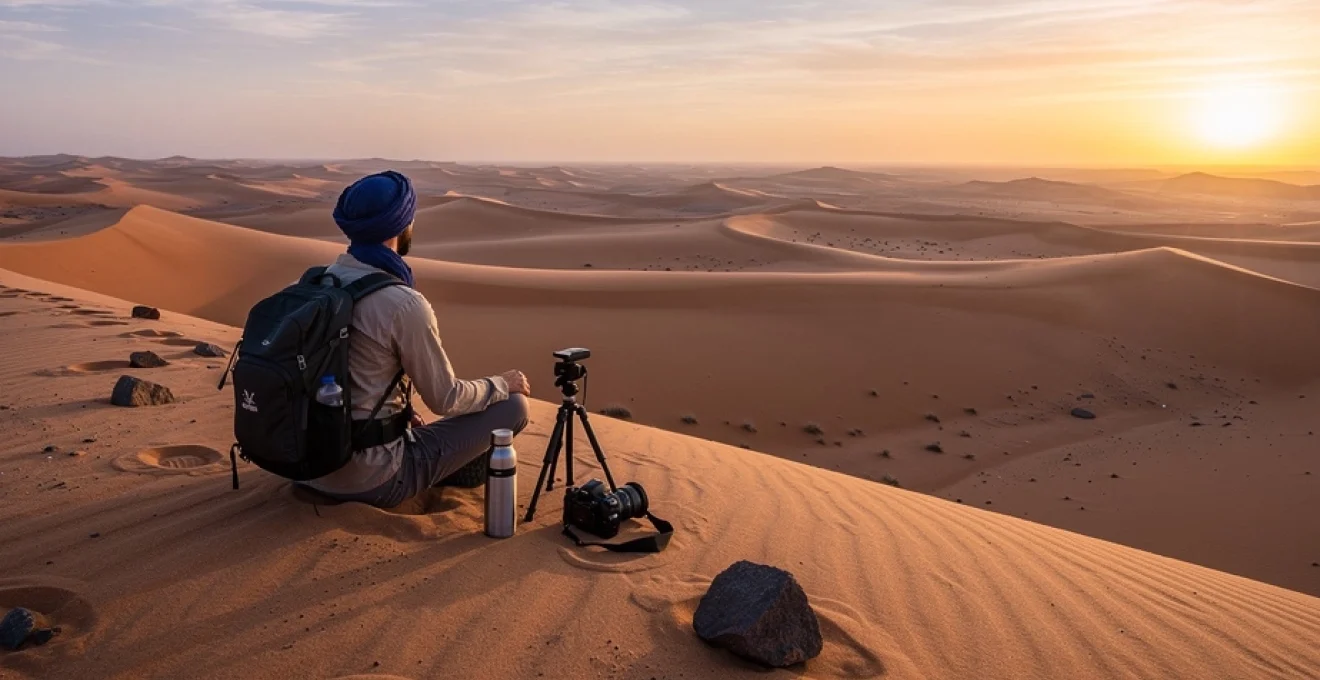
The Sahara Desert at dawn offers one of Earth’s most profound experiences of solitude and natural beauty. Standing alone atop a towering dune as the first rays of sunlight pierce the horizon creates an intimate connection between the observer and the vast expanse of golden sand that stretches endlessly in every direction. This moment of transition from darkness to light in the world’s largest hot desert provides not only spectacular visual splendour but also a unique opportunity for introspection and perspective that few other environments can match.
The experience of witnessing a Saharan sunrise in complete solitude transcends mere photography or tourism. It represents a return to humanity’s most fundamental relationship with the natural world, stripped of modern distractions and technological interference. The silence is profound, broken only by the gentle whisper of wind-carried sand and the rhythmic beating of your own heart as you anticipate the spectacular light show about to unfold before you.
Erg chebbi dune formation and geological characteristics for optimal sunrise viewing
The Erg Chebbi dune system in Morocco represents one of the most accessible and photographically stunning locations for experiencing a Saharan sunrise. These massive sand formations have been sculpted over millennia by complex wind patterns and geological processes that continue to shape their appearance daily. Understanding the formation and characteristics of these dunes enhances both the safety and quality of your sunrise viewing experience.
Sand composition analysis: quartz and iron oxide content in saharan dunes
The distinctive golden-orange hue of Erg Chebbi dunes results from their unique mineral composition, primarily consisting of quartz crystals coated with iron oxide particles. This combination creates the spectacular colour variations you witness during sunrise, as different wavelengths of light interact with the mineral surfaces at varying angles. The higher iron oxide content in certain areas produces deeper amber and reddish tones, particularly pronounced during the golden hour when the sun sits low on the horizon.
Quartz grains dominate the sand composition at approximately 85-90%, providing the structural foundation that allows these dunes to maintain their impressive heights. The remaining 10-15% consists of feldspar, mica, and the crucial iron oxide coating that gives Saharan sand its characteristic warm colouration. This mineral diversity means that different sections of the same dune can display varying colour intensities during sunrise, creating natural gradients that shift and evolve as the light angle changes.
Wind pattern dynamics: trade winds and harmattan influence on dune morphology
The shape and orientation of Erg Chebbi dunes directly result from prevailing wind patterns, particularly the northeast trade winds and the seasonal Harmattan winds that blow from the Sahara towards the Atlantic. These atmospheric forces constantly reshape the dune faces, creating the sharp ridges and gentle slopes that provide optimal vantage points for sunrise observation. Understanding wind direction helps you position yourself on the lee side of dunes, where sand movement is minimal and viewing conditions remain stable.
The Harmattan wind system, active primarily between November and March, contributes to the formation of the crescent-shaped barchan dunes characteristic of this region. These winds carry fine particles that create the smooth, rippled surfaces ideal for capturing the interplay of light and shadow during dawn. Wind speeds typically decrease during pre-dawn hours, creating calmer conditions that enhance the clarity of sunrise photography and reduce sand displacement.
Elevation gradient mapping: identifying prime vantage points above 150 metres
Erg Chebbi features several dunes exceeding 150 metres in height, with the tallest reaching approximately 250 metres above the surrounding desert floor. These elevated positions provide unobstructed views of the eastern horizon while offering sufficient elevation to witness the sun’s emergence above distant mountain ranges. The optimal viewing height begins around 100 metres, where atmospheric haze diminishes and visual clarity improves significantly.
Strategic positioning involves identifying dunes with eastern-facing slopes that capture direct sunlight while providing stable footing during the critical sunrise period. GPS coordinates and topographical awareness become essential for solo expeditions, as the pre-dawn darkness can make navigation challenging even for experienced desert travellers. The gradient typically ranges from 30-35 degrees on the windward side to 15-
40 degrees on the leeward slip face, so choosing a route that zigzags along the ridge rather than attacking the steepest side reduces fatigue and the risk of minor slides. When planning to watch the sunrise alone in the Sahara, you should allow at least 45–60 minutes to climb from camp level to a 150-metre vantage point, especially in soft sand. Starting in civil twilight rather than full darkness also helps you read the contours of the dune more clearly, improving both safety and your chances of reaching the summit in time for first light.
Thermal inversion phenomena: temperature differentials at dawn in arid ecosystems
One of the more surprising aspects of a Saharan sunrise is how cold it can feel just before the sun appears. In arid ecosystems like Erg Chebbi, heat escapes rapidly into the atmosphere at night, often creating a shallow thermal inversion where cooler air is trapped near the surface beneath a slightly warmer layer above. As you sit alone on a dune crest waiting for dawn, you are often positioned right at the boundary of these layers, which is why you may feel sharp temperature changes with even small shifts in wind direction.
Typical pre-dawn temperatures in the Sahara during spring and autumn can drop to 5–10°C, even when daytime highs exceed 30–35°C. This 20–25°C swing within a single 24-hour period affects not only your comfort but also how you experience the sunrise visually. Cool, dense air near the surface can increase the apparent clarity of distant horizons, while the warmer layer above slightly distorts light as the first rays pass through. Packing layered clothing, thin gloves, and a light beanie allows you to remain still and present in the moment rather than being distracted by the cold.
As the sun clears the horizon, the inversion breaks down rapidly. You can almost feel the process happening: first a faint warmth on your face, then on your hands, and finally a subtle shift in the breeze as rising thermals begin to stir. Within 30–45 minutes, the air temperature can rise by several degrees, and the sand around you transitions from cool and firm to warm and yielding. Understanding this thermal cycle helps you plan how long to stay on the summit, when to begin your descent, and how much water and clothing you need to carry for a solitary sunrise in the Sahara Desert.
Solar positioning and astronomical calculations for saharan sunrise photography
Knowing where and when the sun will appear is essential if you want to do more than simply watch the dawn; it is the foundation of serious Saharan sunrise photography. In the open landscape of Erg Chebbi, a few degrees of solar azimuth can mean the difference between a perfectly backlit dune ridge and a flat, uninteresting scene. By combining basic astronomical calculations with on-the-ground observation, you can predict the sun’s path accurately enough to plan compositions, time-lapses, or even a simple sequence of images that captures the progression from first light to full sunrise.
Fortunately, you do not need to be an astronomer to make use of this information. Modern ephemeris apps, offline sunrise calculators, and simple rules of thumb give you all the data you need: sunrise time, solar azimuth, and elevation angles at specific minutes after dawn. The key is to translate these abstract numbers into decisions about where you stand, which direction you face, and how you position the curves of the sand in relation to the growing light.
Ephemeris data interpretation: solar azimuth and elevation angles by season
At the latitude of Erg Chebbi (approximately 31°N), the position of sunrise shifts noticeably over the course of the year. In winter, the sun rises closer to the southeast; in summer, its azimuth swings towards the northeast, spanning a range of roughly 60–70 degrees. When you consult an ephemeris, you will typically see sunrise azimuth values between about 110° (winter solstice) and 60–70° (summer solstice), measured clockwise from true north. For a sunrise alone in the Sahara, this tells you exactly where on the horizon to expect the first hint of light.
Solar elevation, the angle of the sun above the horizon, matters just as much for desert photography. Between 0° and 6° elevation, light is low, soft, and strongly directional, casting long shadows that emphasise the texture of sand ripples. By around 10–12° elevation—often 40–60 minutes after official sunrise at this latitude—the contrast increases and the soft golden tones start to flatten. If your goal is to capture the most dramatic interplay of light and shadow on the dunes, you will want to be in position well before the sun reaches 6° elevation.
How do you use this in practice? Before you go to sleep in your desert camp, check the ephemeris data for the next morning: note sunrise time, azimuth, and the times when the sun will be at 2°, 4°, and 6° elevation. Then scout a dune whose main ridge roughly aligns at an angle to the predicted azimuth—this will give you side-light that sculpts the dune profile. When you climb in the dark, you are heading not just for the highest point, but for a place where the geometry of the sand and the mathematics of the sunrise work together.
Golden hour timing: civil twilight duration in desert latitudes 20-30°N
In desert latitudes between 20° and 30°N, including much of the Saharan belt, twilight behaves differently than in higher latitudes. Civil twilight—the period when the sun is between 0° and 6° below the horizon—typically lasts around 25–30 minutes. This brief window is critical if you want to experience the full emotional and photographic potential of a sunrise alone in the Sahara Desert. It is during this time that the sky shifts from deep blue to pastel hues, while the dunes remain in shadow, waiting for the first direct rays.
Many travellers set their alarms for official sunrise time and unknowingly miss half of the show. If civil twilight begins at 06:15 and sunrise is at 06:45, you should aim to be on your chosen dune summit by 06:00. That extra 45 minutes allows your eyes to adapt, your heart rate to settle after the climb, and your mind to transition into a quieter, more observant state. The desert’s famous “blue hour” is particularly pronounced here: without artificial light pollution, the sky takes on saturated indigos that gradually soften as the horizon begins to glow.
From a practical standpoint, understanding civil twilight duration helps you plan how early to leave camp and how much light you will have on your ascent. In the first 10–15 minutes of civil twilight, you may still rely heavily on a headlamp; by the final 10 minutes, you will often see enough without artificial light to navigate the ridge lines safely. For sunrise photography, this period offers opportunities for long exposures that capture the subtle tonal gradations of the sky above a still-dark sea of sand, giving you images very different from the classic golden dune shots.
Atmospheric refraction effects: light bending through saharan air masses
Atmospheric refraction—the bending of light as it passes through layers of air with different densities—plays a subtle but important role in how you perceive a Saharan sunrise. Near the horizon, especially in the cool pre-dawn hours, temperature and density gradients in the air can shift the apparent position of the sun by up to half a degree, roughly the diameter of the solar disk itself. This means that the sun you see just touching the horizon has, in geometric terms, already risen.
In the Sahara Desert, where nights are clear and humidity is low, these refraction effects are often more visible than in coastal or urban environments. You might notice the sun appearing slightly flattened at the bottom as it breaks free from the horizon, or you may see a thin band of intense colour just above the edge of the earth. Dust and fine sand particles suspended in the air act like a natural filter, scattering shorter blue wavelengths and allowing warm reds and oranges to dominate, particularly when the sun is between 0° and 5° elevation.
For photographers and observers alike, recognising atmospheric refraction helps manage expectations and timing. If you wait to start your exposures until the solar disk is clearly visible, you have already lost a few critical seconds of the most delicate light. Instead, you can begin shooting as soon as the sky over the eastern dunes begins to brighten, knowing that the first “invisible” portion of the sun is already influencing the colours and contrast in front of you. Think of the atmosphere as a giant, constantly shifting lens that adds its own character to every Saharan sunrise.
Shadow length calculations: using gnomon principles for time estimation
When you are alone on a dune with no watch visible and no clear markers of time, the length of your shadow can become a surprisingly reliable indicator of the sun’s elevation—and thus of the passing minutes. This is where basic gnomon principles, the same ideas used in ancient sundials, become useful in a modern Sahara sunrise context. The ratio between the height of an object and the length of its shadow changes predictably as the sun climbs, giving you a simple way to estimate how far you are into the golden hour.
Here is a practical method you can use: stand upright on the crest of the dune and observe your shadow stretching down the slope. When the sun is very low, at an elevation of about 2–3°, your shadow may extend 15–20 times your own height or more, reaching far into the patterned sand below. As the sun rises to around 6°, that ratio typically drops to roughly 10:1. While these exact numbers vary slightly with latitude and time of year, the principle is consistent—shortening shadows signal the end of the most dramatic textural contrast on the dunes.
You can also create a more deliberate gnomon by placing a trekking pole or tripod vertically in the sand and measuring its shadow length at intervals, either by pacing or using simple marks in the sand. This not only helps with time estimation but deepens your awareness of how quickly the desert changes from moment to moment. In a sense, your own body and equipment become a living sundial, connecting you to the same basic observations that guided desert travellers long before modern clocks and GPS devices.
Physiological responses to solitary desert immersion at dawn
Spending sunrise alone in the Sahara Desert is as much a physiological experience as it is a visual or emotional one. Your body reacts to the combination of cool air, low light, and wide horizons in ways that modern neuroscience and environmental psychology are only beginning to fully describe. Understanding these responses can help you prepare for the experience and also appreciate why it often feels so profoundly calming and perspective-shifting.
In the pre-dawn darkness, your body’s circadian rhythm is still in a low-activity phase. As you climb the dune, mild exertion raises your heart rate and stimulates the release of endorphins, while the cool desert air constricts peripheral blood vessels, giving you that familiar sensation of chilled hands and feet. At the same time, your brain is flooded with sensory input that is both simple and intense: the crunch of sand, the faint hiss of wind, the vast, star-studded sky overhead. This combination of physical effort and minimal sensory clutter tends to reduce mental chatter and increase present-moment awareness.
When the first light appears, your retina detects the growing intensity of blue wavelengths and signals your brain to begin suppressing melatonin, the hormone associated with sleep. Within 20–30 minutes of sunrise, cortisol levels naturally increase, supporting alertness and a gentle rise in blood pressure. In a city, these hormonal shifts are often drowned out by alarms, screens, and noise; in the Sahara, you can feel them almost directly. Many travellers describe a subtle but noticeable “reset” after a solitary sunrise—an internal recalibration that leaves them feeling more grounded and mentally clear.
Of course, the desert environment also introduces specific physiological risks. Even in the early hours, dehydration can creep up on you, especially after a dry, windy night. Low humidity accelerates moisture loss through breathing and skin, so drinking water before leaving camp and carrying at least 0.5–1 litre for a short sunrise excursion is sensible. Mild altitude—Erg Chebbi sits around 700–800 metres above sea level—can also slightly reduce oxygen availability, which you may notice as shortness of breath during steep climbs. Pacing yourself and taking breaks on the way up allows your body to adapt without pushing into discomfort.
There is also an important mental-health dimension to being alone in such an expansive environment. Research on “awe experiences” suggests that exposure to vast natural landscapes can temporarily diminish self-focused thinking and increase feelings of connection to something larger than oneself. As you watch the shadow of your dune retreat and the Sahara slowly ignite under the rising sun, you may feel your usual concerns shrink in significance. Rather than being an abstract spiritual idea, this shift is tied to measurable changes in brain activity and stress-related biomarkers.
For travellers planning to experience a sunrise alone in the Sahara Desert, a few physiological guidelines are worth keeping in mind:
- Sleep at least 6–7 hours before your ascent to avoid fatigue and impaired judgement in the dark.
- Eat a light snack rich in complex carbohydrates—such as bread or dates—30–60 minutes before climbing to provide stable energy.
- Dress in breathable layers so you can adapt quickly as the temperature rises 5–10°C within the first hour after sunrise.
- Take a few minutes at the summit to simply sit, breathe slowly, and allow your nervous system to settle before you start photographing or filming.
By listening to your body as well as watching the light, you transform the sunrise from a mere visual spectacle into a holistic experience—one that aligns physiology, psychology, and environment in a rare moment of coherence.
Navigation techniques and safety protocols for solo saharan expeditions
Venturing alone into the dunes before dawn demands more than enthusiasm and a camera. While places like Erg Chebbi are relatively accessible compared to the deep Sahara, the landscape can still be disorienting and unforgiving if you underestimate it. Effective navigation techniques and clear safety protocols are what allow you to enjoy your solitude without slipping into unnecessary risk. Think of them not as limitations, but as the quiet framework that lets you relax fully into the experience.
The first navigation principle is simple: always maintain a clear reference between your camp and the dune you intend to climb. In daylight, this may seem trivial, but under a moonless sky, one dune crest can look very much like another. Before nightfall, identify distinct landmarks—an isolated tree, a rocky outcrop, a line of power poles, or even the light pattern of your specific camp. Mark your planned route on a GPS app with offline maps, and, if possible, walk the first 200–300 metres in daylight so you are familiar with the initial terrain.
As you move out into the dunes, use a combination of digital and analogue navigation. A headlamp with a red-light mode preserves your night vision and makes it easier to read the faint lines of the ridges. A compass, whether physical or integrated into your phone, confirms your general direction, especially if wind begins to erase your footprints. In the Sahara Desert, it is wise to avoid descending into multiple interlocking hollows in the dark; instead, follow ridge lines whenever you can, as they provide clearer sightlines back towards camp once twilight begins.
Safety protocols for a solitary sunrise in the Sahara should be agreed in advance with your host or guide. At a minimum, inform someone of your intended route, departure time, and estimated return time, and carry a fully charged phone or satellite communicator. Many travellers adopt a simple rule: if visibility drops below a certain level due to wind-blown sand, or if they become unsure of their orientation, they turn back immediately while they still have a clear reference point. In a landscape where distances can be deceptive, conservative decisions are usually the wisest.
Carrying a small but well-thought-out kit also makes a substantial difference. Alongside water and extra clothing, include a basic first-aid pouch, a whistle for signalling, and an emergency foil blanket that can provide warmth if you need to stop moving for longer than expected. A lightweight scarf or shemagh protects your face from sudden gusts of sand, and sunglasses—though not needed on the ascent—become essential shortly after sunrise when the low-angle light can be dazzling. With these simple precautions, you are free to focus not on “what if” scenarios, but on the extraordinary stillness unfolding around you.
Cultural significance of sunrise rituals among tuareg and berber communities
While many visitors experience a Sahara sunrise as a deeply personal moment, it is also part of a much older cultural rhythm for the desert’s indigenous communities. Among Tuareg and Berber groups, dawn has long marked a natural boundary between night and day, danger and activity, solitude and social connection. Understanding this context adds another layer of meaning to your own solitary vigil on the dunes, reminding you that you are stepping into a pattern of life that predates modern tourism by centuries.
For pastoral Berber families living on the fringes of the dunes, sunrise is traditionally when daily tasks begin. Animals are checked, water is fetched, and fires are lit while the air is still cool. In many households, the first tea of the day is prepared just after dawn—a ritual that is both practical and symbolic. Sharing mint tea at sunrise becomes a quiet affirmation of continuity and resilience in an environment that demands both. If you listen carefully on still mornings near settled areas, you may hear the distant sounds of goats, low voices, and clinking metal even as you sit alone on a dune crest.
Among Tuareg communities, whose nomadic patterns have historically taken them across vast stretches of the central Sahara, dawn also carries navigational and spiritual significance. Travel often began early to take advantage of the cooler hours, with caravan leaders using the fading stars and first light to confirm their bearings. Oral poetry and songs sometimes reference the sunrise as a witness to human vows and endurance—a silent companion to journeys that might last weeks or months. Though lifestyles are changing, echoes of this symbolism remain in stories and songs shared around desert fires today.
As a visitor, you might be invited to join a simple sunrise ritual at a camp: drinking tea, listening to traditional drumming, or quietly watching the light change with your Berber hosts. These are not staged performances so much as everyday practices shared with you for a brief time. When you later walk alone into the dunes, you carry those gestures with you. The silence you experience is no longer empty; it is woven with the memory of people who have greeted this same rising sun from different vantage points across generations.
In the end, watching the sunrise alone in the Sahara Desert is both a solitary and a shared act. You stand by yourself on a ridge of shifting sand, yet you are also participating—knowingly or not—in a long continuum of human attention directed towards the same horizon. The light that touches your face is the same light that has guided caravans, warmed nomad camps, and illuminated prayer mats on cold desert mornings. Recognising this shared thread of experience can turn a beautiful view into something deeper: a moment of perspective that connects your brief stay in the Sahara to the enduring life of the desert and its people.