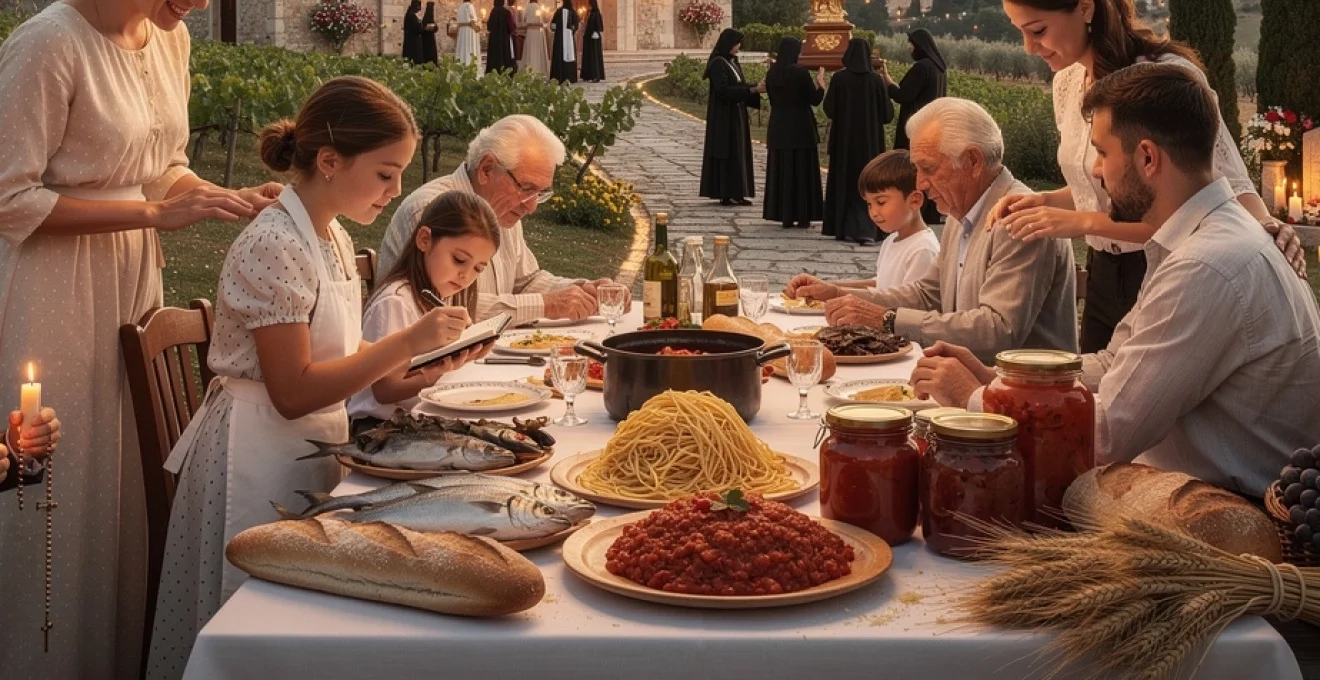
Italian family traditions represent one of Europe’s most enduring cultural legacies, weaving together centuries of religious devotion, culinary mastery, and ancestral wisdom into the fabric of daily life. These time-honoured customs continue to shape modern Italian society, creating unbreakable bonds between generations whilst preserving authentic regional practices that define Italy’s cultural identity. From the sacred observances rooted in Catholic tradition to the intricate culinary rituals passed down through maternal lineages, Italian families maintain a profound connection to their heritage through ceremonial practices that have withstood the test of time.
The preservation of these traditions reflects more than mere nostalgia; it represents a living testament to the Italian understanding that family serves as the cornerstone of social stability and cultural continuity. Whether celebrating religious feast days in Sicily’s ancient communities or participating in harvest festivals across Tuscany’s wine regions, Italian families continue to honour customs that have defined their ancestors for generations. These rituals create a sense of belonging that transcends geographical boundaries, uniting Italians worldwide through shared experiences and collective memory.
Sacred catholic traditions and Vatican-Sanctioned family observances
Catholic traditions form the spiritual backbone of Italian family life, with religious observances serving as pivotal moments that strengthen familial bonds and reinforce cultural identity. The Vatican’s influence extends far beyond Rome’s borders, permeating every aspect of Italian family celebrations and establishing frameworks for community participation that have remained largely unchanged for centuries. These sacred traditions provide structure and meaning to the Italian calendar, creating rhythmic patterns of celebration and reflection that define the cultural year.
Family participation in religious ceremonies demonstrates the interconnectedness of faith and kinship in Italian society. Parents, grandparents, and extended family members all play specific roles in these observances, ensuring that religious knowledge and ceremonial practices transfer seamlessly from one generation to the next. The preparation periods preceding major religious celebrations often involve weeks of family coordination, with different relatives contributing their specialised knowledge and skills to create memorable experiences for younger family members.
First communion ceremonial preparations in sicilian orthodox communities
In Sicily’s Orthodox communities, First Communion preparations represent months-long family endeavours that unite extended relatives in elaborate ceremonial planning. Grandmothers traditionally oversee the creation of ceremonial garments, whilst fathers and uncles collaborate on venue arrangements and feast preparation. These communities maintain distinct traditions that differ significantly from mainland Catholic practices, incorporating Byzantine influences that reflect Sicily’s complex religious heritage.
The preparatory process involves intricate family meetings where roles are assigned according to traditional hierarchies. Elder family members share stories of their own First Communion experiences, creating narrative threads that connect current celebrations to ancestral memories. Children participate in intensive catechism sessions led by family members who have received special religious education, ensuring that spiritual preparation occurs within the intimate family setting rather than exclusively through institutional channels.
Christmas eve feast of seven fishes regional variations across calabria
Calabrian families maintain distinctive Christmas Eve traditions centring on the Feast of Seven Fishes, with each coastal community developing unique interpretations of this sacred meal. The preparation begins days before Christmas Eve, with different family members responsible for procuring specific types of seafood according to ancestral recipes that have never been written down. These oral traditions require younger generations to observe and participate actively in the preparation process, ensuring knowledge transfer through experiential learning.
Regional variations reflect local fishing traditions and seasonal availability, with mountain communities adapting the tradition to include preserved fish and imported seafood. Extended families gather to share preparation duties, with each household contributing particular dishes that showcase their culinary expertise. The evening’s celebration extends beyond mere dining, incorporating traditional songs, storytelling, and religious observances that connect families to their maritime heritage and Catholic faith simultaneously.
Easter vigil processions and benedictine monastery customs
Easter Vigil processions in communities surrounding Benedictine monasteries involve elaborate family participation structures that have evolved over centuries of monastic influence. Families coordinate their involvement months in advance, with different lineages responsible for specific aspects of the procession, from carrying religious artifacts to organising community feasts. These customs demonstrate the profound integration between monastic traditions and family religious observances throughout central and southern Italy.
The preparation period requires extensive family coordination, with elder members teaching younger generations about proper ceremonial protocols and historical significance. Many families maintain special garments and religious
objects that are carefully stored and passed down as family heirlooms. The night itself is marked by a shared sense of vigil and anticipation, with families often remaining together late into the evening, combining liturgical participation with intimate at-home rituals such as reading Gospel passages, sharing simple Lenten dishes, and preparing symbolic foods for the joyful Easter lunch that follows. In many Benedictine-influenced villages, the ringing of monastery bells at midnight signals not only the Resurrection but also a reaffirmation of the enduring bond between the religious community and the families who have supported it for generations.
Saint’s day patronage systems in neapolitan family hierarchies
In Naples and the surrounding Campania region, saint’s day patronage systems remain central to how families structure their spiritual lives and even their internal hierarchies. Many Neapolitan children are named after a particular saint, and their onomastico (name day) is celebrated with as much enthusiasm as, if not more than, their birthday. Grandparents often act as custodians of these devotions, recounting miracles associated with the family’s patron saint and explaining why a specific figure was chosen as protector of the household.
Within traditional Neapolitan family structures, certain saints are associated with specific trades, neighbourhoods, or even family histories, creating a layered network of religious allegiances. A family of fishermen might honour San Gennaro, but also maintain a special devotion to San Nicola for protection at sea, weaving multiple patronages into their annual ritual calendar. These observances are not limited to church services; home altars adorned with candles, flowers, and images of the saints transform living rooms into small domestic chapels, where relatives gather to pray for guidance, health, and prosperity.
On major feast days, entire family networks converge in the city’s historic churches, often reserving pews or chapels that their ancestors have occupied for decades. Afterwards, the devotional aspect flows seamlessly into the social sphere, as relatives host elaborate meals featuring dishes traditionally linked to that saint or season. Through these layered patronage systems, Neapolitan families reinforce both their religious commitments and their internal bonds, using shared devotion as a framework for respect, obligation, and mutual support.
Ancestral culinary heritage and traditional recipe preservation methods
Food traditions lie at the heart of Italian family life, functioning as a living archive of regional history and domestic memory. Across the peninsula, ancestral culinary heritage is preserved not only through written recipes, but also through gestures, stories, and seasonal rituals that are repeated year after year. Italian families understand that every dish carries with it a narrative—of migration, hardship, celebration, or sacrifice—and these narratives are transmitted alongside the techniques themselves.
In many households, the kitchen acts like a family archive where sensory memory replaces written documentation. The sound of a wooden spoon striking a copper pot, the feel of properly kneaded dough, or the smell of tomatoes simmering for hours becomes a kind of unspoken language between generations. As you explore Italian family traditions, it becomes clear that culinary practices are more than methods of preparing food; they are carefully maintained systems of knowledge preservation that ensure regional identities remain vibrant in an increasingly globalised world.
Nonna’s handwritten recipe codification in tuscan wine regions
In Tuscany’s wine-producing areas, many families still rely on handwritten notebooks compiled by grandmothers—nonne—to safeguard their most cherished recipes. These notebooks, often stained with olive oil and wine, serve as informal codices documenting everything from everyday soups to elaborate feast-day dishes. Rather than following strict measurements, they frequently include intuitive indications such as “a handful,” “until it feels right,” or “as much as needed,” reflecting a trust in the cook’s sensory judgement.
The act of transcribing recipes is itself a ritual. Younger relatives may sit at the kitchen table with an elderly nonna, carefully copying her notes while she explains subtle variations that never make it onto the page. In many Tuscan families, the passing on of the recipe book coincides with life milestones such as marriages or the birth of a first grandchild, symbolising the transfer of both culinary authority and familial responsibility. These written records, combined with oral coaching and practical demonstrations, create a robust system that keeps regional dishes like ribollita, pappa al pomodoro, and wild boar stews firmly anchored within the family lineage.
Artisanal pasta-making techniques passed through generational apprenticeship
Across Italy, but especially in regions such as Emilia-Romagna and Marche, artisanal pasta-making remains a disciplined craft taught through long-term generational apprenticeship. Children often begin by observing from a distance, then gradually earn the right to help with simple tasks such as breaking eggs, sieving flour, or turning the hand-cranked pasta machine. With time, they progress to more complex techniques: rolling out dough with a long wooden rolling pin, shaping tortellini with rapid, precise movements, or cutting tagliatelle to the exact width dictated by tradition.
This apprenticeship model resembles classical guild systems, where mastery is achieved not through formal certification but through recognition by senior family members. Mistakes—dough that is too sticky, pasta that cooks unevenly—become teaching moments that reinforce standards of quality and patience. For many Italian families, particularly in rural areas, homemade pasta is reserved for Sundays and holidays, transforming the kitchen into a mini workshop where relatives work side by side. Through repetition, encouragement, and gentle correction, elders ensure that artisanal pasta-making techniques remain an integral part of Italian family identity rather than a skill relegated to professional chefs alone.
Regional bread-baking rituals from pugliese wheat cultivation
In Puglia, where golden wheat fields dominate the landscape, bread-baking rituals occupy a central place in family and community life. Traditional loaves such as pane di Altamura are not merely food items, but symbols of local pride and agricultural continuity. Historically, households would prepare dough at home using flour milled from locally grown wheat, then mark each loaf with a distinctive family symbol before bringing it to a communal wood-fired oven for baking.
Although modern ovens have reduced the reliance on communal bakeries, many families still follow inherited schedules and techniques: preparing starter cultures the night before, allowing slow fermentation, and using specific folding methods to create the desired crumb texture. The weekly bread-making day often becomes a social occasion, with neighbours exchanging tips on hydration levels or sharing surplus loaves with relatives unable to bake for themselves. In this way, the humble act of baking bread connects domestic routines to the wider agricultural cycle, reminding each generation of the land that sustains them.
Preserved tomato canning ceremonies in campanian agricultural communities
In Campania, late summer heralds one of the most anticipated family rituals: the annual tomato canning ceremony, known locally as fare la conserva or fare le bottiglie. Over one or two intense days, entire extended families gather to transform crates of ripe San Marzano or local heirloom tomatoes into bottled sauces that will flavour winter meals. Each person assumes a role—washing, blanching, peeling, milling, bottling, or sterilising—and the efficiency with which these tasks are carried out reflects years of practice and coordination.
The process is as much about togetherness as it is about food preservation. Stories are traded while hands move almost automatically, grandparents explain why certain tomatoes are best for sauce, and children are entrusted with simple tasks that make them feel part of something important. The rows of cooling bottles, lined up on balconies or in courtyards, become a visible testament to a family’s effort and foresight. Much like an insurance policy written in red, these preserved tomatoes guarantee that the taste of summer will endure throughout the colder months, reinforcing a sense of security rooted in collective labour and shared tradition.
Sunday ragu preparation protocols in emilian family structures
In Emilia-Romagna, Sunday ragù preparation is governed by unwritten yet precise protocols that reflect the region’s reputation as Italy’s gastronomic heart. The sauce is rarely a last-minute decision; it begins early in the morning, if not the night before, when specific cuts of meat are selected and finely chopped or ground. Many families insist on a particular combination of beef, pork, and sometimes veal, combined with a carefully balanced soffritto of onion, carrot, and celery that must be sautéed slowly until it reaches a deep, sweet aroma.
Responsibility for the ragù typically falls to the most experienced cook in the household, often a grandmother or an aunt, who oversees simmering times that can extend for several hours. Younger relatives may be allowed to stir the pot but are closely supervised to ensure they respect the low, steady heat required for proper flavour development. When served with fresh egg pasta—tagliatelle or lasagne—the finished sauce represents more than a meal; it is a weekly reaffirmation of familial roles, culinary standards, and regional pride. Through this repeated Sunday ritual, Emilian families keep alive a culinary tradition that outsiders frequently attempt to imitate yet rarely fully reproduce.
Marriage customs and matrimonial ceremonial protocols
Marriage in Italy has long been regarded as both a personal commitment and a social contract involving entire families, not just the couple. Traditional matrimonial ceremonial protocols blend religious rites, civil requirements, and regional customs into multi-stage events that can span several days. Even as modern couples opt for smaller or more informal weddings, many still incorporate elements that honour their grandparents’ experiences and local traditions.
Historically, marriage preparations began with formal meetings between families, during which expectations about dowries, living arrangements, and future responsibilities were discussed. While these negotiations have softened in tone, echoes remain in the way relatives support a couple with housing, furniture, or business introductions. The engagement period often includes pre-marital courses organised by the parish, during which couples reflect on the spiritual dimensions of their union. On the wedding day itself, symbolic gestures—such as the bride walking to church with her father, or the throwing of rice to wish fertility and prosperity—serve as visible links to centuries of Italian matrimonial culture.
Regional variations add further richness to these customs. In the South, it is common for processions of honking cars to accompany the couple from church to reception, while in certain northern villages, neighbours may decorate the couple’s doorway with flowers or ribbons the night before. The wedding banquet, complete with multiple courses and elaborate toasts, becomes the stage where extended families meet, forge new alliances, and publicly welcome the spouses into one another’s kinship networks. Through these enduring practices, Italian marriage traditions continue to affirm that a wedding is not merely about two individuals, but about the merging of families and the continuation of a shared cultural legacy.
Seasonal agricultural celebrations and harvest festival observances
Seasonal cycles play a defining role in Italian family traditions, particularly in rural areas where agricultural work still shapes daily life. Harvest festivals mark the culmination of months of labour and provide opportunities for families to reconnect with their ancestral relationship to the land. Whether celebrating the grape harvest in Tuscany, the olive harvest in Umbria, or the chestnut season in Piedmont, Italian families treat these events as both work and celebration.
Participation in these festivals often begins in childhood, when youngsters accompany parents and grandparents into vineyards or orchards to help with simple tasks. Over time, they learn the more demanding aspects of harvest work, such as identifying optimal ripeness or handling delicate produce without damage. Even for relatives who now live in cities, returning to the countryside for harvest time offers a powerful way to maintain ties with their origins. Have you ever noticed how a single day of grape picking, followed by a shared meal in a farmhouse courtyard, can strengthen bonds more effectively than weeks of casual conversation?
Many communities also organise public festivities after the harvest, featuring processions, music, and tastings of newly produced wine or oil. Families plan their calendars around these dates, knowing that they provide rare opportunities for multi-generational gatherings. At a time when digital communication often replaces face-to-face interaction, seasonal agricultural celebrations function like an annual reset button, drawing scattered relatives back to a shared physical and cultural landscape. In this sense, harvest festivals are to rural Italy what large Sunday lunches are to urban families: recurring rituals that reaffirm belonging and continuity.
Death commemorations and ancestral veneration practices
Italian family traditions surrounding death and remembrance reveal a deep commitment to honouring ancestors and maintaining bonds beyond the grave. While contemporary life has introduced new attitudes toward mortality, many families still observe long-established customs that blend Catholic doctrine with local practices. These rituals offer structure during times of grief and provide a framework for expressing respect, love, and ongoing connection to deceased relatives.
From the moment of passing through the anniversaries that follow, Italian families engage in a series of formal and informal actions designed to accompany the soul of the departed and support the mourners. Wakes held at home or in funeral parlours allow neighbours and extended kin to pay their respects, often bringing food as a tangible sign of solidarity. Over time, regular visits to cemeteries, participation in memorial Masses, and observance of All Souls’ and All Saints’ Days ensure that the deceased remain an active part of family consciousness. Much like rings in a tree trunk, each commemoration adds a new layer to the family’s collective memory.
Nine-day novena prayer cycles for deceased family members
One of the most enduring Italian Catholic practices is the nine-day novena of prayers offered for a deceased family member. Immediately following a funeral, relatives may gather each evening—either in a church or in a private home—to recite specific prayers, rosaries, and litanies. This repeated cycle serves two purposes: it expresses the family’s hope for the repose of the soul, and it creates a structured space in which grief can be shared rather than borne alone.
In many communities, older women play a key role in organising and leading novena prayers, ensuring that traditional formulas and hymns are not forgotten. Younger relatives, even if less devout, often attend out of respect for grandparents and parents, finding in the ritual a comforting rhythm during an emotionally disorienting time. By the ninth day, the family has not only completed a spiritual obligation but also established a new pattern of mutual support, helping each person gradually adjust to the absence of the loved one.
All saints’ day cemetery visitation protocols in roman catholic tradition
All Saints’ Day and the following All Souls’ Day occupy a special place in Italian family calendars, particularly when it comes to cemetery visitations. On these days, cemeteries transform into vibrant, if solemn, social spaces where multiple generations converge to clean graves, lay fresh flowers, and light candles. Families often follow established protocols, such as visiting tombs in a particular order—starting with the most recently deceased, then moving to grandparents, great-grandparents, and other relatives.
These visits are about more than maintaining physical memorials; they also provide opportunities for storytelling and intergenerational education. Grandparents might point to a name on a headstone and recount how that person survived war, migration, or economic hardship, turning the cemetery into a kind of open-air classroom of family history. For younger Italians who may live far from their ancestral towns, returning for All Saints’ Day can feel like reconnecting with a deeper part of their identity, as if the rows of illuminated graves were a map of where they come from and who they belong to.
Memorial mass scheduling and perpetual prayer society memberships
Beyond the immediate period of mourning, Italian families frequently arrange memorial Masses to be celebrated on key dates such as the first anniversary of a death or the deceased’s birthday. Parish offices across Italy maintain detailed schedules of these intentions, and it is not uncommon for older relatives to keep handwritten lists of Masses requested for multiple family members throughout the year. Attending these services becomes another way for families to gather, reflect, and reinforce bonds that stretch across generations.
Some families also enrol their deceased relatives in perpetual prayer societies, often associated with religious orders or shrines. These memberships ensure that regular Masses and prayers are offered indefinitely for the souls of the departed, providing comfort to the living who feel they are continuing to care for their loved ones in a spiritual sense. Much like an endowment established in someone’s name, these arrangements symbolise an ongoing investment in remembrance. They also tie the family to specific churches or religious communities, creating enduring links between domestic and institutional expressions of faith.
Grief expression rituals through traditional black mourning attire
Although less common among younger generations, the wearing of black mourning attire remains a powerful symbol of grief in many Italian regions, particularly in the South and in rural communities. Widows, in particular, may choose to dress in black for extended periods—sometimes for the rest of their lives—as a visible sign of respect and ongoing connection to their deceased spouse. This practice functions like a public language, immediately communicating a person’s emotional status to the community.
In earlier decades, entire households might adopt muted or dark clothing for a specified mourning period, during which participation in public festivities would be limited. While these strict codes have largely softened, you can still observe older women in small towns maintaining them with quiet determination. For them, black garments act almost like a second skin, signalling that part of their identity remains anchored to the past. Even when formal rules fade, the underlying principle endures: external rituals of dress help structure internal experiences of loss, giving shape to feelings that might otherwise seem overwhelming.
Contemporary adaptation mechanisms for traditional italian family structures
As Italian society confronts economic pressures, shifting gender roles, and increased mobility, traditional family structures are undergoing noticeable change. Nuclear households are more common, marriage rates have declined, and many young adults delay leaving the parental home due to financial constraints. Yet rather than abandoning ancestral customs, many families are adapting them to new realities, demonstrating that tradition in Italy is less a fixed monument and more a flexible framework.
One visible adaptation is the way diaspora communities—Italians living abroad or descendants of migrants—reinterpret rituals such as Sunday lunch, Christmas Eve dinners, or patron saint celebrations. They might replace certain ingredients, shorten ceremonies, or hold gatherings on more convenient dates, but the core intention remains intact: to carve out regular time for connection and to honour shared origins. Digital tools also play an increasing role, with video calls allowing grandparents in Sicily to watch a grandchild’s First Communion in Milan or even in another country entirely. In this sense, screens become modern extensions of the traditional family table.
Within Italy, younger generations are renegotiating gender expectations around caregiving, cooking, and elder support, often embracing more egalitarian models while still valuing strong intergenerational ties. You might see a grandson, rather than a granddaughter, learning to make ragù from his nonna, or a son taking primary responsibility for an aging parent. At the same time, state policies on parental leave and elder care are gradually recognising the central role families play in social welfare. The result is a hybrid model in which ancient practices coexist with contemporary lifestyles: weddings may be smaller, but still feature traditional blessings; harvest festivals might attract tourists, yet remain rooted in local participation. Through such adaptations, Italian family traditions continue not as relics of the past, but as evolving rituals that help individuals navigate the complexities of modern life while staying anchored to something enduring and deeply familiar.