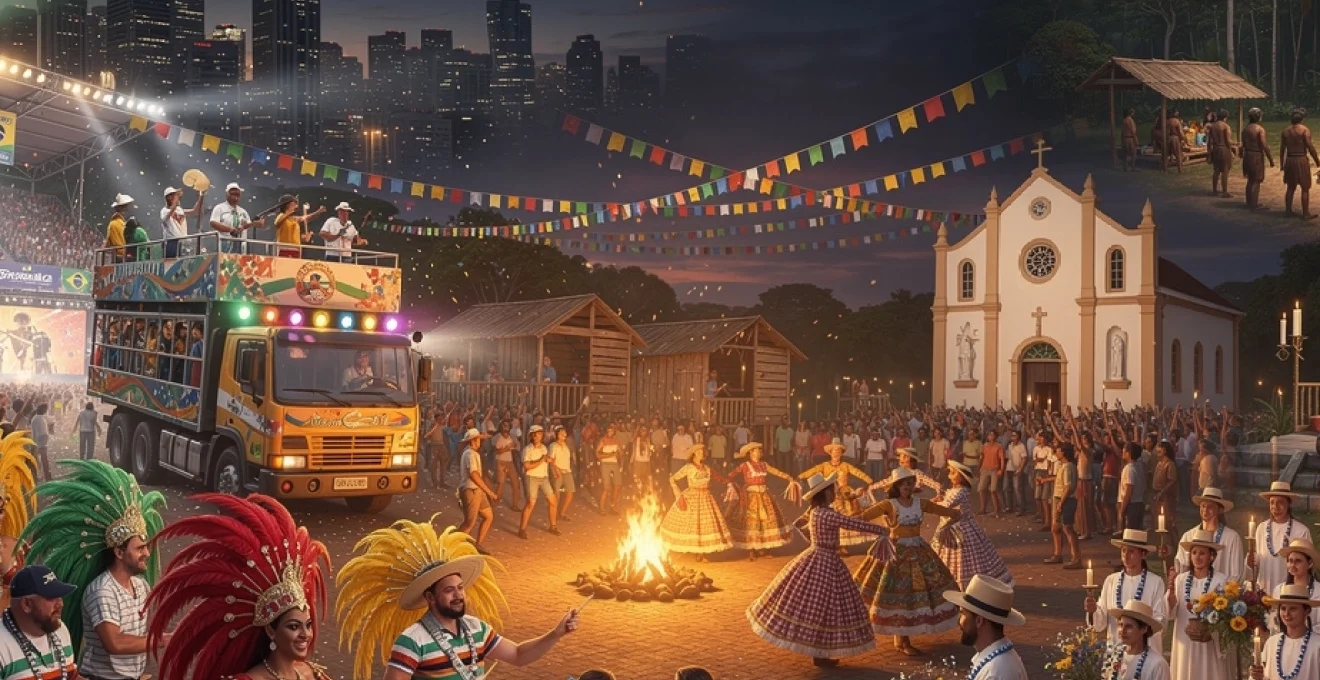
Brazil’s cultural landscape pulses with an extraordinary vitality that transforms streets, neighbourhoods, and entire cities into stages for collective celebration. From the glittering spectacles of Rio’s Sambadrome to the intimate bonfire gatherings in rural communities, Brazilian festivals represent far more than mere entertainment—they function as essential threads weaving together the nation’s diverse cultural heritage. These celebrations embody centuries of cultural syncretism, blending Indigenous traditions, African rhythms, European colonial influences, and contemporary Brazilian innovation into something uniquely captivating. Whether you’re drawn to the thunderous percussion of samba schools or the rustic charm of Northeastern agricultural festivities, Brazil offers an unparalleled immersion into how communities preserve identity, strengthen social bonds, and create joy through shared ritual and revelry.
Carnival traditions: from rio de janeiro’s sambadrome to salvador’s street blocos
Brazilian Carnival stands as the world’s largest and most spectacular celebration, attracting over 5 million participants annually and generating billions of reais for the national economy. Yet beyond the economic statistics lies something far more profound: Carnival represents Brazil’s soul, a cultural phenomenon where entire communities invest months of creative labour into fleeting moments of collective ecstasy. The festival’s timing—immediately preceding the Christian period of Lent—transforms it into a final explosion of indulgence before austerity, though for many Brazilians, the religious context matters less than the social and artistic dimensions of participation.
The diversity of Carnival celebrations across Brazil’s regions reveals the nation’s geographical and cultural complexity. Rio de Janeiro’s highly structured spectacle differs dramatically from Salvador’s participatory street parties, while Recife and Olinda present yet another distinct interpretation. Each variation reflects local histories, demographic compositions, and evolving relationships between tradition and innovation. What unites these diverse expressions is their fundamental function as community-building exercises, where neighbourhood associations, religious groups, and cultural organizations channel collective identity into spectacular public performances that reaffirm belonging and shared purpose.
Samba schools and the competitive parade structure at marquês de sapucaí
The Sambadrome parade in Rio de Janeiro represents Carnival’s most internationally recognized manifestation, where elite samba schools compete in an elaborately structured championship that combines artistic merit, technical precision, and emotional impact. These « schools » function as year-round community organizations based in Rio’s favelas and working-class neighbourhoods, employing thousands of artisans, designers, choreographers, and musicians who dedicate months to creating parade elements. Each school presents a themed narrative through coordinated segments featuring elaborate allegorical floats, precisely choreographed wing sections, and a 300-member percussion orchestra called the bateria that drives the entire performance forward with hypnotic rhythmic intensity.
The competitive element introduces fascinating dynamics rarely seen in other cultural celebrations. Judges evaluate schools across multiple criteria including musical composition, percussion execution, costume design, float construction, choreography, and thematic coherence. Point deductions for timing violations or synchronization failures create genuine suspense, transforming what might be purely celebratory into something resembling athletic competition. This structure emerged during the 20th century as Carnival evolved from spontaneous street revelry into organized spectacle, reflecting broader Brazilian tensions between grassroots cultural expression and commercial entertainment infrastructure.
What makes Rio’s samba schools particularly remarkable is their social composition. These organizations emerge from Brazil’s poorest communities, yet produce artistic work rivaling anything created with institutional resources. The São Clemente school, for instance, generated what experts considered 2017’s best Carnival song through collective creative processes involving community members rather than professional songwriters. This democratic creativity challenges conventional assumptions about where sophisticated art originates, demonstrating how material poverty need not limit imaginative wealth when communities possess strong organizational structures and shared cultural purpose.
Trio elétrico phenomenon in bahian carnival culture
Salvador’s Carnival presents a radically different model emphasizing participatory engagement over spectator experience. The trio elétrico—a massive truck equipped with powerful sound systems and a performing band—creates mobile parties that move through city streets followed by thousands of dancers. Unlike Rio’s fixed parade route and seated audiences, Salvador’s format allows anyone to join the celebration either by purchasing an abadá (a branded shirt granting access to r
abadás and joining a specific bloco, or by simply following the sound in the open streets. This moving architecture of sound and people transforms the city into a fluid dance floor, where social boundaries soften and participants experience what many describe as a rare sense of freedom and inclusion.
Bahian Carnival also foregrounds Afro-Brazilian musical traditions such as axé and samba-reggae, popularised by iconic artists and Afro blocs like Ilê Aiyê and Olodum. These groups use the trio elétrico as both a stage and a platform for political expression, celebrating Black identity and denouncing racism through lyrics, costumes, and visual symbolism. For visitors, understanding this context is crucial: joining a bloco is not only about dancing behind a sound truck, but about entering a living narrative of resistance, pride, and community organisation that has shaped Salvador’s cultural identity since the 1970s.
From an economic perspective, Salvador’s Carnival illustrates how large-scale street festivals can drive local development. Temporary jobs in security, hospitality, street vending, and event production multiply during the season, and many micro-entrepreneurs rely on this period for a significant share of their annual income. At the same time, municipal authorities face the complex challenge of balancing tourism promotion with public safety, noise regulation, and the protection of Afro-Brazilian neighbourhoods from excessive commercialisation—an ongoing negotiation between cultural authenticity and market pressure.
Olinda and recife’s frevo dance heritage during pernambuco festivities
Further north along the coast, Recife and Olinda offer yet another Carnival ecosystem built around the frantic rhythms of frevo. Unlike the samba sway or the axé swing, frevo is characterised by rapid footwork, acrobatic jumps, and the colourful use of small umbrellas that have become an icon of Pernambuco’s festive identity. Originating in the early 20th century from military brass bands and capoeira movements, frevo today is both a street dance and an intangible cultural heritage recognised by UNESCO, preserved through schools, community groups, and professional ensembles.
During Carnival, historic hills in Olinda and central Recife fill with blocos that parade to brass-heavy frevo orchestras. The atmosphere is notably more horizontal and less commercialised than in Rio or Salvador: there are no grandstands or paid arenas, and locals and visitors mingle freely in narrow colonial streets. For those willing to climb steep cobbled slopes under the tropical sun, the reward is an immersion in a festival where music seems to erupt spontaneously from every corner, and where you are invited not just to watch but to join in the frenetic choreography—often discovering, within minutes, just how demanding frevo’s tempo can be.
Pernambuco’s Carnival also shows how regional traditions can adapt without losing their core identity. New generations have incorporated rock, electronic music, and hip-hop into frevo arrangements, attracting younger audiences while keeping the distinctive syncopated beat intact. Cultural organisations and city governments invest in year-round training programs and youth projects, ensuring that dance and brass skills are transmitted from masters to apprentices. In this sense, Recife and Olinda demonstrate that protecting cultural heritage does not mean freezing it in time, but allowing it to evolve in dialogue with contemporary urban life.
Indigenous influences in parintins folklore festival’s boi-bumbá performances
While Carnival dominates February, the Amazonian city of Parintins becomes the focus of national attention every June with its Festival Folclórico de Parintins. Centred on the boi-bumbá tradition, this festival stages an intense artistic rivalry between two teams—Caprichoso (blue) and Garantido (red)—that dramatise the legend of a resurrected ox through spectacular night-time performances. What makes Parintins unique in Brazil’s festive calendar is the explicit integration of Indigenous cosmologies and Amazonian imagery into the choreography, costumes, and set design.
Each team’s presentation blends storytelling, music, and dance with elaborate floats representing forest deities, river spirits, and ancestral heroes drawn from local Indigenous narratives. Performers embody shamans, warriors, and mythological beings, while the arena’s scenography evokes the rainforest’s grandeur. Many Indigenous communities from the region participate directly, advising on mythological themes, contributing craftwork, or performing traditional dances that are reinterpreted within the competitive format. The result is a striking example of how popular festivals can serve as vehicles for Indigenous visibility and cultural pride in a country where these voices were long marginalised.
At the same time, the Parintins festival raises important questions about representation and cultural appropriation. Organisers and community leaders must constantly negotiate how to honour Indigenous knowledge without reducing it to decorative folklore for tourist consumption. Visitors who approach the event as a mere show risk missing its deeper message: that Amazonian peoples and landscapes are not exotic backdrops but central protagonists in Brazil’s cultural story. For travellers and observers, engaging respectfully with these performances means learning about the history of the Charrua, Minuano, and other groups, recognising their contemporary struggles, and supporting initiatives that preserve both the Cerritos and other forms of Indigenous heritage.
June festivities: festa junina’s regional variations across brazilian states
As Carnival memories fade, Brazil’s calendar quickly turns toward the winter cycle of June festivities, collectively known as Festa Junina. Officially dedicated to Catholic saints—Anthony, John, and Peter—these celebrations have become a vast, decentralised festival system that stretches from small rural chapels to large urban arenas. While you will find bonfires, colourful bunting, and corn-based dishes almost everywhere, the way Brazilians celebrate June holidays varies dramatically between the Northeast, Southeast, and countryside regions, mirroring the country’s geographic and social diversity.
In metropolitan areas like São Paulo or Rio de Janeiro, many June festivals take place in school yards and parish grounds, functioning as community fundraisers and safe spaces for families. In the Northeast, however, Festa Junina reaches another level of intensity, with entire cities such as Campina Grande and Caruaru competing for the title of “biggest São João in the world.” Here, the line between religious celebration, rural nostalgia, and large-scale entertainment blurs, creating an atmosphere where you can attend a church mass in the late afternoon and dance to internationally known forró bands under the stars at night.
Quadrilha dance formations in northeast agricultural celebrations
At the heart of many June festivals lies the quadrilha, a collective dance inspired by 19th-century European court choreographies but reinterpreted through Brazilian rural aesthetics. Dancers usually dress as stereotypical caipiras—country folk—with plaid shirts, straw hats, patched dresses, and painted freckles, turning the dance floor into a playful caricature of village life. A “caller” guides couples through a sequence of moves—such as “change partners” or “tunnel”—often improvising humorous instructions and local jokes that provoke laughter and friendly teasing.
In the agricultural towns of the Northeast, quadrilha competitions have become serious business, involving months of rehearsal, custom costume design, and sophisticated choreographic elements. Some troupes now feature dozens of dancers, thematic narratives, and even scenographic props that resemble small-scale theatre productions. Yet beneath this growing professionalism, the dance retains its core social function: strengthening community bonds, encouraging intergenerational participation, and giving young people an opportunity to perform in front of their neighbours, families, and peers.
From a visitor’s perspective, joining a quadrilha at a local festival can be one of the most accessible ways to experience Brazilian communal joy. Unlike professional samba in the Sambadrome, the steps are simple enough for beginners, and locals are usually delighted to teach newcomers. This participatory nature turns the quadrilha into an ideal example of how cultural traditions act as social technologies: they organise people in space and time, reduce social awkwardness, and create a shared rhythm that makes interaction feel natural and enjoyable.
Caipira aesthetic and traditional cuisine at campina grande’s são joão festival
Campina Grande, in Paraíba state, has gained fame for hosting one of Brazil’s largest São João festivals, attracting millions of visitors over several weeks each June. The city transforms its central park into a vast “arraial”—a traditional festival ground—complete with wooden stalls, stages, and a replica rural village where the caipira aesthetic is celebrated in every detail. Here, the rustic look is not seen as backward or unsophisticated; instead, it symbolises authenticity, warmth, and a connection to agricultural roots that many urban Brazilians idealise.
Cuisine plays a starring role in Campina Grande’s festivities. Stalls offer an impressive array of corn-based dishes—such as pamonha, canjica, and corn cake—alongside regional specialties like baião de dois, carne de sol, and pé-de-moleque. For many families, tasting these foods together is as important as dancing to forró or watching fireworks. The act of sharing a steaming plate of canjica around a wooden table under a canopy of flags becomes a ritual of belonging, connecting present generations with grandparents who grew up in rural communities.
The economic impact of Campina Grande’s São João is also significant. Local farmers supply ingredients, artisans sell straw crafts and embroidered garments, and musicians—from legendary forró trios to emerging electronic-forró bands—find a crucial platform for their work. For travellers interested in cultural tourism, planning a visit in June offers a chance to experience a different side of Brazil, far removed from the beach stereotypes, and to understand how the “caipira lifestyle” has been revalued as a source of pride rather than stigma.
Bonfire rituals and catholic saints’ day observances in rural communities
Outside the major urban hubs, countless small towns and villages across Brazil maintain more intimate June rituals centred on bonfires and saints’ day masses. Families gather in front of their houses to build modest fires, roast corn on the cob, and pray the rosary, often dedicating specific evenings to Saint Anthony (13 June), Saint John (24 June), or Saint Peter (29 June). In some regions, children jump over small bonfires in playful initiation rites, while adults exchange promises or vows—known as promessas—in gratitude for perceived miracles.
These rural celebrations highlight the ongoing importance of Catholicism in Brazilian daily life, even as religious affiliation becomes more diverse. For many households, lighting a bonfire is both a spiritual gesture and a practical one: a way to symbolically ward off misfortune, mark the harvest season, and create a social focal point on cold winter nights. Compared with the high-decibel sound systems of major festivals, the soundscape here is modest—church bells, guitar strumming, the crackle of wood—but the emotional intensity can be just as strong.
From a sociological perspective, bonfire rituals illustrate how religious and secular elements coexist comfortably in Brazilian celebrations. A single evening might include a formal procession led by the local priest, followed by hours of dancing, card games, and storytelling around the fire. Rather than seeing faith and festivity as opposites, many Brazilians treat them as complementary dimensions of community life: you thank the saints, then you enjoy the blessings in good company.
Religious processions: círio de nazaré and afro-brazilian syncretic ceremonies
Beyond Carnival and June festivals, Brazil’s cultural calendar is punctuated by processions and religious ceremonies that mobilise millions of devotees each year. Some, like the Círio de Nazaré in Belém, remain explicitly Catholic, while others, such as Candomblé and Umbanda rituals, blend African cosmologies with Christian imagery and Indigenous elements. Together, these celebrations demonstrate how religion in Brazil rarely stays confined to church walls; it spills onto streets, rivers, and squares, turning faith into a lived, collective experience.
Basilica of nossa senhora de nazaré pilgrimage dynamics in belém
The Círio de Nazaré, held annually in October in Belém do Pará, is often compared to major global pilgrimages such as those in Lourdes or Fátima. Over the course of two weeks, more than two million people participate in a complex sequence of processions, river parades, and devotional events honouring Our Lady of Nazareth, the region’s patron saint. The spiritual core of the celebration centres on a small statue of the Virgin, carried from the Catedral da Sé to the Basílica de Nossa Senhora de Nazaré along a route packed with emotional devotees.
One of the most striking features of the Círio is the thick rope attached to the carriage bearing the image, which thousands of pilgrims try to hold or pull as an expression of faith and gratitude. Many travel long distances—sometimes on foot or by boat from remote river communities—to participate in this act, fulfilling promises made in moments of illness, financial crisis, or family hardship. The atmosphere oscillates between collective euphoria and intimate reflection, with tears, chants, and songs merging into a powerful soundscape of devotion.
Logistically, orchestrating the Círio de Nazaré requires intense coordination between church authorities, civil defence, and municipal services. Healthcare teams, water distribution points, and volunteer brigades line the route to support pilgrims who may walk for hours under intense heat. For observers interested in how large-scale religious events operate, Belém’s Círio offers a case study in combining spiritual authenticity with public management, while also revealing how pilgrimage economies support local vendors, artisans, and hospitality businesses.
Candomblé and umbanda ritual calendars in urban terreiros
Parallel to Catholic processions, Afro-Brazilian religions such as Candomblé and Umbanda maintain rich ritual calendars that structure community life within terreiros—sacred yards or temples often located in urban peripheries. These ceremonies honour orixás (deities of Yoruba and related traditions), ancestral spirits, and entities associated with nature, such as rivers, forests, and storms. Drumming, chanting, trance states, and dance form the core of these rituals, which can last several hours and often extend into the night.
Key dates in the Candomblé calendar include observances for specific orixás—such as Iemanjá, Oxum, or Ogum—as well as collective feasts where food offerings, known as comidas de santo, are prepared and shared. While some ceremonies are closed to outsiders, others welcome respectful visitors, particularly during public festivals when terreiros open their doors to the broader community. In cities like Salvador, Rio de Janeiro, and Porto Alegre, these events function as cultural anchor points for Afro-descendant populations who have historically faced discrimination and violence.
Understanding these rituals requires moving beyond exoticism and focusing on their social role. Terreiros frequently act as informal support networks, offering counselling, herbal medicine, conflict mediation, and material assistance to members. In that sense, attending a Candomblé or Umbanda feast is not just witnessing religious performance; it is glimpsing an alternative model of community care and resilience that has survived centuries of persecution and continues to adapt to contemporary urban realities.
Lavagem do bonfim tradition and bahian catholic-african融合
Few celebrations illustrate Brazil’s religious syncretism as vividly as the Lavagem do Bonfim in Salvador, held every January. Thousands of participants—led by baianas dressed in traditional white lace and colourful beads—walk from the Church of Conceição da Praia to the hilltop Church of Nosso Senhor do Bonfim, carrying clay pots filled with scented water and flowers. Upon arrival, they ceremonially wash the church steps, blending Catholic devotion to Christ the Saviour with Afro-Brazilian reverence for Oxalá, an orixá associated with peace and creation.
The procession is as much a social and political act as a spiritual one. Historically, Black women and Candomblé practitioners were excluded from many formal religious spaces, yet they carved out their own rituals that eventually became central to Bahia’s public identity. Today, the Lavagem attracts politicians, musicians, and tourists, but at its core remain the gestures of blessing, cleansing, and gratitude performed by the baianas. Their presence embodies a quiet assertion: Afro-descendant culture is not peripheral to Brazilian Catholicism; it is woven into its practice.
For visitors, participating respectfully in the Lavagem means recognising this layered meaning. It is tempting to focus solely on the photogenic white dresses and festive drumming, but the ritual also reflects ongoing struggles for racial equality and religious freedom. When you watch the water splash over the stone steps of Bonfim, you are seeing centuries of negotiation between the church, Afro-Brazilian terreiros, and the wider society—a delicate fusion that continues to define Bahian identity.
Festa do divino espírito santo’s portuguese colonial legacy
The Festa do Divino Espírito Santo, celebrated in various regions including the Central-West and parts of the South, traces its origins to medieval Portugal. Brought to Brazil during the colonial period, it honours the Holy Spirit through processions, coronations of “emperors” or “empresses” (often children), and communal feasts. While the specific format varies by town, common elements include red flags bearing the dove symbol, distribution of blessed bread, and the collection of donations to support charitable works.
In many communities, preparations for the Festa do Divino last weeks, involving rehearsals for folk dances, decoration of altars, and cooking of large quantities of food to be shared freely with participants. This emphasis on sharing reflects a core theological message: under the Holy Spirit’s reign, social hierarchies should dissolve and abundance should be distributed collectively. Anthropologists often describe the festival as a “rehearsal of utopia,” where, for a brief period, generosity replaces scarcity and neighbours experience a sense of egalitarian fellowship.
Today, the Festa do Divino also faces modern pressures. Urbanisation, migration, and changing religious affiliations sometimes reduce the pool of volunteers willing to sustain labour-intensive traditions. Yet in towns that maintain strong Festa do Divino systems, the celebration remains a vital expression of local identity, connecting residents to Portuguese colonial heritage while allowing contemporary reinterpretations—such as incorporating local musical styles or using the event to raise funds for schools and health clinics.
Municipal festa patronal systems: neighbourhood saint celebrations and social cohesion
Beyond nationally recognised holidays, much of Brazil’s festive life unfolds through festas patronais—local celebrations dedicated to each municipality’s or neighbourhood’s patron saint. These events may not draw international tourists, but they are central to how communities organise time, strengthen ties, and negotiate their relationship with local authorities. Typically, the calendar includes novenas (nine-day prayer cycles), street processions with the saint’s image, live music, and temporary food stalls lining the main square.
In smaller towns, the festa patronal often serves as the main annual reunion, prompting former residents who migrated to cities to return for a few days. Weddings, baptisms, and family gatherings are scheduled around the festivities, turning the celebration into a kind of informal homecoming season. For mayors and councillors, supporting the festa patronal is both a religious gesture and a political one: sponsoring stages, fireworks, or security reinforces their visibility and shows responsiveness to constituents’ cultural expectations.
At the neighbourhood level in big cities, patronal systems create micro-identities that complement broader urban belonging. A favela might rally around Saint George, while an adjacent district venerates Saint Sebastian, each with its own procession route, musical preferences, and fundraising strategies. These hyper-local celebrations act as social glue, giving residents a reason to cooperate, volunteer, and negotiate shared use of public space. For urban planners and community organisers, understanding festa patronal cycles can be key to designing policies that align with existing rhythms of collective life rather than imposing external schedules.
Contemporary urban festivals: são paulo fashion week and rock in rio’s community impact
While many Brazilian celebrations are rooted in centuries-old traditions, the country also hosts contemporary festivals that showcase its role in global creative industries. Events like São Paulo Fashion Week and Rock in Rio demonstrate how modern urban festivals can function as both economic engines and platforms for social debate, extending Brazil’s culture of celebration into domains of design, music, and lifestyle.
São Paulo Fashion Week (SPFW), for instance, is Latin America’s largest fashion event and a key meeting point for designers, models, buyers, and media. Beyond runway shows, SPFW has increasingly addressed themes such as sustainability, racial diversity, and body positivity, responding to criticism that Brazil’s fashion industry historically excluded Black, Indigenous, and plus-size models. When you see a runway featuring Indigenous designers from the Xingu or Afro-Brazilian stylists from Salvador, you are witnessing another form of cultural celebration—one that uses fabric and silhouette instead of drums and fireworks, but that still negotiates identity and representation in the public sphere.
Rock in Rio, originally launched in 1985 and now staged periodically in Rio de Janeiro and abroad, operates on a massive scale, attracting hundreds of thousands of spectators and global superstars. Yet its community impact extends beyond the concert stages. Organisers invest in transportation upgrades, temporary jobs, and environmental initiatives such as carbon-offset programs, while local entrepreneurs—food trucks, merchandise sellers, accommodation providers—benefit from the surge in visitors. The festival also curates Brazilian acts alongside international headliners, giving national artists a rare chance to perform for vast, diverse audiences.
Both SPFW and Rock in Rio illustrate how Brazil’s celebratory culture adapts to contemporary urban realities. Instead of saints or harvests, these festivals honour creativity, music, and style, but they still mobilise crowds, reshape public space, and spark debates about who gets to participate in the national narrative. For cities seeking to leverage culture as a development strategy, the Brazilian experience shows that large events can succeed when they balance commercial objectives with community engagement, accessibility, and meaningful representation.
Indigenous celebration preservation: kuarup ceremony and xingu ritual gatherings
Amid the glitter of Carnival and the neon lights of modern festivals, some of Brazil’s most profound celebrations take place far from urban centres, within Indigenous territories such as the Xingu Indigenous Park. There, communities continue to hold complex ritual gatherings like the Kuarup, a ceremony that honours the dead and reaffirms alliances between different villages. Unlike tourist-oriented festivals, these events are primarily for the communities themselves, rooted in cosmologies and social structures that long predate the Brazilian nation-state.
The Kuarup typically involves the erection of wooden logs representing deceased leaders, around which days of singing, dancing, and wrestling matches unfold. Visitors from neighbouring villages bring gifts and participate in carefully choreographed interactions, reinforcing networks of reciprocity and mutual support. For anthropologists, the ceremony reveals how mourning, politics, and identity are intertwined: by celebrating the memory of past chiefs, communities also negotiate present leadership and future cooperation.
Preserving such celebrations has become an urgent challenge in the face of deforestation, land conflicts, and cultural assimilation pressures. Many Xingu peoples now work with researchers, NGOs, and documentary filmmakers to record rituals, train younger generations in traditional songs and crafts, and secure legal protections for sacred sites. Yet leaders emphasise that preservation cannot mean turning ceremonies into entertainment. When outside observers are invited, it is under strict protocols that prioritise respect, consent, and the community’s control over how their culture is represented.
For those of us looking at Brazil from the outside, recognising the importance of Indigenous celebrations like the Kuarup requires a shift in perspective. Instead of viewing them as marginal curiosities, we can see them as foundational layers of the country’s cultural fabric—older than Carnival, June festivals, or fashion weeks, and vital to any honest understanding of Brazilian identity. In a nation where celebrations often act as mirrors of society, the survival and visibility of Indigenous rituals remind us that cultural diversity is not just a tourist asset, but a living right that demands protection, listening, and long-term commitment.