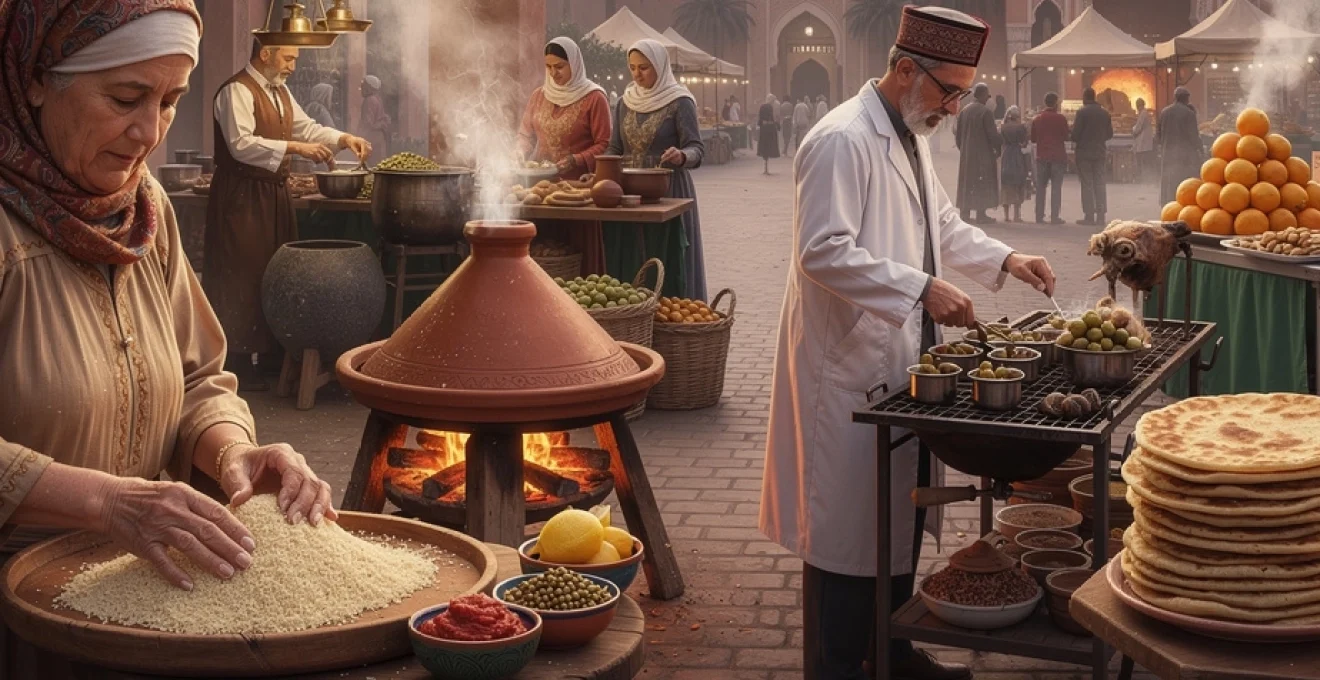
Marrakech stands as a living testament to Morocco’s extraordinary culinary legacy, where ancient cooking techniques continue to flourish amidst the bustling souks and traditional riads. This imperial city has preserved its gastronomic heritage through generations of skilled artisans, from the communal bread ovens of the medina to the sophisticated palace kitchens that once served royalty. The red city’s culinary landscape represents a fascinating convergence of Berber, Arab, and Andalusian influences, creating a distinctive food culture that remains deeply rooted in tradition whilst embracing contemporary innovation.
The significance of Marrakech’s culinary heritage extends far beyond mere sustenance, embodying the social fabric and cultural identity of its inhabitants. Each tagine preparation, every hand-rolled couscous grain, and the intricate spice blending techniques represent centuries of accumulated knowledge passed down through families and communities. This gastronomic tradition continues to thrive in the city’s medina, where time-honoured methods coexist with modern culinary interpretations, creating an authentic yet evolving food scene that captivates both locals and visitors alike.
Traditional moroccan culinary techniques in marrakech’s medina kitchens
The medina of Marrakech functions as a living museum of traditional Moroccan cooking techniques, where ancient methods have been preserved and refined over countless generations. These time-tested approaches to food preparation reflect a deep understanding of ingredient properties, cooking temperatures, and flavour development that modern culinary science continues to validate. The narrow alleys and hidden courtyards of the old city contain kitchens where master cooks still employ techniques that predate contemporary cooking equipment by centuries.
Tagine clay pot cooking methods and temperature control
The iconic conical clay vessels known as tagines represent one of Morocco’s most sophisticated cooking technologies, designed to maximise flavour whilst conserving precious water resources. These earthenware pots utilise a unique steam circulation system where moisture from cooking ingredients condenses on the conical lid and returns to the base, creating a self-basting environment that intensifies flavours whilst maintaining tender textures. Master tagine cooks in Marrakech’s traditional kitchens demonstrate remarkable skill in temperature management, using charcoal placement and clay thickness to achieve precise heat control without modern thermometers.
The seasoning process for new tagines involves specific rituals that prepare the clay for optimal cooking performance, including soaking in water, rubbing with garlic, and gradually heating to prevent cracking. Experienced cooks recognise the subtle changes in steam patterns and aromatic intensity that indicate perfect cooking progression, adjusting heat sources and ingredient timing with intuitive precision. This mastery of tagine cooking represents generations of accumulated knowledge about heat distribution, moisture retention, and flavour concentration techniques.
Preserved lemon and harissa fermentation processes
The art of preserving lemons and fermenting harissa paste demonstrates Marrakech cooks’ mastery of controlled decomposition processes that enhance flavour complexity whilst extending ingredient shelf life. Traditional preserved lemon preparation involves careful salt curing techniques that draw moisture from citrus whilst preventing harmful bacterial growth, creating intensely flavoured condiments that add depth to tagines and couscous dishes. The timing and salt ratios required for successful preservation represent precise knowledge accumulated through generations of trial and refinement.
Harissa fermentation showcases even more complex biochemical processes, where carefully selected chilli varieties undergo controlled fermentation alongside garlic, spices, and salt to develop characteristic heat levels and umami depth. Master harissa makers in the medina guard their specific spice proportions and fermentation timing closely, understanding how environmental factors like humidity and temperature affect the final product’s flavour profile and preservation qualities.
Couscous Hand-Rolling techniques in berber households
The laborious process of hand-rolling couscous from semolina flour represents one of North Africa’s most demanding culinary skills, requiring precise moisture control and rhythmic hand movements to achieve uniform grain size. Traditional Berber families in Marrakech continue this practice using wooden bowls and specialised techniques passed down through maternal lineages, creating couscous with superior texture and flavour compared to machine-produced alternatives. The rolling process involves gradually adding salted water to semolina whilst maintaining constant circular motions that form perfectly sized gr
ains. As the couscous granules increase in volume, they are repeatedly sieved, rested, and steamed over aromatic broths, allowing each grain to absorb flavour without clumping. This meticulous approach to couscous making in Berber households creates a light, almost cloud-like texture that industrial methods simply cannot replicate. For many Marrakchi families, gathering to hand-roll couscous ahead of Friday lunch remains an important ritual that reinforces intergenerational bonds as much as it preserves culinary heritage.
For visitors keen to understand these couscous hand-rolling techniques, several local cooking schools and riads in Marrakech now offer workshops where you can practise under the guidance of home cooks. Watching the experienced hands of a Berber matriarch transform coarse semolina into perfectly aerated couscous is a lesson in patience and precision. You will quickly realise that mastering the right level of moisture is a bit like learning to knead bread dough: too wet and the grains stick, too dry and they crumble. With practice, however, you begin to feel when the semolina reaches the ideal stage, gaining insights that no recipe alone can provide.
Wood-fired communal oven systems at mouassine bakery
The historic Mouassine neighbourhood is home to some of Marrakech’s most renowned ferran, or communal bakeries, where wood-fired ovens still form the backbone of daily bread production. In these traditional spaces, families prepare dough at home before sending children or neighbours to deliver it to the bakery on woven mats or metal trays. Bakers at Mouassine carefully organise each batch, using carved symbols or distinctive scoring patterns to identify which loaves belong to which household, ensuring nothing is misplaced amid the steady flow of bread.
The oven itself is a remarkable piece of culinary engineering, usually built from heat-retaining brick or clay and fuelled with carefully managed wood or olive pits. Skilled bakers control temperature not with dials, but by reading the colour of the embers, the smell of the smoke, and the speed at which test pieces of dough brown. This intuitive temperature control allows them to bake everything from round barley loaves to delicate pastries in a single long firing cycle. For many residents of the medina, the Mouassine communal oven is not just a bakery but a social hub, where news is exchanged, recipes are discussed, and the rhythm of daily life is quite literally baked into the bread.
For travellers interested in heritage food experiences in Marrakech, observing a morning shift at a communal oven provides invaluable insight into how traditional Moroccan cuisine is sustained at community level. You will see how energy-efficient these ovens are compared with individual household ovens, and how shared baking helps reduce fuel consumption in a dense urban environment. It is also a reminder that, in Marrakech, food culture is fundamentally collective rather than individualistic: bread is not simply a product, but the outcome of a neighbourhood-wide collaboration.
Heritage spice markets and artisanal food production networks
Beyond the hidden kitchens of the medina, Marrakech’s culinary heritage is sustained by intricate networks of spice traders, oil producers, olive growers, and beekeepers who supply the city with its essential ingredients. The heritage food markets around the old city, particularly in and around the souks, function as both trading hubs and repositories of ancestral knowledge. Here, you can trace how centuries-old trade routes, cooperative systems, and artisanal practices still shape what ends up on the Marrakchi table today.
Understanding these heritage spice markets and artisanal production networks allows you to see Marrakech not just as a destination for eating, but as a living ecosystem of growers, traders, and craftsmen. From the bright mounds of ras el hanout at Souk el Attarine to the rich argan oil produced by women’s cooperatives, each ingredient carries a story of geography, climate, and human ingenuity. As we explore these elements, you may start to ask yourself: when you taste a tagine, how many invisible hands have contributed to its final flavour?
Souk el attarine’s saffron and ras el hanout trade routes
Souk el Attarine, one of the oldest and most atmospheric sections of the medina, has long been the beating heart of Marrakech’s spice trade. Historically positioned along key caravan routes from the Sahara and the High Atlas, this market connected Marrakchi spice merchants with traders from sub-Saharan Africa, the Middle East, and Europe. Today, the narrow alleys are still lined with jars of carefully layered spices, dried herbs, and medicinal plants that testify to centuries of commercial and culinary exchange.
Among the most prized products in Souk el Attarine is Moroccan saffron, typically sourced from the Taliouine region, where small-scale farmers cultivate crocus flowers by hand at altitudes of 1,200–1,500 metres. The precious threads are sold by the gram, with experienced merchants able to judge quality by colour, aroma, and elasticity. Alongside saffron, many stalls specialise in crafting bespoke blends of ras el hanout, the famous Moroccan spice mix whose name translates roughly as “head of the shop”. Each vendor’s ras el hanout can contain anywhere from 12 to more than 30 ingredients, from cumin and coriander to more unusual additions like dried rosebuds, cubeb pepper, or orris root.
For travellers, Souk el Attarine is an ideal place to deepen your understanding of Moroccan spice culture and heritage food sourcing practices. Asking a spice seller to assemble a blend tailored to tagines, grilled meats, or couscous dishes can feel a bit like commissioning a bespoke perfume: the merchant will ask how you like your food – smoky, aromatic, or hot – before balancing the ingredients accordingly. This interactive process not only results in a unique souvenir, but also offers a practical lesson in how spice ratios shape flavour, giving you new confidence when recreating traditional Marrakchi recipes at home.
Cooperative feminine d’argan oil extraction methods
Argan oil production in the regions surrounding Marrakech is deeply linked to women’s cooperatives known as coopératives féminines, which preserve ancestral extraction techniques while providing vital income for rural communities. Traditionally, Berber women harvested argan nuts from gnarled trees that grow almost exclusively in south-western Morocco, sun-drying them before removing the outer pulp by hand. The hard inner shells are then cracked open between stones to reveal the small kernels, which are lightly roasted for culinary oil or left raw for cosmetic use.
In a typical argan cooperative, women still perform much of this work manually, using stone hand-mills to grind the kernels into a thick paste. This paste is then kneaded with warm water to release the oil, a process that may take several hours and requires both strength and stamina. While some modern cooperatives have introduced mechanical presses to increase output, many continue to combine old and new methods, ensuring that the oil retains its characteristic nutty aroma and rich flavour prized in Moroccan cuisine. Because each litre of argan oil can require 30–40 kilograms of fruit, the product remains one of the most valuable culinary oils in the world.
Visiting a women’s argan cooperative as part of a culinary tour from Marrakech offers more than just a chance to taste fresh argan oil drizzled over amlou (a traditional almond and honey spread). It also provides insight into how heritage food production can support sustainable development and women’s economic empowerment. Many cooperatives are certified fair-trade and follow strict environmental guidelines to protect argan forests, which UNESCO recognises as a biosphere reserve. When you purchase a bottle of argan oil directly from these cooperatives, you are not only taking home a unique ingredient for your Moroccan dishes, but also supporting a production model that helps safeguard both culture and landscape.
Traditional olive processing at menara gardens
The Menara Gardens, just outside central Marrakech, are best known for their reflective pool and views of the Atlas Mountains, yet they also play a significant role in the region’s olive-growing heritage. For centuries, the surrounding groves have supplied olives to local mills, where traditional processing methods turn ripe fruit into oil and preserved table olives. Before modern mechanical presses became widespread, olives were crushed using large stone wheels powered by mules or donkeys, producing a thick paste that was then spread onto woven mats and subjected to pressure to release the oil.
Even today, some small-scale producers near Marrakech maintain elements of these ancestral techniques, particularly when crafting premium, cold-pressed oils for local consumption. The olives are harvested by hand or gently knocked from branches with poles, then sorted to remove damaged fruit before pressing. The resulting oil is decanted slowly to allow natural sedimentation, rather than being aggressively filtered, which helps preserve the complex grassy and peppery notes that characterise high-quality Moroccan olive oil. Alongside oil, brined and spice-marinated olives – flavoured with preserved lemon, garlic, cumin, or paprika – remain an essential accompaniment on Marrakchi tables, served at the start of most meals.
For visitors seeking authentic food experiences in Marrakech, exploring the olive stalls in local markets or joining a guided visit to traditional mills near Menara Gardens can be both educational and enjoyable. You will learn to distinguish between different olive varieties, such as the small, intensely flavoured picholine marocaine and larger, fleshier table olives. Much like tasting wine, sampling several oils side by side helps you recognise subtle differences in bitterness, fruitiness, and finish. This heightened awareness makes it easier to select the right oil for finishing a vegetable tagine, dressing a salad, or simply dipping fresh bread at breakfast.
Berber honey production in atlas mountain apiaries
The Atlas Mountains, visible from Marrakech on clear days, host numerous Berber villages where traditional beekeeping practices produce highly prized honeys. Unlike large-scale industrial apiaries, these mountain operations typically maintain a limited number of hives, allowing bees to forage on diverse wild flora such as thyme, lavender, carob, and carob blossoms. This botanical richness translates into complex, region-specific honey profiles, with some varieties valued not only for their flavour but also for their reputed medicinal properties.
Traditional hives were often made from hollowed tree trunks or woven reeds coated with mud, though many beekeepers now use wooden box hives while maintaining low-intervention methods. Honey is harvested only a few times a year, using smoke to gently calm the bees before combs are removed and pressed. In some areas, raw honey is still strained by hand rather than mechanically filtered, preserving pollen and micro-crystals that contribute to its texture and aroma. Berber families sell their honey at rural souks or to trusted intermediaries who bring it to Marrakech, where it is used in pastries, herbal infusions, and restorative drinks during Ramadan.
For those interested in sustainable food tourism from Marrakech, visiting mountain apiaries or purchasing honey from reputable vendors provides a tangible link between the city’s cuisine and its rural hinterland. You may notice that thyme honey pairs particularly well with goat’s cheese, while eucalyptus honey complements mint tea or yoghurt. Considering the global threats facing pollinators, supporting traditional beekeeping in the Atlas Mountains also carries an environmental dimension: by choosing heritage honey, you help maintain landscapes and practices that are vital for biodiversity in Morocco.
Michelin-recognised restaurants preserving marrakchi gastronomy
While Marrakech’s culinary heritage thrives in home kitchens and street stalls, it is increasingly being championed on the international stage by high-end restaurants recognised by the Michelin Guide and other prestigious listings. Although Morocco currently has no Michelin-starred establishments, several Marrakech restaurants are featured in the Michelin Guide and comparable global rankings for their refined interpretations of traditional dishes. These venues bridge the gap between palace-style cuisine and contemporary gastronomy, proving that heritage recipes can shine in formal, destination-dining settings.
In many of these restaurants, chefs draw directly on classical Marrakchi dishes such as lamb mrouzia, pigeon pastilla, or seven-vegetable couscous, while refining presentation and technique to meet modern expectations. Slow-cooked meats may be prepared sous-vide before being finished in clay pots, and spice blends are measured with laboratory precision to ensure consistency of flavour. Yet the essence of Marrakchi gastronomy remains intact: long cooking times, generous use of herbs and spices, and a focus on convivial dining. For visitors wondering where to taste “elevated” Moroccan food in Marrakech, these Michelin-recognised addresses offer a curated introduction without losing authenticity.
Many of these establishments also play an important role in safeguarding culinary knowledge by offering apprenticeships and training programmes for young Moroccan cooks. By learning both classical French techniques and ancestral Moroccan methods, the next generation of chefs becomes fluent in multiple culinary languages. This dual expertise enables them to innovate responsibly, whether by introducing vegetarian tasting menus based on traditional legumes or by reimagining festive dishes in lighter, health-conscious formats. For travellers, dining in these restaurants is not only a treat for the senses but also an opportunity to support institutions actively preserving and reinterpreting Marrakchi food heritage.
Street food culture and jemaa el-fnaa’s culinary heritage
No exploration of heritage food in Marrakech would be complete without delving into the vibrant street food culture centred on Jemaa el-Fnaa, the city’s legendary main square. As dusk falls, this UNESCO-recognised cultural space transforms into a vast open-air dining hall, where smoke from grills mingles with the sounds of storytellers, musicians, and hawkers. Here, simple cooking equipment and age-old recipes come together to produce some of the most memorable dishes you can taste in the city, often at modest prices.
What makes Jemaa el-Fnaa’s culinary heritage so compelling is not only the variety of food on offer but also the way vendors pass down their trade from parent to child. Many stalls have been run by the same families for decades, if not longer, and each specialises in a narrow range of dishes honed over years of repetition. Whether you are trying snail broth, charcoal-grilled skewers, or freshly squeezed orange juice, you are participating in a living tradition where performance, hospitality, and flavour are inseparable. The square can feel overwhelming at first, but with a little guidance, it becomes one of the most rewarding places to explore traditional Marrakchi flavours.
Escargot preparation techniques at traditional food stalls
Among the most distinctive offerings in Jemaa el-Fnaa are the simmering pots of escargots, or snails, which draw curious visitors and loyal local customers alike. Unlike French-style garlic butter preparations, Moroccan escargots are cooked in an aromatic broth infused with a complex combination of herbs and spices. Common additions include anise, thyme, mint, liquorice root, and sometimes a touch of chilli, creating a broth that is both restorative and highly perfumed. For many Marrakchis, sipping this hot, spiced liquid is as important as eating the snails themselves, particularly on cool evenings.
Street vendors usually source their snails from rural suppliers, who gather them after rainfall when they emerge in abundance. Before cooking, the snails are purged and thoroughly rinsed to remove impurities, a crucial step that affects both flavour and safety. The cooking process can last several hours, during which the vendor monitors the simmering pot and periodically skims the surface to maintain clarity of the broth. Eating escargots at these stalls is an informal ritual: you are handed a small bowl and a toothpick, then left to extract each snail and sip the fragrant liquid. If you are unsure whether to try them, consider starting with the broth – you may find it surprisingly comforting, like a Moroccan herbal tea with added depth.
Msemen and rghaif flatbread artistry
Another highlight of Marrakech’s street food culture is the artistry involved in making msemen and rghaif, two closely related layered flatbreads. Typically prepared on metal griddles at small stalls or hole-in-the-wall bakeries, these breads are made from a simple dough of flour, semolina, water, and a little oil or butter. The magic lies in the shaping: dough portions are stretched into paper-thin sheets, then folded repeatedly into squares or coils, with each layer brushed with fat to create a crisp, flaky texture. Watching a skilled vendor at work can feel like observing a calligrapher, each movement fluid and precise.
Msemen is usually shaped into neat squares and often served plain or with honey for breakfast, while rghaif can be round, coiled, or stuffed with savoury fillings such as onions, minced meat, or spiced vegetables. In Jemaa el-Fnaa and smaller neighbourhood squares, you will often see locals grabbing a hot msemen and a glass of mint tea as a quick snack between errands. If you want to sample these breads at their very best, look for stalls where the dough is being rolled and cooked continuously; the faster the turnover, the fresher the product. Trying to reproduce msemen at home later can be a fun challenge: as with puff pastry, mastering the layering technique is key, but even imperfect attempts are delicious.
Sheep’s head and offal cooking methods
For more adventurous eaters, the sheep’s head and offal stalls around Jemaa el-Fnaa offer a direct encounter with nose-to-tail Moroccan cuisine. These vendors specialise in parts of the animal that were too precious to waste in traditional households, transforming them into delicacies through careful cleaning, slow cooking, and judicious spicing. Sheep’s heads are typically seasoned and then either roasted in underground pit ovens or simmered until the meat becomes meltingly tender. Once cooked, the vendor deftly carves the cheeks, tongue, and other prized morsels to order, serving them with cumin, salt, and sometimes a squeeze of lemon.
Offal, including liver, heart, and kidneys, is often skewered and grilled over charcoal, providing rich, smoky flavours that pair well with freshly baked bread. Some stalls also prepare tanjia-style dishes using tripe or other innards, slow-cooked in earthenware pots with preserved lemon and spices. For many locals, these foods are not exotic but everyday fare linked to specific occasions, such as Eid al-Adha or family celebrations. If you are curious but hesitant, you might start with liver skewers wrapped in caul fat – a classic Marrakchi street snack that offers a gentler introduction to offal through familiar grilled-meat aromas and textures.
Fresh orange juice pressing and serving rituals
The line of orange juice stands bordering Jemaa el-Fnaa is one of the square’s most recognisable sights, with vendors stacking fruit into geometric displays and calling out to passers-by. Morocco is a major producer of citrus, and the oranges grown in regions around Marrakech and further north are renowned for their sweetness and juiciness. At these stalls, whole oranges are pressed to order using simple mechanical juicers, ensuring that your glass is filled with juice that has not been diluted or stored. The speed and rhythm of the pressing – slice, press, pour – becomes a performance in itself, especially during busy evenings.
There are also unwritten rules and rituals around how fresh orange juice is served and enjoyed. Many stands offer the option of a small or large glass, with refills sometimes included at the vendor’s discretion, particularly for regular customers. Some stalls sell blends with grapefruit or other citrus varieties, while others specialise in pure orange juice, maintaining a reputation for quality by refusing to add ice or water. When choosing where to buy, look for stalls frequented by locals and those that keep their equipment visibly clean; this simple rule of thumb will help you enjoy the experience with confidence. As you sip your juice while watching the square’s swirling activity, you participate in a daily ritual that marries local agriculture with urban street culture in the most refreshing way.
Palace cuisine legacy from saadian and alaouite dynasties
Marrakech’s rich food culture owes much to its history as an imperial capital under dynasties such as the Saadians and Alaouites, whose courts elevated cooking to an art form. In their palace kitchens, teams of specialised chefs, pastry makers, and butchers crafted elaborate banquets that showcased both local ingredients and imported luxuries arriving via caravan and maritime routes. These lavish meals were designed not only to feed, but also to impress visiting dignitaries and reinforce the ruler’s prestige, with courses that could stretch over many hours and include dozens of distinct dishes.
Many iconic Moroccan recipes can trace their origins or refinement to this palace context. Sweet-and-savoury combinations, such as pigeon pastilla dusted with icing sugar and cinnamon or lamb slow-cooked with prunes and almonds, reflect a courtly taste for complexity and contrast. The careful use of orange blossom water, rosewater, and saffron in desserts and festive dishes also speaks to an era when rare aromatics signalled wealth and cosmopolitan connections. Today, while modern households tend to reserve such labour-intensive recipes for weddings and major celebrations, their influence is evident in the way Marrakchi families think about hospitality: a generous, beautifully presented meal remains one of the highest forms of honouring a guest.
Traces of palace cuisine are still visible in the architectural remains of Saadian tombs and restored riads, where spacious courtyards once hosted formal feasts. Some contemporary heritage hotels and restaurants in Marrakech have consciously revived elements of dynastic menus, offering tasting experiences inspired by historical sources. These might include multi-course dinners beginning with a selection of cooked salads, followed by intricately spiced meat and poultry dishes, and concluding with pastries, seasonal fruits, and mint tea. For culinary travellers, seeking out these experiences provides a window into how power, aesthetics, and food intersected in pre-modern Morocco, and how those legacies continue to shape the city’s gastronomic identity today.
Contemporary chefs revitalising traditional marrakchi recipes
In recent years, a new generation of chefs in Marrakech has begun to reinterpret traditional recipes in ways that respect their roots while adapting them to changing tastes and lifestyles. Many of these culinary innovators trained abroad before returning to Morocco, bringing with them techniques from French, Nordic, or Asian kitchens that they now apply to local ingredients. The result is a dynamic food scene where you might find a classic lamb tagine paired with seasonal vegetables from organic farms, or a deconstructed pastilla that preserves the original flavours but presents them in a surprising new format.
One of the most notable trends is the rise of plant-forward and health-conscious interpretations of Marrakchi cuisine, responding to global interest in Mediterranean-style diets. Chefs highlight pulses, whole grains, and vegetables – all long-standing pillars of Moroccan home cooking – in refined dishes that appeal to both locals and international visitors. You might encounter couscous made from barley or spelt, topped with slow-roasted root vegetables and a light saffron broth, or shakshuka enriched with preserved lemon and fresh herbs. These innovations demonstrate that the essence of Marrakech’s food heritage lies not in rigid adherence to the past, but in its ability to evolve.
Contemporary chefs in Marrakech are also playing a key role in promoting sustainable sourcing and ethical practices within the city’s hospitality sector. Many partner directly with small-scale producers of argan oil, saffron, olives, and honey, ensuring that their menus reflect the seasonal rhythms and regional diversity of Moroccan agriculture. Some organise pop-up dinners or workshops that invite diners into the creative process, explaining the history of each dish and the provenance of its ingredients. As you explore Marrakech’s restaurants, riads, and cooking schools, you will notice that the most memorable experiences often arise where old and new meet – when a familiar spice blend is used in an unexpected way, or a childhood street snack appears reinvented as a refined appetiser.
For travellers eager to deepen their connection with Marrakchi cuisine, seeking out these contemporary interpretations can be as illuminating as tasting the most traditional versions of each dish. Trying both allows you to appreciate the full spectrum of the city’s culinary heritage, from humble communal ovens to polished dining rooms. Ultimately, what unites all of these experiences is a shared respect for the ingredients, techniques, and stories that have shaped Marrakech over centuries – a living heritage that continues to evolve with every cook who stirs a pot or fires up a grill in the red city.