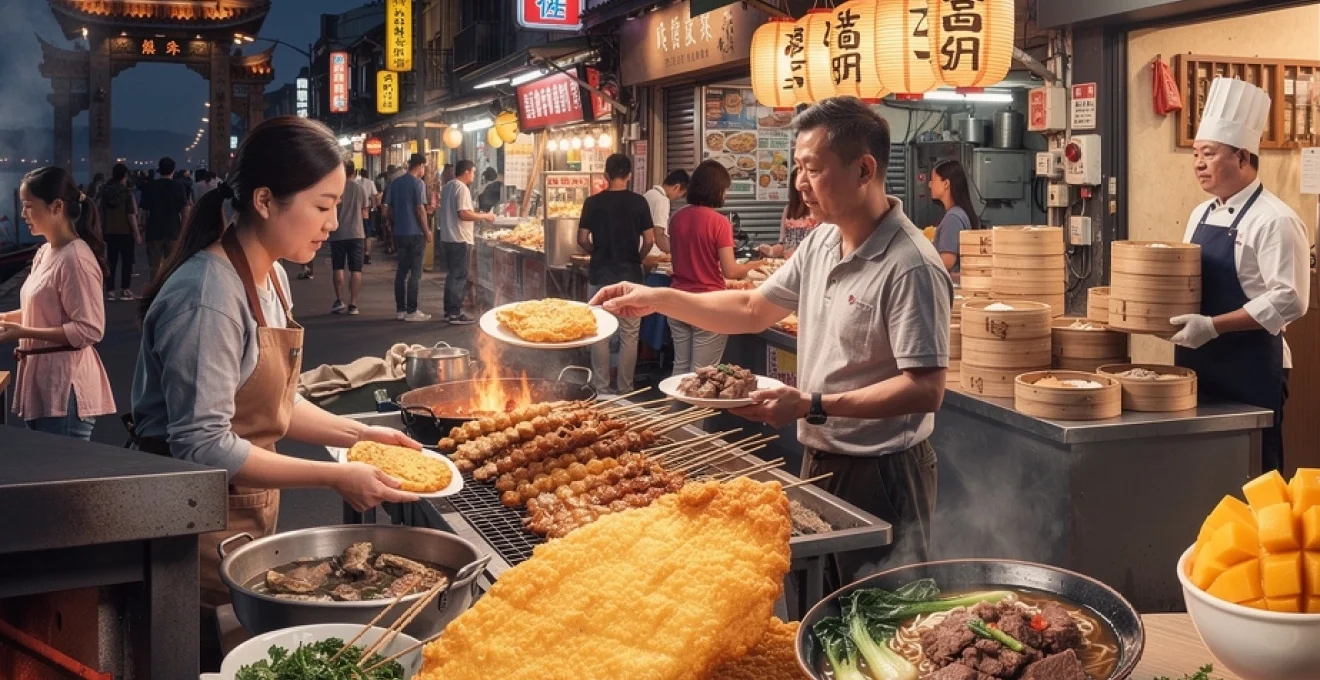
# Street Bites and Night Markets in Taipei
Taipei’s night markets represent one of Asia’s most vibrant culinary phenomena, where centuries-old food traditions collide with contemporary innovation under neon-lit skies. These bustling nocturnal bazaars serve as the beating heart of Taiwanese food culture, offering everything from ancestral recipes passed down through generations to experimental fusion creations that push culinary boundaries. With over 20 major night markets scattered across the capital, Taipei presents an almost overwhelming array of options for food enthusiasts seeking authentic street food experiences. The sheer density of vendors, combined with the theatre of open-air cooking and the intoxicating aroma of sizzling meats and fermented delicacies, creates an atmosphere that transcends mere dining—it becomes a cultural immersion into Taiwan’s gastronomic soul.
Shilin night market: taiwan’s largest nocturnal food destination
Established in 1899, Shilin Night Market holds the distinction of being Taiwan’s oldest and most expansive night market, sprawling across multiple city blocks in the Shilin District. This legendary food destination attracts approximately 80,000 visitors daily, making it not only a culinary landmark but also a significant economic driver for the local community. The market’s architecture divides into two distinct zones: the underground food court housing over 500 dedicated food stalls, and the surrounding street-level area featuring an additional 200-300 vendors selling clothing, accessories, and carnival-style games alongside supplementary food options.
The underground food court, renovated in 2011, provides a more organized and climate-controlled environment compared to the chaotic energy of street-level operations. This subterranean dining hall operates with a sophisticated ventilation system designed to manage the intense smoke and steam generated by hundreds of simultaneous cooking operations. The layout follows a grid pattern with clearly marked aisles, though first-time visitors frequently report feeling disoriented by the sheer volume of choices presented at every turn. Food stall density reaches approximately 12 vendors per 100 square metres, creating one of the highest concentrations of dining options anywhere in the world.
Iconic stalls at the shilin underground food court
Among the underground food court’s most celebrated vendors, several have achieved near-legendary status through decades of consistent quality. The Shilin Sausage stalls produce the quintessential Taiwanese sausage—a slightly sweet, garlicky pork sausage with a distinctive snap when bitten. These sausages contain a higher sugar content than their Western counterparts, resulting in caramelization during grilling that creates complex flavour profiles balancing savoury, sweet, and umami notes. Many vendors offer the « big sausage wrapping small sausage » variation, where sticky rice formed into a bun-like shape encases the traditional pork sausage, creating a carbohydrate-heavy but satisfying meal.
Stinky tofu vendors occupy dedicated sections of the food court, their pungent offerings segregated to minimize olfactory interference with neighbouring stalls. The fermentation process for authentic stinky tofu typically spans several months, during which the tofu absorbs the complex bacterial cultures that produce its characteristic aroma—often compared to aged cheese or unwashed feet by Western visitors. Despite the challenging smell, stinky tofu remains one of Taiwan’s most beloved street foods, with consumption rates exceeding 15 million servings annually across the island.
Oyster omelettes and hot star large fried chicken at shilin
The oyster omelette, known locally as o-a-chian, represents a fundamental component of Taiwanese night market cuisine. This dish combines fresh oysters with eggs, sweet potato starch, leafy vegetables, and a distinctive pink sauce made from tomato paste, chilli sauce, and other proprietary ingredients that vary by vendor. The sweet potato starch creates a gelatinous texture that Western palates sometimes find unusual, but this consistency is precisely what Taiwanese diners seek. Premium versions incorporate larger, plumper oysters sourced from Taiwan’s western coastal aquaculture operations, where oyster farming has been practiced for over three centuries.
Hot Star Large Fried Chicken achieved international fame by offering chicken cut
cutlets the size of a human face, pounded thin, marinated in a proprietary blend of soy, garlic, and spices, then dredged in a fine sweet potato flour before deep-frying. At Shilin, queues for Hot Star often snake around the corner, with wait times of 10–20 minutes during peak hours. The result is a sheet of chicken with a shatteringly crisp crust and juicy interior, often dusted with chilli, seaweed, or plum powder. Nutritionally, it is an indulgence rather than an everyday meal, but as a quintessential Taiwanese street bite, it is difficult to skip on your first visit. If you are sharing, ask the vendor to cut it into bite-sized strips to make it easier to eat as you walk.
Many travellers pair Hot Star with other classic Shilin dishes, creating an informal tasting menu as they navigate the underground maze. One effective strategy is to split portions among two or three people so that you can sample more famous stalls without reaching “food fatigue” too early in the evening. You will notice that most vendors at Shilin have laminated certificates or newspaper clippings on display; while these endorsements can be useful, long queues and a high turnover of food are often more reliable indicators of quality and freshness. For those concerned about hygiene, Shilin’s underground court is subject to regular inspections, and vendors are required to display permits, a practice that has helped maintain consumer confidence even as visitor numbers rise.
Navigating shilin’s old and new market sections
Shilin Night Market today can be conceptually divided into two primary zones: the “new” underground food court directly adjacent to Jiantan MRT Station, and the “old” street market area weaving through lanes such as Wenlin Road, Dadong Road, and Danan Road. The underground section focuses heavily on prepared food and snacks, while the older street-level lanes retain more of the market’s traditional character, with stalls selling clothing, accessories, mobile phone cases, and carnival games alongside food carts. If your priority is sampling as many iconic Taipei street foods as possible, it makes sense to begin in the underground zone, then emerge to wander the more atmospheric alleyways. Think of the underground food court as a tightly curated buffet, and the surrounding streets as the “after-dinner” stroll where you continue grazing.
First-time visitors often underestimate how easy it is to become disoriented here, especially because many entrances and exits look similar. A simple way to orient yourself is to use Jiantan MRT Station as your anchor point; most signboards and directional arrows reference the station, and you can always navigate back by following the heaviest pedestrian flow. Another useful tip is to mentally divide your exploration into quadrants, focusing on one cluster of streets at a time rather than zigzagging randomly. This approach not only reduces backtracking but also helps you notice subtle differences between sections, from the student-focused fashion stalls to family-oriented game areas with ring tosses and balloon darts.
Peak hours and crowd management strategies at shilin
Shilin’s peak hours typically run from 7:00 p.m. to 10:00 p.m., when both tourists and local residents arrive after work or school. During weekend evenings and public holidays, pedestrian density can exceed 20,000 people per hour in the core blocks, creating conditions that some visitors liken to a slow-moving river of bodies. If you are crowd-averse, consider arriving right at opening time around 4:30–5:00 p.m., when vendors are already cooking but aisles remain wide open, or come later in the evening after 10:30 p.m. when lines shorten significantly. The trade-off, of course, is that a few smaller stalls may sell out or close earlier, especially on weekdays.
To manage the crowds effectively, treat your visit like a short expedition: wear comfortable shoes, keep valuables secure in a front-facing bag, and carry a small pack of tissues or wet wipes for impromptu dining. Rather than stopping abruptly in the middle of a busy aisle to take photos or deliberate on what to eat, move to the side to avoid disrupting the flow. You will also notice that seasoned visitors often adopt a “scout and regroup” strategy, where one person holds a place in line while another member of the group explores nearby stalls. While it may feel chaotic at first, Shilin’s organised bustle quickly becomes part of its charm, and navigating it can feel almost like learning the rhythm of a new city.
Raohe street night market: traditional fuzhou pepper buns and temple culture
Raohe Street Night Market offers a more linear and traditional alternative to Shilin’s sprawling complexity. Stretching for roughly 600 metres along Raohe Street in Songshan District, this market is framed at one end by the ornate Ciyou Temple, a multi-storey Mazu temple whose intricate carvings and lanterns set the tone for the entire experience. Unlike Shilin’s multi-block sprawl, Raohe is essentially a straight corridor of food, clothing, and game stalls, which makes it easier for first-time visitors to navigate without constantly checking maps. The atmosphere here feels slightly more old-world, with a focus on classic Taiwanese snacks rather than experimental fusion dishes.
Because of its more compact layout and strong temple presence, Raohe is ideal for travellers interested in understanding how religion, daily life, and street food intersect in Taipei. As dusk falls, worshippers light incense at Ciyou Temple while just metres away vendors fire up charcoal grills and oil-filled woks. This juxtaposition is not accidental; many night markets in Taiwan historically grew from temple fairs, where worshippers needed convenient food after making offerings. At Raohe, you can still feel this origin story in the way traffic flows from the temple gates directly into the market’s main artery, blending pilgrimage with pleasure in a uniquely Taiwanese way.
Fuzhou ancestor temple and its culinary influence
Although Ciyou Temple is the most visually striking landmark at Raohe, the market’s culinary identity also reflects the influence of Fuzhou migrants from mainland China’s Fujian Province. These communities brought with them a repertoire of snacks and baking techniques that evolved into some of Taipei’s most iconic night market dishes. The notion of encasing seasoned meat in a sturdy, tandoor-baked dough shell, for instance, can be traced back to Fujianese and Fuzhou traditions of savoury pastries baked in clay ovens. Over time, these recipes adapted to local Taiwanese tastes, incorporating different spice blends, cuts of pork, and baking temperatures.
This migration-driven culinary heritage is why Raohe is often celebrated as the spiritual home of Taiwan’s most famous pepper bun style. Food historians note that pepper buns at Raohe began gaining city-wide fame in the 1980s and 1990s, parallel to Taiwan’s rapid urbanisation and the rise of domestic food tourism. As internal travellers began visiting Taipei not just for work but also for leisure, Raohe’s Fuzhou-influenced snacks became a must-try experience, much like how New York’s pizza or Tokyo’s ramen came to symbolise their respective cities. When you bite into a freshly baked pepper bun at Raohe, you are tasting not just a snack but the accumulated history of cross-strait migration and adaptation.
Signature raohe vendors: yaoji pepper bun and medicinal rib soup
The single most famous vendor at Raohe is the pepper bun stall often romanised as Fuzhou Shizu Hujiao Bing, easily identifiable by its queue and circular clay ovens lined with buns. Known colloquially as Yaoji Pepper Bun by some locals, this stall specialises in hand-formed buns stuffed with marinated pork and scallions, rolled in sesame seeds, and slapped onto the side of a cylindrical oven similar to those used for baking naan. The resulting pastry has a blistered, crisp exterior that contrasts with the juicy, pepper-forward pork filling inside. Because each batch takes time to bake, the line can move slowly, but the high turnover ensures that you are almost always served a bun fresh from the oven.
Another signature category of street food at Raohe is medicinal rib soup, often advertised with signboards featuring the characters for “herbal” (藥膳) or “tonic” (補湯). These soups, simmered with pork ribs, goji berries, angelica root, and other Chinese medicinal herbs, are prized for their supposed restorative properties, especially during the cooler months. While the flavour profile leans slightly bitter and aromatic compared to Western-style broths, the collagen-rich ribs and warming spices make for a deeply comforting bowl. For many visitors, pairing a pepper bun with a small bowl of medicinal rib soup creates a satisfying meal that balances rich, baked dough with nourishing broth.
Accessing raohe via songshan MRT station
Reaching Raohe Street Night Market is straightforward thanks to Taipei’s efficient MRT system. The most convenient access point is Songshan Station on the Green Line (Songshan–Xindian Line); simply take Exit 5 and follow the clearly marked signs for about five minutes to reach the temple gate that marks the market’s main entrance. Because Songshan is a terminal station, trains tend to be less crowded when arriving from central Taipei, especially if you avoid commuting rush hours around 6:00–7:30 p.m. If you are staying near Ximending or Taipei Main Station, you can expect the journey to take around 20–25 minutes.
For those exploring multiple night markets in one evening, it is technically possible to combine Raohe with nearby Xinyi District attractions such as Taipei 101, either by MRT transfer or short taxi ride. However, given how dense the eating experience can be, many travellers find it more enjoyable to dedicate an entire evening to Raohe alone. Public transport runs late enough that you do not need to worry about getting stranded; the MRT typically operates until around midnight, and buses and taxis remain widely available after that. As always in Taipei night markets, carrying small-denomination cash (NT$100 notes and coins) will make transactions smoother, as many stalls do not accept cards.
Ningxia night market: concentrated traditional taiwanese snack hub
Ningxia Night Market, located in Taipei’s Datong District, occupies a relatively short stretch of Ningxia Road, yet packs a remarkable density of traditional snacks into its modest footprint. Often described as a “greatest hits” compilation of Taiwanese street food, this market is especially popular with local families and older residents who appreciate its nostalgic flavours and manageable scale. Unlike Shilin’s sprawling labyrinth or Raohe’s tourist-heavy corridor, Ningxia feels more intimate; the central pedestrian lane is flanked by facing rows of stalls, with some permanent shopfronts providing additional seating and specialty foods. In terms of atmosphere, it sits somewhere between a community gathering space and an open-air food court.
What makes Ningxia particularly attractive for food-focused travellers is its reputation for quality and consistency. Several vendors here have been recognised by the Michelin Guide’s Bib Gourmand list in recent years, including stalls specialising in braised pork rice (lu rou fan), oyster vermicelli, and taro desserts. Because the market is only a 10–15 minute walk from Taipei Main Station, it is also one of the most convenient night markets to slot into a short itinerary. If you are looking for a place to methodically sample traditional Taiwanese snacks—without having to walk kilometres between stalls—Ningxia is arguably your best option.
Yongkang street dining district: artisan eateries and din tai fung’s xiaolongbao legacy
While not a night market in the strict sense, Yongkang Street has evolved into one of Taipei’s premier dining districts, renowned for its concentration of restaurants, dessert shops, and artisan tea houses. Located in the Da’an District and easily accessible from Dongmen MRT Station, this area is ideal if you want to experience Taipei street food culture in a slightly more relaxed, sit-down environment. Here, instead of temporary stalls, you will find established eateries that specialise in particular dishes, from beef noodle soup and xiaolongbao to mango shaved ice and handcrafted pastries. The vibe is more café-lined boulevard than crowded bazaar, yet the same spirit of culinary exploration pervades every block.
Yongkang Street’s evolution mirrors broader trends in Taipei’s food scene: a gradual shift from purely functional street-side eating to an emphasis on ambience, presentation, and service. For travellers, this means you can enjoy street food–inspired dishes with air conditioning, proper seating, and the option to linger over tea or dessert. At peak dining hours, especially on weekends, sidewalks here can be just as bustling as any night market, with queues forming outside famous institutions. If you enjoy combining food with boutique shopping and people-watching, Yongkang Street offers a complementary experience to the more chaotic night markets.
Din tai fung flagship location and michelin recognition
The most internationally famous name on Yongkang Street is undoubtedly Din Tai Fung, whose original shop on Xinyi Road near Yongkang evolved from a modest cooking oil business into a global dumpling empire. Although the company now operates numerous branches across Taipei and abroad, many enthusiasts still consider the flagship location a pilgrimage site for xiaolongbao (soup dumplings). Here, you can watch teams of chefs in the open kitchen meticulously weigh and fold each dumpling to achieve the brand’s signature 18 pleats, a level of precision that has become almost symbolic of Taiwanese culinary craftsmanship. Din Tai Fung’s Hong Kong outlets have earned Michelin stars, and while the Taipei branches are frequently recommended in guides rather than formally starred, the overall standard remains high.
Dining at Din Tai Fung is a markedly different experience from grabbing dumplings at a night market stall. The broth-filled dumplings arrive in bamboo steamers, each dumpling delicately translucent, with instructions on how to mix the perfect ratio of soy sauce, vinegar, and ginger provided on the menu. Waiting times can stretch to an hour or more during peak periods, but the restaurant operates an efficient number system that allows you to browse Yongkang Street while your table approaches. If you are curious about how traditional dim sum techniques have been elevated into a global brand, this is an excellent place to observe that evolution first-hand.
Smoothie house and mango shaved ice specialists
Just a short walk from Din Tai Fung, you will find several dessert shops specialising in mango shaved ice, the most famous of which is often referred to simply as Smoothie House. This towering dessert typically features a base of finely shaved ice—closer in texture to snow than standard ice chips—crowned with generous cubes of ripe mango, condensed milk, and sometimes mango sorbet or panna cotta. During Taiwan’s sweltering summer months, when temperatures frequently exceed 30°C with high humidity, these towering bowls offer a refreshingly sweet way to cool down. Because portions are large, they are ideal for sharing among two or three people.
Yongkang’s shaved ice shops illustrate how seasonal Taiwanese fruit is seamlessly integrated into contemporary dessert culture. While mango is the undisputed star from late spring through early autumn, you will also see variations featuring strawberries, kiwifruit, and passionfruit depending on the time of year. Compared to ice desserts at night markets, these sit-down versions usually feature more elaborate toppings and higher-quality fruit, reflecting their slightly higher price point. If you want to understand why “mango shaved ice in Taipei” has become a long-tail search query in many travel forums, Yongkang Street is the most reliable place to experience a benchmark version of the dish.
Beef noodle soup at yong kang beef noodles
No exploration of Yongkang Street would be complete without mentioning beef noodle soup, Taiwan’s unofficial national dish. Yong Kang Beef Noodles, one of the area’s most renowned establishments, has drawn locals and tourists alike for decades with its rich, slow-simmered broths and tender chunks of beef shank. The restaurant typically offers both braised (hong shao) and clear broth (qing dun) versions, catering to different preferences for spice and depth of flavour. Bowls arrive generous in size, with thick, chewy wheat noodles that hold up well in the robust broth—a far cry from the instant noodle versions you may have encountered elsewhere.
What sets Yong Kang Beef Noodles apart is its unwavering focus on this single, comfort-food classic. In a way, the restaurant functions like the sit-down counterpart to a specialised night market stall, perfecting one dish over time rather than diversifying its menu. For many visitors, a bowl of beef noodle soup here becomes a reference point against which all other versions in Taiwan are compared. If you are mapping out a food-focused itinerary, you could easily spend an afternoon moving from beef noodles to xiaolongbao to shaved ice, experiencing how Yongkang Street condenses a cross-section of Taiwanese culinary culture into just a few walkable blocks.
Boutique tea houses and pineapple cake purveyors
Beyond its flagship restaurants, Yongkang Street is also home to a number of boutique tea houses and pastry shops that specialise in Taiwanese oolong tea and pineapple cakes. These establishments often position themselves at the intersection of tradition and design, offering tasting flights of high mountain oolongs in minimalist interiors that would not look out of place in Tokyo or Copenhagen. Staff are usually happy to explain differences between varieties such as Alishan, Dong Ding, and Oriental Beauty, helping you select teas based on aroma, oxidation level, and brewing style. For travellers, this is an ideal setting to slow down after the sensory overload of night markets and reflect on the more meditative side of Taiwanese gastronomy.
Pineapple cakes, meanwhile, have evolved from simple holiday treats into carefully branded souvenirs, with many shops emphasising their use of real pineapple rather than cheaper winter melon fillers. Some bakeries on and around Yongkang Street offer tasting samples, allowing you to compare crumb texture, filling sweetness, and overall balance before committing to a gift box. Think of these tea and pastry boutiques as the “take-home” component of Taipei’s food culture, transforming ephemeral street bites into tangible memories you can share with friends and family. If you have ever wondered what to bring back from Taipei that truly reflects the city’s flavours, high-quality tea and pineapple cakes are difficult to beat.
Tonghua night market: local residential market character and stinky tofu varieties
Tonghua Night Market, also known as Linjiang Street Night Market, lies within a largely residential area of Da’an District, just a short distance from the gleaming skyscrapers of Xinyi and Taipei 101. This proximity makes Tonghua an appealing option for travellers staying in central Taipei who want a more local night market experience without venturing far from major attractions. Compared to Shilin or Raohe, Tonghua feels more like a neighbourhood market where nearby residents come to pick up dinner, buy fresh produce, or enjoy a casual evening stroll. Food here tends to be slightly less theatrical and more functional, with many stalls specialising in dishes that locals might eat several times a week.
One of Tonghua’s defining features is its impressive range of stinky tofu offerings, from deep-fried cubes served with pickled cabbage and chilli sauce to softer, braised versions simmered in herbal broths. Because the surrounding area attracts fewer tour groups, vendors here are often more willing to customise spice levels or explain the fermentation process if you show genuine curiosity. Prices are also generally a bit lower than at the more tourist-heavy markets, reflecting its role as a daily resource for nearby residents. If you want to taste how stinky tofu and other classic Taipei street foods are enjoyed in a more everyday context, Tonghua is an excellent choice.
Seasonal specialities and regional taiwanese ingredients in taipei street food
Beyond individual markets, one of the most rewarding aspects of exploring street bites in Taipei is noticing how vendors incorporate seasonal and regional Taiwanese ingredients into their menus. Taiwan’s varied geography—from the cool, misty highlands of Alishan to the subtropical coasts of Taitung and Pingtung—produces an astonishing diversity of fruits, vegetables, grains, and seafood. Many of these ingredients appear in humble, affordable forms at night markets long before they are highlighted on fine dining menus. If you return to Taipei at different times of the year, you will likely encounter new limited-time snacks, much like how farmers’ markets in Europe or North America shift offerings with the seasons.
This dynamic interplay between seasonality and street food means that no two visits to the same night market are exactly alike. One month you may find stalls spotlighting bamboo shoots and young ginger, while another month features taro, sweet potato, or pomelo-inspired treats. For food travellers who enjoy the thrill of discovery, this evolving landscape can feel a bit like following a favourite band on tour—you recognise the core “set list” of classic dishes, but the special additions keep each performance fresh. Paying attention to these seasonal touches is one of the best ways to deepen your understanding of Taiwanese culinary culture beyond its most famous icons.
Tamsui fish ball soup and danshui river seafood integration
On Taipei’s northern fringe, the riverside district of Tamsui (Danshui) offers a compelling example of how local ingredients shape regional street food. Historically a key port at the mouth of the Tamsui River, this area developed a robust seafood culture, with fish balls (yu wan) becoming one of its most recognisable specialties. Tamsui fish balls are typically made from finely minced fish paste beaten until elastic, then filled with minced pork or mushroom and served in a clear, lightly seasoned broth. The texture is bouncy rather than flaky, a characteristic that may surprise visitors accustomed to Western-style fish cakes.
While Tamsui Old Street is distinct from Taipei’s central night markets, many vendors in the city proudly advertise that their fish balls or seafood skewers are sourced from Tamsui or the wider Danshui River estuary. You might see signs indicating “Tamsui-style” or “Danshui-flavour,” signalling a connection to this coastal heritage. In this way, even when you are eating seafood in a landlocked night market like Ningxia, you are indirectly tasting products of Taipei’s broader maritime ecosystem. For those with more time, a half-day excursion to Tamsui pairs well with evening visits to inner-city markets, allowing you to compare how the same ingredients are presented across different settings.
Hakka lei cha and indigenous Millet-Based dishes
Beyond Han Chinese influences, Taipei street food increasingly reflects the culinary contributions of Hakka communities and Taiwan’s Indigenous peoples. Hakka lei cha, sometimes translated as “thunder tea,” is a prime example: a savoury, nutrient-dense bowl combining ground tea leaves, nuts, seeds, and grains with rice and assorted vegetables. While traditionally associated with rural Hakka villages, simplified versions of lei cha have appeared at urban night markets and food courts, often marketed as a wholesome alternative to heavier fried snacks. The dish’s complex, slightly herbal taste can be an acquired one, but it offers a fascinating glimpse into how tea functions as both beverage and food in Taiwanese culture.
Indigenous Taiwanese cuisines, particularly from Austronesian groups such as the Amis, Atayal, and Paiwan, are also gaining visibility in Taipei’s street food landscape. Millet, once a staple grain before rice became dominant, features in dishes such as millet mochi, millet wine, and steamed millet cakes sweetened with local honey. While these dishes are still less common than pork sausages or bubble tea, you may encounter them at cultural festivals or special pop-up stalls within larger markets. Trying these millet-based foods is akin to sampling heirloom grains at a farmers’ market—it connects you to older layers of the island’s food history that predate modern urbanisation.
Seasonal fruit integration: wax apple, sugar apple, and longan applications
Taiwan’s fruit stands are legendary, and night markets make full use of this abundance, particularly when it comes to lesser-known tropical fruits such as wax apple, sugar apple, and longan. Wax apples, with their bell-like shape and crisp, mildly sweet flesh, are often sold sliced and chilled in takeaway cups, providing a refreshing counterpoint to rich fried foods. Sugar apples (also known as custard apples) have a creamy, segmented interior that is sometimes incorporated into smoothies or dessert toppings, though more often you will see them sold whole at surrounding produce stalls. Longans, small and translucent with a musky sweetness, appear dried in herbal teas or fresh on skewers, especially during their late summer and early autumn peak.
For visitors accustomed to apples, oranges, and bananas, these fruits can feel as novel as any exotic dish, yet they slip seamlessly into the rhythm of Taipei’s snack culture. Some dessert vendors experiment with integrating seasonal fruit into shaved ice, crepes, or even savoury salads, reflecting a broader trend toward lighter, fruit-forward options alongside traditional sweets. Paying attention to which fruits dominate stalls at different times of year is an engaging way to track the seasons while travelling—much like watching which vegetables appear in European bistros or North American brunch spots. In Taipei’s night markets, the produce section is not just an add-on; it is an integral part of the culinary story, reminding us that even the most inventive street bite begins with what the land and climate provide.