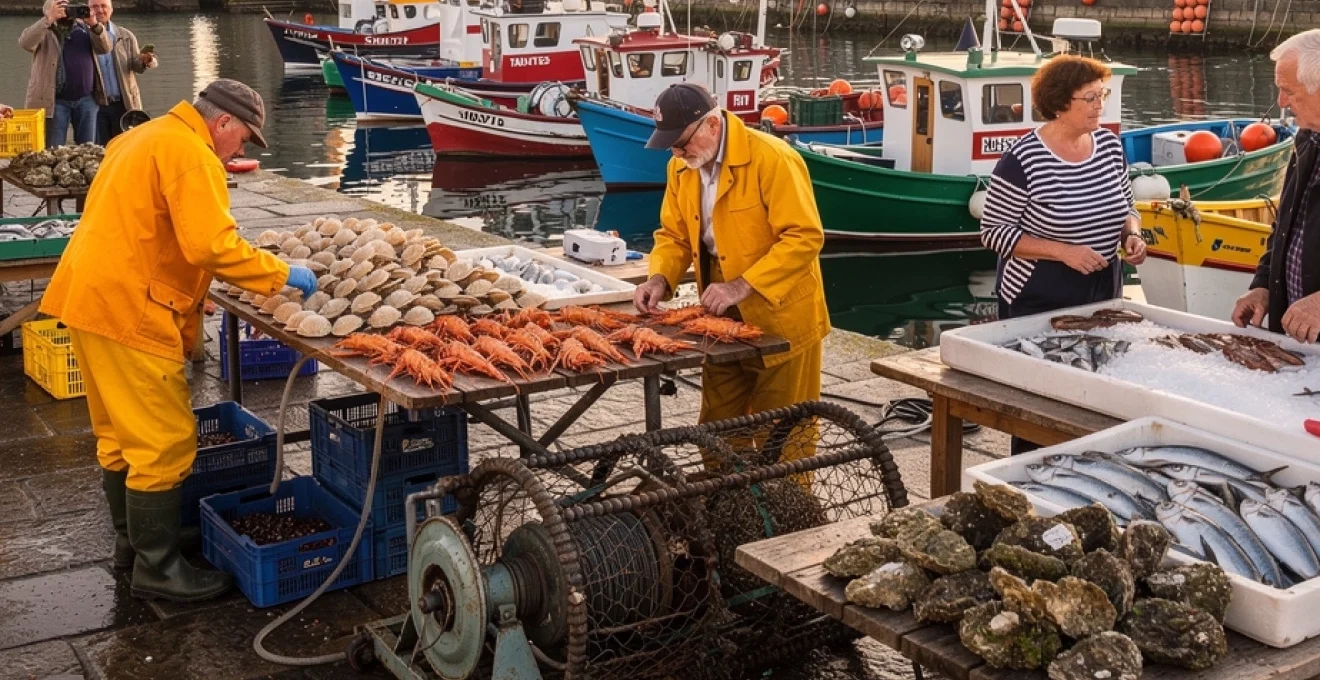
The rugged coastline of Brittany awakens each morning to a symphony of fishing vessels returning with their precious cargo, seagulls crying overhead, and the rhythmic clatter of nets being hauled onto weathered docks. This northwestern region of France has built its identity around the sea, where generations of fishermen have perfected their craft and coastal communities have flourished through maritime traditions. From the bustling fish auctions in ancient ports to the delicate cultivation of oysters in protected estuaries, Brittany’s seafood industry represents one of Europe’s most sophisticated marine ecosystems.
The morning hours reveal the true essence of Breton maritime culture, as trawlers navigate treacherous waters to deliver the freshest catch directly from the Atlantic Ocean. Each harbour tells its own story through distinctive fishing techniques, seasonal specialities, and artisanal preparation methods that have been refined over centuries. The region’s commitment to sustainable practices and marine conservation ensures that these morning rituals will continue to define Brittany’s coastal character for generations to come.
Traditional breton fishing harbours and morning market operations
The pre-dawn hours along Brittany’s coast reveal a complex network of fishing operations that have evolved over centuries to maximise both efficiency and quality. Traditional harbours serve as the beating heart of local communities, where the intersection of ancient maritime knowledge and modern fishing technology creates a unique environment for seafood commerce. The rhythmic patterns of tidal cycles dictate the precise timing of vessel departures and returns, creating a natural choreography that seasoned fishermen navigate with instinctive precision.
Concarneau’s ville close fish auction dynamics
Within the fortified walls of Concarneau’s historic Ville Close, the morning fish auction represents one of France’s most prestigious seafood markets. The criée operates with military precision, as buyers assess the quality of freshly landed catches whilst auctioneers maintain rapid-fire bidding sequences. Professional buyers arrive as early as 4:30 AM to examine specimens, checking for clarity of eyes, firmness of flesh, and the distinctive fresh sea aroma that indicates premium quality.
The auction system employs a descending price mechanism, where values start high and decrease until a buyer accepts the current price by pressing their electronic bidding device. This Dutch-style auction format ensures rapid turnover of perishable goods whilst maintaining competitive pricing structures. Daily volumes regularly exceed 15 tonnes of varied species, including premium line-caught sea bass, turbot, and the prized John Dory that commands exceptional market prices.
Lorient port’s commercial trawler fleet schedule
The port of Lorient operates as Brittany’s largest fishing harbour, where industrial-scale trawlers follow meticulously planned schedules to optimise catch efficiency and market timing. Vessels typically depart between 2:00 and 4:00 AM, allowing crews to reach productive fishing grounds as dawn breaks over the Atlantic. The fleet consists primarily of stern trawlers ranging from 20 to 45 metres in length, each equipped with sophisticated sonar systems and GPS technology to locate fish concentrations.
Returning vessels announce their estimated arrival times via radio communication, enabling harbour authorities to coordinate unloading sequences and ensure processing facilities are prepared for immediate handling. The port’s modern refrigeration infrastructure maintains the cold chain from vessel to market, with temperature-controlled storage areas capable of handling over 100 tonnes of fresh seafood daily. This systematic approach ensures that langoustines caught at dawn can reach Parisian restaurants by evening service.
Douarnenez sardine processing facility operations
The historic sardine capital of Douarnenez continues its centuries-old tradition of processing these silvery fish through a combination of traditional techniques and modern efficiency measures. Processing begins immediately upon vessel return, typically between 6:00 and 8:00 AM, when sardines maintain their optimal freshness and oil content. Workers skilled in traditional filleting methods can process over 500 sardines per hour, maintaining the precision cuts that preserve the fish’s delicate texture and appearance.
The facility operates multiple processing lines simultaneously, with some sardines destined for immediate fresh sale whilst others undergo various preservation methods including smoking, salting, and oil preservation. Quality control specialists monitor each batch for size consistency, fat content, and
overall freshness. Metal detection and microbiological sampling form part of the routine checks, ensuring that every tin of Douarnenez sardines meets stringent European food safety standards. By mid-morning, labelled boxes are ready for export across France and international markets, carrying with them the reputation of Brittany’s coastal expertise and a taste of traditional sardine fishing mornings along the Atlantic.
Le guilvinec’s artisanal fishing cooperative structure
Le Guilvinec, one of France’s leading artisanal ports, operates around a cooperative structure that places small-scale fishermen at the centre of the local seafood economy. Rather than competing individually, many skippers pool resources through producer organisations that negotiate prices, coordinate landings, and manage quotas collectively. This cooperative model allows vessels under 18 metres to maintain viable operations despite fluctuating fuel costs and changing regulations, while still landing premium-quality, line-caught and net-caught fish each morning.
The daily rhythm in Le Guilvinec revolves around dawn landings at the criée, where mixed catches of monkfish, hake, pollock, and langoustines are sorted by cooperative staff. Transparent pricing boards, shared cold-storage facilities, and collective access to ice plants help level the playing field between small-scale boats and larger industrial trawlers. For visitors, the port’s observation gallery offers a front-row view of auction activity and cooperative logistics, turning what might seem like a purely commercial operation into a living classroom on artisanal fishing in Brittany.
Seasonal seafood species and harvesting techniques along finistère
Finistère, literally meaning “the end of the earth”, is Brittany’s westernmost department and a key zone for seasonal seafood along the Atlantic coast. Here, powerful tides, rocky seabeds, and nutrient-rich currents create ideal conditions for a wide range of species, from coquille Saint-Jacques and langoustine to oysters and spider crab. Each species requires its own harvesting technique, carefully adapted to the local marine environment and increasingly regulated to protect fragile ecosystems.
Understanding how these seafood harvesting methods work transforms a simple plate of shellfish into a story of seasons, tides, and skilled labour. When you enjoy a scallop gratin or a platter of fresh oysters in a harbour restaurant, you are tasting the result of complex coordination between fishermen, scientists, and regulators. Below, we explore how some of Finistère’s most iconic species are brought from sea to shore using methods that balance efficiency with environmental responsibility.
Coquille Saint-Jacques dredging methods in baie de Saint-Brieuc
Although Baie de Saint-Brieuc lies just beyond Finistère, its coquille Saint-Jacques set the benchmark for scallop harvesting methods across Brittany. Dredging here is strictly controlled, with a short fishing season typically running from October to April and limited to a few hours per week. Specialised dredges, fitted with metal teeth and a collecting bag, are towed slowly across authorised scallop beds, raking mature shells from sandy or gravelly seabeds while leaving younger specimens to grow.
To reduce by-catch and habitat disturbance, the regional fisheries committee has introduced gear modifications and real-time monitoring of dredging zones. Electronic logbooks, satellite positioning, and periodic scientific surveys help ensure that fishing effort matches the natural regeneration capacity of scallop stocks. For consumers, this means that when you order coquille Saint-Jacques from Baie de Saint-Brieuc in winter, you are enjoying a carefully managed resource that embodies some of the most advanced sustainable scallop dredging practices in Europe.
Langoustine trawling operations off pointe du raz
Off the dramatic cliffs of Pointe du Raz, langoustine trawlers target the muddy seabeds where these prized crustaceans burrow. Boats typically set out during the night so that trawls can be hauled at first light, when langoustines are most active. The nets used are designed with specific mesh sizes and escape panels to reduce juvenile capture and minimise impacts on non-target species, reflecting EU regulations that have tightened in recent years.
Handling on board is rapid and meticulous: langoustines are sorted by size, rinsed in seawater, and immediately placed on crushed ice to preserve their characteristic sweetness and firm texture. Many vessels now participate in selective fishing trials, testing lighter gear or raised footropes to reduce seabed contact. For you as a seafood lover, this means that those delicate langoustines on your Brittany seafood platter represent not just a culinary highlight, but also ongoing innovation in trawling techniques along the Finistère coast.
Oyster cultivation techniques in belon river estuary
The Belon River estuary, on the southern edge of Finistère, is synonymous with flat oysters whose subtle balance of salinity and nuttiness has earned international acclaim. Oyster cultivation here follows a multi-year cycle that begins with spat collection, often using cultches (shells or structures) placed in areas where wild larvae naturally settle. Once juvenile oysters reach a workable size, they are transferred to mesh bags or trays fixed on metal tables just above the seabed, where tidal flows provide constant renewal of nutrient-rich water.
Growers carefully adjust the density of oysters in each bag, turning and thinning them several times a year to ensure uniform growth and shell formation. The mix of freshwater from the river and saltwater from the Atlantic acts like a natural seasoning, infusing Belon oysters with their celebrated flavour profile. Harvesting is timed around both tide tables and market demand, with producers grading oysters by size and shape before sending them to restaurants and markets across Europe. When you savour oysters in the Belon estuary itself, you are often eating shellfish harvested just hours earlier from the very beds visible at low tide.
Spider crab potting strategies around archipel des glénan
Around the turquoise waters of the Archipel des Glénan, spider crab (araignée de mer) fishing relies on traditional potting techniques that are both selective and relatively low-impact. Fishermen deploy strings of baited pots—often made of plastic-coated metal or more eco-friendly materials—on rocky seabeds where crabs naturally forage. Buoys mark the locations, and GPS coordinates help crews retrieve their gear with precision during early-morning rounds.
Because pots capture live crabs without damaging the seabed, fishermen can easily sort their catch on deck, releasing undersized individuals and egg-bearing females back into the water. Seasonal closures and minimum size limits further protect breeding stocks, ensuring that the famous springtime spider crab season remains sustainable. For visitors, enjoying a boiled spider crab at a harbour-side restaurant near Concarneau or Bénodet becomes a vivid connection to these careful potting strategies around the Glénan islands, where clear waters and healthy crab populations reflect a long-standing respect for the marine environment.
Artisanal seafood preparation methods in coastal brittany
Once seafood is landed in Brittany’s ports, a second wave of expertise takes over: the artisans who smoke, cure, and cook the catch using techniques honed over generations. From family-run smokehouses to crêperies that reinterpret maritime ingredients, coastal communities transform raw fish and shellfish into dishes that define Breton gastronomy. If fishing is the heartbeat of Brittany’s mornings, then artisanal preparation is the soul, adding depth of flavour and cultural identity to every plate.
These methods are not just about tradition; they are also about preserving freshness and adding value in a competitive global seafood market. By understanding how smoking, salting, and culinary creativity work together, you can better appreciate why a simple slice of smoked mackerel or a buckwheat galette filled with scallops tastes so distinctive along this stretch of the French Atlantic coast. The following sections explore some of the key artisanal techniques that shape seafood mornings in Brittany.
Traditional breton fish smoking techniques in audierne
Audierne, on the Cap Sizun peninsula, is renowned for its small smokehouses where mackerel, salmon, and occasionally tuna are transformed into richly flavoured delicacies. Traditional Breton fish smoking begins with a careful selection of whole fish, which are cleaned, sometimes brined in lightly salted water, and then hung on racks to dry. This initial drying phase is crucial: like allowing paint to set before adding new layers, it prepares the flesh to absorb smoke evenly without becoming soggy.
Smokehouses in Audierne typically rely on beech or oak wood chips, sometimes mixed with a touch of fruitwood for a more nuanced aroma. Cold smoking, kept at around 25°C, is used for delicate species like salmon, while hot smoking at 60–80°C suits oily fish such as mackerel, giving them a firmer texture and deeper colour. Many artisans still judge the process by eye and nose rather than by timers alone, adjusting airflow and temperature based on weather conditions and the look of the fish. When you buy smoked fish directly from a coastal smokehouse, you are tasting this subtle interplay of craftsmanship and local microclimate.
Sea salt curing processes using guérande salt
Although the Guérande salt marshes lie just south of Brittany’s official border, their grey sea salt and delicate fleur de sel are fundamental to Breton seafood preparation. Curing fish with Guérande salt follows a simple yet precise process: fillets or whole fish are layered with coarse crystals, which draw out moisture while seasoning the flesh. The length of curing—ranging from a couple of hours for lightly salted anchovies to several days for gravlax-style salmon—determines the final texture and intensity of flavour.
Think of salt curing as a slow, controlled transformation, much like ageing cheese or maturing wine. The salt not only firms the flesh but also inhibits bacterial growth, extending shelf life without the need for artificial preservatives. Many coastal producers now combine Guérande salt with Breton seaweed flakes, citrus zest, or local herbs to create signature curing blends. For home cooks inspired by their travels, replicating a simple Guérande-salt cured fish at home is one of the easiest ways to bring a taste of Brittany’s seafood mornings into your own kitchen.
Kelp and seaweed integration in roscoff cuisine
Roscoff, a coastal town already famous for its sweet pink onions, has also emerged as a hub for edible seaweed innovation. Harvested from the nearby Iroise Sea, kelp, dulse, nori, and sea lettuce are collected by licensed foragers who work with the tides, cutting only the upper portions of the plants so that they can regenerate. After rinsing and drying, these seaweeds become versatile ingredients in everything from butters and tapenades to crackers and dried seasoning blends.
Local chefs in Roscoff treat seaweed as a maritime equivalent of aromatic herbs, using it to layer umami and minerality into traditional recipes. You might find kelp simmered in fish stock to deepen flavour, or finely chopped dulse folded into butter and served with oysters and grilled fish. For visitors, tasting seaweed-infused dishes is a reminder that Brittany’s cuisine draws not only from the fish and shellfish in its waters but also from the underwater “vegetable garden” that thrives along its rocky coastline. It is a culinary evolution that feels both ancient and distinctly modern.
Crêperie maritime menu development and execution
Across coastal Brittany, crêperies have begun to integrate seafood more prominently into their menus, creating what many describe as “crêperie maritime” concepts. At the heart of these menus are buckwheat galettes, naturally gluten-free and robust enough to hold generous fillings of scallops, smoked fish, or mussels in cream sauce. Menu development often starts with what is available that very morning at the local market or fish auction, making seasonality a built-in feature rather than a marketing slogan.
Kitchen execution requires a choreography as precise as any fishing operation: galette batter, rested for several hours, is spread thin on cast-iron billigs, while fillings are prepared à la minute to preserve texture and flavour. A signature dish might pair pan-seared coquille Saint-Jacques with leek fondue and a drizzle of cider reduction, all enveloped in a crisp-edged galette. For you as a diner, this combination of simple dough and ultra-fresh seafood encapsulates what seafood mornings along the coast of Brittany are all about: humble ingredients elevated through timing, technique, and an intimate connection to the sea.
Marine conservation practices and sustainable fishing quotas
Brittany’s reputation as a seafood paradise depends not only on skilled fishermen and talented chefs, but also on rigorous marine conservation measures. Over the past decades, declining stocks of certain species—cod, hake, and even scallops in some areas—have prompted a shift towards science-based management. Today, total allowable catches (TACs), individual vessel quotas, and seasonal closures are standard tools used to balance economic activity with long-term ecosystem health.
French and European regulations set the framework, but implementation often happens at a regional level, with Breton fisheries committees working alongside marine biologists and local cooperatives. Electronic monitoring systems track vessel activity, while port sampling provides real-time data on catch composition and size. It can feel complex from the outside, yet the logic is straightforward: by slightly reducing fishing pressure now, Brittany can ensure that future generations will still experience early-morning landings and thriving seafood markets along the Atlantic coast.
Beyond quotas, a growing number of Breton fishermen participate in eco-certification schemes such as MSC (Marine Stewardship Council) or local labels that recognise low-impact methods. These programmes typically require independent audits, gear modifications, and traceability from boat to plate, giving consumers clearer information when choosing seafood. As a traveller or home cook, you can support these efforts by asking where your fish was caught, favouring lesser-known species with healthy stocks, and respecting closed seasons—even when a favourite dish is temporarily off the menu. In this way, everyone plays a role in preserving Brittany’s marine heritage.
Coastal tourism infrastructure supporting seafood gastronomy
Coastal tourism in Brittany has evolved far beyond simple beach holidays, with a growing emphasis on immersive food experiences linked to the region’s maritime culture. Many harbours now feature interpretive centres, guided tours of fish auctions, and “from sea to plate” workshops that explain exactly how local seafood travels from fishing grounds to your table. Accommodation providers—from boutique guesthouses to larger hotels—frequently partner with nearby restaurants and producers, offering oyster farm visits, seaweed foraging excursions, or cooking classes focusing on Breton seafood recipes.
Transport infrastructure also plays a crucial role in sustaining seafood gastronomy tourism. Well-maintained coastal roads, ferry links to islands, and increasingly frequent train connections make it easier for visitors to move between ports such as Concarneau, Le Guilvinec, Douarnenez, and Roscoff. Many towns have invested in harbour promenades, outdoor markets, and upgraded marinas, creating attractive spaces where morning fishing activities and café terraces coexist. As you wander these quaysides with a coffee in hand, watching crates of fish being unloaded just metres from restaurant kitchens, you witness first-hand how tourism and professional fishing can complement rather than compete with each other.
Local and regional authorities increasingly see seafood gastronomy as a key pillar of Brittany’s sustainable tourism strategy. Initiatives promoting short supply chains, seasonal menus, and low-impact activities—from shore fishing workshops to sailing trips along the Pink Granite Coast—aim to spread visitor spending while preserving the very landscapes and seascapes that attract travellers in the first place. For anyone planning a trip, this means you can design entire mornings, or indeed entire holidays, around following the journey of seafood along the coast of Brittany: from the first flash of trawler lights on the horizon to the final, memorable bite of a perfectly cooked scallop or a briny, just-opened oyster.