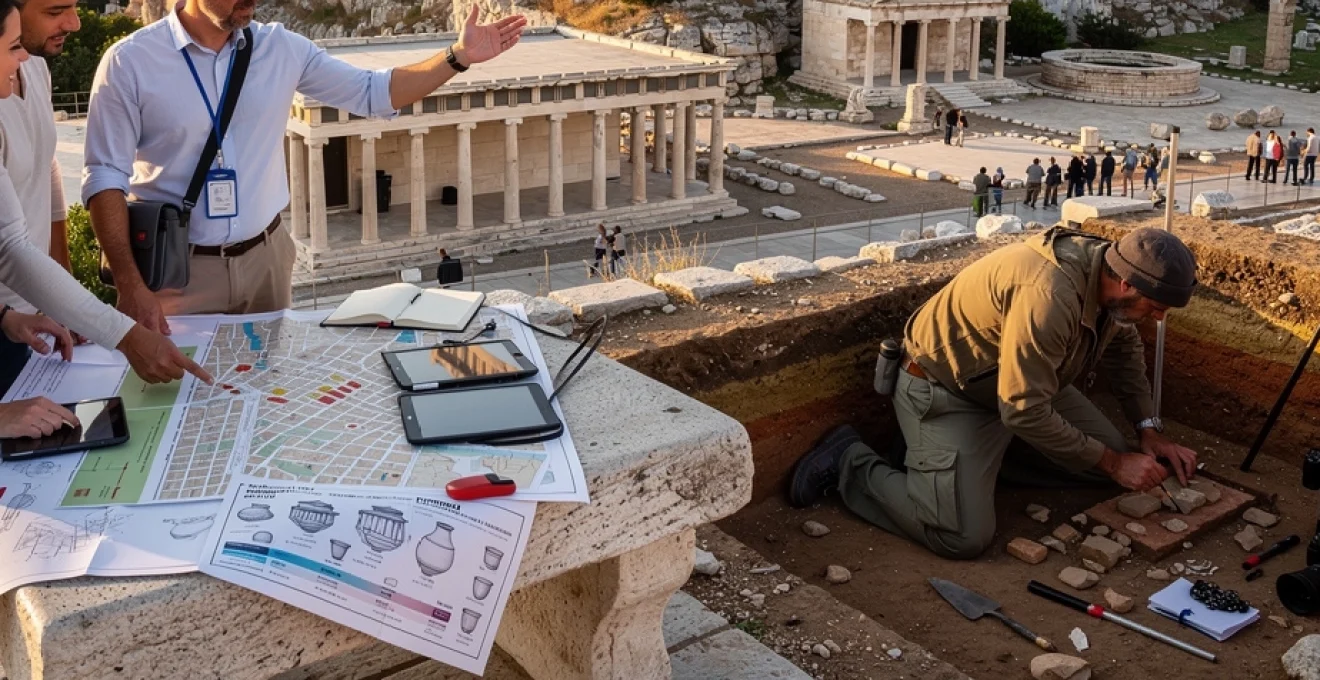
Athens stands as one of the world’s most archaeologically rich capitals, where every street corner whispers tales of democratic innovation, philosophical breakthroughs, and architectural mastery. Planning a comprehensive exploration of this ancient metropolis requires more than simply purchasing tickets to the Acropolis – it demands a strategic approach that respects the chronological layers of history whilst maximising your educational experience. The city’s archaeological landscape spans nearly three millennia, from Bronze Age settlements to Byzantine churches, creating a complex tapestry that rewards careful preparation and informed navigation.
Modern Athens presents unique challenges for the historically minded traveller. Unlike museum collections where artefacts are neatly categorised and labelled, the city’s ancient monuments exist within a living urban environment where Roman foundations support contemporary buildings and Byzantine chapels nestle between neoclassical facades. This extraordinary palimpsest of civilisations offers unparalleled opportunities to understand how successive cultures have shaped and reshaped the urban landscape.
Pre-journey archaeological research and historical context mapping
Successful exploration of Athens’ archaeological treasures begins long before you set foot on Greek soil. The city’s historical complexity requires a methodical approach to research that will transform your visit from casual sightseeing into profound historical engagement. Understanding the chronological framework of Athenian civilisation provides the essential scaffolding upon which to build your itinerary and interpret the monuments you’ll encounter.
Classical period chronology: from archaic to hellenistic athens (800-146 BCE)
The Archaic period (800-480 BCE) witnessed Athens’ transformation from a collection of hilltop settlements into a unified polis. During this era, the city established its fundamental religious and civic institutions, many of which left archaeological traces still visible today. The earliest temples on the Acropolis date to this period, though most were destroyed during the Persian Wars and subsequently rebuilt during the Classical era.
The Classical period (480-323 BCE) represents Athens’ golden age, when the city-state reached its zenith of political power, economic prosperity, and cultural achievement. Pericles’ ambitious building programme transformed the Acropolis into a showcase of Athenian supremacy, whilst the Agora developed into the Mediterranean’s most sophisticated commercial and political centre. This period produced the monuments that define Athens’ archaeological identity today.
The Hellenistic era (323-146 BCE) marked Athens’ gradual decline from superpower to regional centre, yet continued architectural innovation. New building types emerged, including elaborate stoas and philosophical schools, whilst foreign rulers contributed monuments that reflected changing political relationships. Understanding these chronological phases helps visitors recognise architectural styles and interpret the historical significance of individual monuments.
Pericles’ building programme: golden age construction timeline and architectural significance
The Periclean building programme (447-406 BCE) represents one of history’s most ambitious architectural undertakings, designed to demonstrate Athenian cultural superiority whilst providing employment for the city’s craftsmen. The programme’s careful choreography reveals sophisticated understanding of architectural symbolism and urban planning principles that influenced Western architecture for millennia.
The Parthenon (447-438 BCE) served as the programme’s centrepiece, embodying the mathematical precision and aesthetic refinement that characterised Classical Greek architecture. Its construction employed cutting-edge engineering techniques, including subtle optical corrections that compensate for the human eye’s perceptual limitations. Contemporary visitors can observe these refinements firsthand, noting how seemingly straight lines actually curve slightly to create visual perfection.
Subsequent monuments, including the Propylaea gateway (437-432 BCE) and the Temple of Athena Nike (427-424 BCE), demonstrate how individual buildings were conceived as components of a larger architectural ensemble. The programme’s coordinated design creates dramatic processional routes that guide visitors through carefully orchestrated spatial experiences, from the secular city below to the sacred precinct above.
Archaeological stratigraphy: understanding Multi-Layered historical periods at athenian sites
Athens’ archaeological sites represent thousands of years of continuous occupation, creating complex stratigraphic sequences that require careful interpretation. Modern excavation techniques have revealed how successive civilisations built upon earlier foundations, reusing materials and adapting existing structures to new purposes. This palimpsest effect means that
visitors frequently encounter Roman walls beneath Byzantine chapels or Classical foundations reused in Ottoman-period houses. To make sense of this, approach each major site with a mental “layer cake” of periods: Archaic, Classical, Hellenistic, Roman, Late Antique, Byzantine, and Ottoman/modern. As you move through Athens, ask yourself at each structure: which layer am I seeing, and which earlier phases might be hidden below? This habit will help you organise your history-filled journey not just by geography, but by time.
Before travelling, it is worth consulting basic stratigraphic diagrams from published excavation reports (the American School of Classical Studies in Athens and the Hellenic Ministry of Culture offer open-access material). Even if you are not an archaeologist, a simple grasp of how deposits accumulate—oldest at the bottom, latest at the top, with cuts such as pits and foundations intruding down—will sharpen your observational skills on site. When you peer through the glass floors at the Acropolis Museum or Monastiraki Metro, you will recognise not a jumble of stones, but distinct occupation layers that speak to Athens’ shifting religious and civic priorities.
Primary historical sources: pausanias, plutarch, and ancient travel accounts
No history-filled journey through Athens is complete without at least a passing acquaintance with the ancient authors who first described the city’s monuments. Chief among them is Pausanias, a second‑century CE traveller whose Description of Greece functions as a kind of Roman-era guidebook. His account of Attica offers invaluable topographical clues that you can match to the sites you visit today, from the route up to the Acropolis to the layout of the Agora and the sanctuaries beyond the city walls.
Plutarch, writing biographies of famous Athenians such as Pericles, Themistocles, and Theseus, provides the political and moral framework behind many buildings. Reading his Life of Pericles before visiting the Acropolis helps you understand the ideological ambitions that lay behind the gleaming marble. Other authors—Herodotus, Thucydides, Xenophon—add layers of narrative detail about battles, decrees, and everyday life in the city. For practical purposes, you do not need to read them in full; good modern translations with introductions and maps will give you enough context to enrich your time on the ground.
You might think of these texts as the “audio guide” of antiquity. Just as a modern guide narrates what you see, Pausanias walks you through sanctuaries, lists statues, and pauses to recount myths attached to certain spots. Consider bringing a slim printed copy or saving key passages offline on your phone, so you can read his description of the Acropolis while you stand on the same rock, nearly two millennia later. The interplay between what he saw and what you see today becomes one of the most rewarding aspects of an intellectually structured Athens itinerary.
Acropolis complex: sacred precinct navigation and monument analysis
The Acropolis is the conceptual heart of any history-focused trip to Athens, but its density of monuments can feel overwhelming without a strategy. Rather than wandering aimlessly from ruin to ruin, plan a route that mirrors the ancient Panathenaic procession: from the city’s lower quarter, through the Propylaea, and into the sacred plateau crowned by the Parthenon and the Erechtheion. Organising your visit this way allows you to experience the site not only as a collection of temples, but as a carefully choreographed sacred journey.
To maximise your time at this UNESCO World Heritage Site, secure timed-entry tickets in advance and aim for early morning or late afternoon, when light is best for architectural photography and crowds are thinner. Bring a printed plan of the Acropolis or download a detailed map to your device, marking vantage points where you can pause to examine specific architectural elements. Treat each major monument not as an isolated masterpiece, but as part of a larger narrative about Athenian identity, religious practice, and political ambition.
Parthenon architectural elements: doric order refinements and optical corrections
The Parthenon’s apparent simplicity conceals an extraordinary level of technical sophistication. At first glance, it appears to be a straightforward Doric peripteral temple—a rectangular cella surrounded by a colonnade of fluted columns topped with simple capitals. Yet every “straight” line is in fact subtly curved, and every column slightly adjusted, to counteract optical distortions that would otherwise make the building seem heavy or warped to the human eye.
As you circle the Parthenon, look closely at the stylobate—the stepped platform on which the columns stand. It gently rises towards the centre on all four sides, an upward curvature of around 6–7 centimetres that prevents the base from appearing to sag. The columns themselves are not perfectly vertical; they incline inward ever so slightly, and feature entasis, a gentle swelling about one-third of the way up. This subtle “breathing” of the shaft counterbalances any impression of frailty that perfectly straight lines would create at such a scale.
For visitors keen to turn observation into structured learning, it helps to bring a short checklist of Doric features: triglyphs and metopes in the frieze, mutules under the cornice, and the relative proportions between column height and diameter. The Parthenon pushes these canonical ratios toward a more slender, refined effect compared to earlier Doric temples such as the Hephaisteion in the Agora. Noticing these refinements on site—even if you are not an architect—will deepen your appreciation of why this building became the benchmark for “classical” architecture across the Western world.
Erechtheion sacred spaces: athena polias sanctuary and caryatid porch symbolism
The Erechtheion, to the north of the Parthenon, appears irregular compared with its grand neighbour, yet this complexity reflects its role as a multi-functional sacred hub rather than a single-purpose temple. Here, the Athenians combined several ancient cults in one building: the sanctuary of Athena Polias (the city’s protector), the hero-shrine of Erechtheus, and sites associated with Poseidon, Hephaestus, and the legendary first king Kekrops. When you stand before the structure, you are effectively looking at a three-dimensional diagram of Athenian myth and identity.
Architecturally, the Erechtheion employs the Ionic order, with slender columns and an elaborately carved frieze. The most iconic feature, however, is the south porch supported by six Caryatids—maiden figures whose draped bodies replace conventional columns. Although the originals are preserved in the Acropolis Museum (and the British Museum), their on-site replicas still convey the extraordinary balance between structural function and sculptural grace. Note how each figure stands in a slightly different pose, their weight subtly shifted, yet together they create a stable, rhythmic colonnade.
When planning your visit, allow time not just to photograph the Caryatid porch from afar, but to walk around the Erechtheion and observe how it negotiates the uneven bedrock of the Acropolis. The building’s split levels, projecting porches, and asymmetrical footprint reflect the need to respect older sacred spots—such as the mark of Poseidon’s trident and the olive tree of Athena—while creating a coherent architectural whole. In practical terms, this makes the Erechtheion an ideal case study for how religious tradition can dictate form more than aesthetic preference, an insight that will serve you at many other ancient sites in Greece.
Propylaea gateway: mnesicles’ architectural innovation and processional route design
The Propylaea, designed by the architect Mnesicles, forms the monumental gateway that separates the secular city from the Acropolis’ sacred precinct. Think of it as an ancient equivalent of a security checkpoint, ceremonial arch, and museum foyer combined. Its strategic placement at the western approach funnels the visitor into a controlled sequence of spaces, heightening the sense of transition from everyday life to divine realm.
Structurally, the Propylaea is remarkable for its combination of Doric and Ionic orders within a single complex. The exterior presents a robust Doric façade to those ascending the hill, while the interior central hall features tall Ionic columns that frame the view towards the inner sanctuaries. This blending of styles is not just decorative; it reflects careful consideration of sightlines and movement, ensuring that the procession of worshippers during the Panathenaic festival experienced an unfolding series of vistas.
As you pass through the Propylaea, pause halfway and look back down towards the city, then forward towards the Parthenon. You are standing at a deliberately engineered visual hinge between Athens below and the gods above. In planning your history-focused itinerary, it can be useful to treat the Propylaea as both starting and ending point: begin your visit by walking slowly through it to absorb the designed perspectives, and before leaving the Acropolis, retrace your steps to appreciate how the gateway frames the city you are about to re-enter.
Temple of athena nike: kallikrates’ ionic masterpiece and victory cult practices
Perched on a bastion to the right of the Propylaea, the diminutive Temple of Athena Nike offers a concentrated lesson in Ionic design and Athenian religious politics. Built by Kallikrates in the late fifth century BCE, this small amphiprostyle temple (with four Ionic columns at each end) honours Athena in her aspect as bringer of victory, particularly in relation to the Persian Wars. Its position overlooking the main approach road allowed Athenians and visitors alike to associate military success with divine favour every time they entered the Acropolis.
The temple once housed a cult statue of Athena Nike without wings—Apteros Nike—symbolising that victory would never fly away from the city. While the statue is lost, the temple’s sculpted friezes and balustrades, now largely in the Acropolis Museum, depict dynamic scenes of battle and graceful representations of Nike. When you visit, try to imagine the original polychromy and the gleaming marble against the Attic sky; what we see as weathered stone was once a riot of colour and visual storytelling.
For itinerary planning, the Temple of Athena Nike works well as a transitional stop either on your way in or out of the Acropolis. Because of its elevated bastion, it also provides excellent viewpoints over the modern city, the Saronic Gulf, and the ancient road to Piraeus. Combining a short architectural analysis with a few minutes of panoramic observation helps anchor your understanding of how closely Athens’ religious life was tied to its military and maritime fortunes.
Ancient agora archaeological zone: civic life reconstruction techniques
If the Acropolis represents the spiritual and ideological summit of Classical Athens, the Ancient Agora embodies its everyday realities. Here, citizens gathered to trade, debate, worship, and socialise; philosophers lectured beneath the shade of stoas, and magistrates administered the laws that defined Athenian democracy. For the historically minded traveller, the Agora is an unparalleled open-air laboratory for reconstructing civic life in the fifth and fourth centuries BCE.
To make the most of this zone, obtain a combined ticket that includes the Acropolis and several secondary sites, and allocate at least half a day to the Agora alone. Begin at the site museum within the Stoa of Attalos to familiarise yourself with the topography and key buildings, then explore the ruins with a site plan in hand. As you walk, actively imagine the noise of vendors, the smell of incense, and the bustle of citizens moving between law courts, council chambers, and shrines. This mental reconstruction turns scattered foundations into a coherent civic landscape.
Stoa of attalos museum: hellenistic architecture and artefact interpretation methods
The reconstructed Stoa of Attalos, originally built in the second century BCE by King Attalos II of Pergamon, dominates the eastern side of the Agora. Its modern rebuilding in the 1950s, based closely on archaeological evidence, provides a rare opportunity to experience the spatial qualities of a Hellenistic stoa: a long, two-storey colonnaded hall designed for shelter, commerce, and display. Walking through its cool interior offers welcome relief from the Athenian sun and a tangible sense of how ancient Athenians moved and gathered in such spaces.
Inside, the Agora Museum presents a carefully curated selection of artefacts excavated from the surrounding area: ostraka (pottery shards used for voting political exiles), official inscriptions, sculptural fragments, household items, and coins. As you examine these objects, try adopting an interpretive method used by archaeologists: consider context first. Where was the item found? In a well, in a house, in a sanctuary deposit? Context transforms a simple shard into evidence for a legal process, a religious practice, or a domestic habit.
For a structured visit, you might choose one theme—say, democracy, religion, or daily life—and follow it through the displays. Read the labels not just for dates, but for findspots and functions, then step out into the Agora and locate the buildings where those artefacts once belonged. This back-and-forth between museum and site mirrors professional practice and will significantly deepen your understanding of how material culture and architecture interrelate in reconstructing ancient Athens.
Hephaisteion temple: Best-Preserved doric temple analysis and metallurgy cult significance
On a low hill overlooking the Agora stands the Hephaisteion, often mislabelled the “Theseion”, and widely regarded as the best-preserved Doric temple in Greece. Dedicated to Hephaestus, god of metalworking, and Athena Ergane, patroness of crafts, it reflects the industrial character of the surrounding Kerameikos and potters’ quarter. Its near-complete state makes it an ideal reference point for understanding the Doric order that was more subtly manipulated at the Parthenon.
As you approach, note the robust columns, widely spaced triglyphs and metopes, and the relatively squat proportions compared to the Parthenon. Walk slowly around the exterior, observing how the colonnade frames shifting views of the Agora below and the Acropolis beyond. This visual dialogue between temples underscores how Athenian religion integrated both lofty ideals and practical skills: the same city that honoured Athena as goddess of wisdom also venerated her as protector of artisans and labourers.
To bring out the cult significance of the Hephaisteion in your itinerary, consider pairing your visit with a stop in the nearby industrial sections of the Agora where bronze workshops once stood. Archaeological finds from these areas—slag, moulds, tools—indicate intensive metalworking activity. Standing among the temple’s cool columns after viewing such evidence, you can better appreciate how worship and work were intertwined in ancient Athens, and how religious architecture validated the economic activities that sustained the polis.
Tholos and bouleuterion: democratic institution architecture and political process archaeology
Near the centre of the Agora lie the remains of the Tholos and the Bouleuterion, two key buildings of Athenian democratic governance. Though less visually impressive than the standing temples, their low foundations and scattered column bases mark the spot where decisions shaping the ancient world were debated and enacted. Understanding these structures transforms an unassuming corner of the site into one of its most intellectually charged.
The Tholos, a circular building with a conical roof, served as the headquarters and dining hall of the prytaneis, the rotating executive committee of the Council of 500. Archaeological evidence such as storage pits for official weights and measures indicates its role in overseeing standards and emergency governance; at least some councillors slept there on duty to respond quickly to crises. The adjacent Bouleuterion functioned as the meeting place for the full council, where legislative proposals were drafted before being presented to the citizen Assembly on the Pnyx.
When you visit, use a site plan to trace the relationship between these buildings and nearby law courts, archives, and shrines. Even though little stands above ground, the clustering of civic structures in this area reflects the spatial logic of democracy: key institutions placed within easy reach of one another and of the Agora’s open assembly spaces. For a more immersive experience, you might reread a passage from Aristotle’s Constitution of the Athenians or a relevant speech by Demosthenes while standing here, imagining the political drama that once animated these now-quiet stones.
American school excavations: stratigraphic documentation and site interpretation protocols
The modern appearance of the Agora owes much to the long-running excavations conducted by the American School of Classical Studies at Athens since the 1930s. Their work has not only uncovered buildings and artefacts but also set methodological standards for stratigraphic documentation and publication. For the historically curious visitor, understanding these protocols adds a contemporary archaeological layer to your journey, reminding you that “ancient Athens” is still partly under construction in scholarly terms.
Look for informational panels on site that explain excavation trenches, conservation choices, and reconstruction debates (such as the decision to rebuild the Stoa of Attalos). These displays often include photographs of early 20th-century digs, with balks (unexcavated walls of earth) left standing to show sequence of deposits. Noting how archaeologists distinguish between fill layers, construction cuts, and destruction horizons will help you read other sites in Athens with a more critical eye.
Many of the Agora’s most detailed records—plans, notebooks, object catalogues—are now digitised and publicly accessible. If you enjoy advance preparation, exploring a few of these online before your trip allows you to approach the site almost as a collaborator rather than a passive tourist. You will recognise features mentioned in excavation diaries, follow the evolution of interpretations over time, and appreciate that every pathway and labelled ruin represents decades of careful, sometimes controversial, scholarly work.
Roman period monuments: imperial transformation of classical athens
While most travellers focus on Classical Athens, a history-filled journey should also account for the city’s substantial Roman phase. From the first century BCE onward, emperors and wealthy benefactors reshaped parts of Athens to align with imperial tastes while simultaneously venerating its Greek heritage. The result is a landscape where Roman and Greek architectural vocabularies coexist, sometimes harmoniously, sometimes in tension.
Begin your exploration at the Roman Agora, constructed under Julius Caesar and Augustus as a new commercial hub east of the Classical Agora. Its colonnaded courtyard, monumental Gate of Athena Archegetis, and integrated shops illustrate how Roman urban planning imported new spatial arrangements while respecting local deities. A short walk away, the Tower of the Winds—a remarkable octagonal structure combining water clock, sundials, and wind vane—exemplifies late Hellenistic and early Roman scientific architecture. Standing here, you can literally trace the evolution from Classical civic square to Roman imperial forum.
Further east, Hadrian’s Library and the colossal Temple of Olympian Zeus reflect the personal patronage of Emperor Hadrian, a noted philhellene. The library’s vast courtyard and reading rooms symbolised Roman commitment to Athens as a centre of learning, while the temple—centuries in the making and finally completed under Hadrian—embodied imperial power on a scale unmatched by earlier sacred architecture in the city. In planning your itinerary, it can be effective to group these Roman sites into a half-day circuit, allowing you to compare how different emperors visually inscribed their authority onto the Athenian cityscape.
Byzantine heritage sites: medieval athens archaeological landscape
After the Classical and Roman eras, Athens did not simply vanish from history; it continued as a modest but continuous urban centre through the Byzantine and Ottoman periods. Many visitors overlook this medieval layer, yet its compact churches and reused spolia (recycled ancient architectural elements) offer invaluable insight into how later communities engaged with their classical inheritance. Including a selection of Byzantine monuments in your journey will round out your understanding of Athens as a city of many lives.
The historic core around Plaka and Monastiraki is particularly rich in middle- and late-Byzantine churches, often squeezed between modern shops and cafes. Notable examples include the Kapnikarea Church on Ermou Street, with its 11th-century masonry and later frescoes, and the small but exquisite Church of the Holy Apostles in the Agora, which sits quite literally atop earlier Roman remains. In each case, observe how builders reused marble columns, capitals, and blocks from abandoned ancient structures, often with little regard for original pagan iconography.
From a practical standpoint, you can integrate these sites into your walking routes between major ancient landmarks. When you pause to step inside, look for characteristic Byzantine features: brick-and-stone cloisonné masonry, domes on pendentives, and interior fresco or mosaic programmes that communicate theological messages as systematically as the Parthenon’s sculptures once expressed civic ideals. Noticing these continuities and contrasts will help you see Athens not just as a frozen “classical museum”, but as a city where communities continuously reinterpreted sacred space according to changing beliefs and political realities.
Professional guided tour strategies and educational interpretation techniques
Even the best-prepared independent traveller can benefit from professional guidance when navigating Athens’ dense archaeological record. The key is to select and structure guided experiences in a way that supports your own research rather than passively replacing it. Think of guides and tours as specialised lenses: each one can help you focus on a particular aspect—architecture, religion, politics, or daily life—and should fit into your broader plan for a history-focused journey.
When choosing a guide, look for academically trained archaeologists or historians with experience in fieldwork or museum curation. Many offer themed walks—such as “Democracy in the Agora” or “Religious Athens from Classical to Byzantine”—that align closely with the sections of this itinerary. Before the tour, share your interests and prior reading so they can adjust their commentary. During the visit, do not hesitate to ask methodological questions: how do we date this wall? Why is this building identified as a council house rather than a temple? Such questions turn a standard tour into a mini-seminar.
To consolidate what you learn, adopt simple educational interpretation techniques used by museums and universities. After each major site, take a few minutes to jot down three key observations and one question you still have. Use photographs not only for aesthetics, but as documentation: capture overviews, details, and explanatory panels so you can reconstruct the visit later. If you are travelling with companions, designate short “debrief” moments in a café or on a shady bench where each person shares one new insight. This active engagement will ensure that your journey through Athens’ ancient landmarks becomes not just a sequence of beautiful views, but a coherent, intellectually satisfying exploration of one of history’s most influential cities.