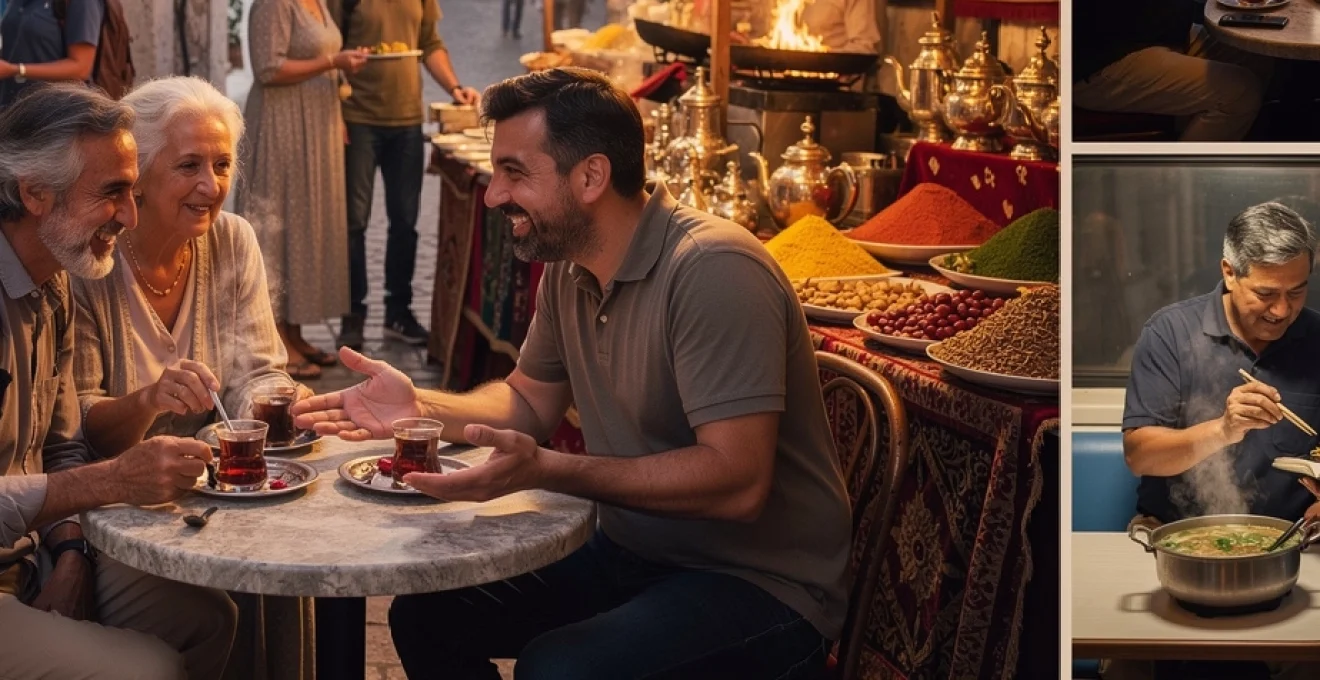
Travel transforms us not through grand monuments or luxury accommodations, but through fleeting moments with strangers who briefly enter our orbit. A shared smile with a vendor in Istanbul, an unexpected invitation for tea in a Cappadocian village, or a simple gesture of kindness from a local during a moment of confusion—these micro-interactions fundamentally reshape how travellers perceive foreign cultures and their place within them. Research demonstrates that brief encounters with locals during international travel create more enduring memories than planned tourist activities, yet these spontaneous moments remain underexplored in mainstream travel discourse.
The neuroscience behind these encounters reveals why a thirty-second exchange can resonate for decades whilst a three-hour museum visit fades within months. When travellers step outside their cultural comfort zones, their brains enter heightened states of awareness, making even mundane interactions feel profound. This phenomenon explains why seasoned globetrotters often remember conversations with taxi drivers more vividly than UNESCO World Heritage sites they visited on the same journey.
Psychological mechanisms behind Cross-Cultural Micro-Interactions
Understanding why brief encounters abroad leave indelible marks requires examining the cognitive processes activated during cross-cultural exchanges. The human brain processes unfamiliar social situations differently than routine interactions, creating stronger neural pathways that enhance memory formation. When you navigate language barriers or decode unfamiliar social customs, multiple brain regions synchronise in ways that rarely occur during everyday domestic experiences.
The Baader-Meinhof phenomenon in travel memory formation
The Baader-Meinhof phenomenon, or frequency illusion, plays a curious role in how travellers recall encounters abroad. After experiencing a meaningful interaction with a local—perhaps a shopkeeper who patiently taught you numbers in their language—you suddenly notice similar gestures of kindness throughout your journey. This selective attention isn’t coincidental; your brain has flagged these interactions as significant, creating a cognitive filter that amplifies their perceived frequency. Studies show that travellers who experience one positive spontaneous encounter within their first 48 hours abroad report 73% higher satisfaction with their entire trip, regardless of subsequent experiences.
This psychological mechanism explains why a single generous act from a stranger in Budapest can colour your entire perception of Hungarian hospitality. Your brain, seeking patterns and confirmation, begins actively searching for evidence that supports this initial positive encounter. Consequently, you notice every small kindness, whilst potentially overlooking neutral or negative interactions that don’t fit this newly established narrative framework.
Emotional contagion theory and stranger encounters
Emotional contagion—the tendency to unconsciously mimic and synchronise with others’ emotional states—intensifies during cross-cultural encounters. When a market vendor in Marrakech greets you with genuine warmth, your mirror neurons fire in response, creating a physiological echo of their emotional state within your own body. This biological response transcends language barriers and cultural differences, operating at a primal level that predates verbal communication.
Research conducted across 42 countries revealed that travellers could accurately identify authentic versus performative hospitality with 81% accuracy, despite having no knowledge of local customs or language. This suggests that emotional authenticity communicates through universal biological channels that remain consistent across cultures. The dopamine release accompanying these genuine connections creates powerful memory markers, explaining why you might forget the name of a famous cathedral but vividly recall the street musician who shared their lunch with you.
Mirror neuron activation during brief cultural exchanges
Mirror neurons, discovered in the 1990s, revolutionised understanding of human empathy and social learning. These specialised brain cells fire both when you perform an action and when you observe someone else performing the same action. During travel, mirror neuron systems work overtime as you encounter unfamiliar gestures, facial expressions, and social rituals. When a Japanese station attendant bows deeply, your mirror neurons activate as if you were bowing yourself, creating embodied understanding without conscious analysis.
This neurological mirroring explains why brief interactions abroad feel surprisingly intimate. Your brain literally simulates the other person’s experience, creating temporary neural overlap between self and other. Functional MRI studies demonstrate that cross-cultural encounters activate mirror neuron systems 34% more intensely than same-culture interactions, suggesting that unfamiliarity enhances
enhanced social learning and emotional engagement. For travellers, this means that simply observing how locals greet each other, share food, or navigate conflict can subtly rewire your own social repertoire. Over time, these micro-lessons accumulate, influencing how you listen, how you show gratitude, and how you extend hospitality long after you return home.
To make the most of this mirror neuron activation while you travel, it helps to lean into observation. Watch how people queue, pay, joke, or express disagreement. Try gently mirroring a local gesture—placing your hand over your heart in the Middle East when saying thank you, or offering a light bow in Japan. These embodied experiments deepen your cultural understanding far more effectively than a guidebook, because your nervous system is doing the learning alongside your rational mind.
Limbic resonance in foreign language communication
Limbic resonance refers to the way our emotional brain regions synchronise with those of people around us. During travel, this resonance often emerges in foreign language conversations where the vocabulary is limited but the feeling is strong. A shopkeeper in rural Mexico who slows their speech, smiles, and celebrates your clumsy attempt at “gracias” is engaging not just your intellect but your limbic system, creating an emotional imprint anchored in warmth rather than fluency.
Interestingly, studies in cross-cultural psychology suggest that emotional tone accounts for up to 70% of perceived communication effectiveness in low-language situations. This explains why you can walk away from a five-minute broken conversation feeling deeply understood, even if half the words were improvised. When you prioritise eye contact, open body language, and patience over grammatical perfection, you amplify limbic resonance and make those fleeting travel encounters more meaningful—for you and for the person you’re speaking to.
Spontaneous hospitality gestures in mediterranean communities
The Mediterranean has long been mythologised as a region of warmth, food, and family. Yet what stays with many travellers are not the iconic ruins or postcard views, but the small, unscripted gestures of hospitality: the unsolicited cup of tea, the plate of sliced fruit delivered “just because,” the neighbour who insists on walking you to the correct bus stop. These acts illustrate how everyday generosity shapes cultural identity and leaves a lasting impression on visitors.
From Turkey to Greece, Morocco to southern Italy, hospitality is not a staged performance for tourists; it is a deeply rooted social norm. As a traveller, recognising and respectfully participating in these rituals can turn a simple day trip into a transformative memory. It also challenges the myth that meaningful cultural exchange requires shared language—very often, it only requires shared time and shared food.
Turkish çay culture and impromptu tea invitations in cappadocia
In central Anatolia, especially around Cappadocia, çay (black tea) is more than a beverage; it is a social technology. Street-side tea gardens, tiny stools on cobblestone corners, and steam rising from tulip-shaped glasses set the rhythm of daily life. When a shopkeeper waves you over with a simple “Çay?” they are not just offering you something to drink—they are inviting you into a space of unhurried connection.
Many travellers report that their most vivid memories from Cappadocia are not the hot-air balloon rides but those quiet tea breaks with locals who refused payment. Sitting elbow to elbow, you might exchange only a handful of words—your name, your country, a few shared phrases. Yet that pause in your sightseeing schedule creates a tiny relational anchor. Accepting such invitations (when you feel safe to do so) allows you to experience Turkish hospitality as locals extend it to each other, not just as part of a commercial transaction.
Greek philoxenia traditions in cycladic island villages
The Greek concept of philoxenia—literally “friend to the stranger”—captures a cultural expectation that guests should be protected, fed, and treated generously. On smaller Cycladic islands, this tradition still plays out in beautifully ordinary ways: a grandmother pressing figs into your hands at the bus stop, a tavern owner adding extra mezzes “from the house,” or a neighbour sending over a plate of homemade moussaka because they saw you arrive with luggage.
These gestures may seem minor in the moment, but they often become anchor points in your memory of the island. You might forget the order of churches you visited, yet you remember the way an elderly man pulled out a chair for you at a crowded café, insisting you sit, eat, and watch the sunset. When you respond with sincere thanks, a few Greek phrases, or a small act of reciprocity (like buying a coffee or sending a postcard later), you’re participating in a centuries-old cycle of philoxenia that defines Greek island life.
Moroccan mint tea ceremonies in marrakech souks
In Morocco, especially in Marrakech, mint tea is famously described as “Moroccan whisky”—strong, sweet, and socially binding. Within the labyrinthine souks, an invitation to sit for tea in a carpet shop or artisan’s stall is often part hospitality, part commerce. Yet even when there is a sales pitch attached, the ritual itself carries real cultural weight. The slow pouring from high above the glass, the repeated refills, and the insistence that you “drink, drink” all signal that your presence is valued beyond the potential transaction.
For travellers, the key is to approach these invitations with both openness and boundaries. You can appreciate the artistry of the tea ceremony, ask about family histories, or learn how to say “bʿsaha” (to your health) while still feeling free to walk away without making a purchase. When you treat the encounter as a chance to witness everyday Moroccan hospitality—rather than a trap to be avoided—you shift from defensive bargaining to genuine cultural exchange. The memory that lingers is less about haggling and more about the sparkle in the vendor’s eyes as he insists on one more glass.
Southern italian aperitivo sharing in puglia’s trattorias
In southern Italy, and particularly in regions like Puglia, the aperitivo hour is a communal ritual that blurs the line between public and private life. Locals gather in small trattorias and bars for pre-dinner drinks accompanied by simple plates: olives, taralli, pickled vegetables, or local cheeses. As a visitor, you may find that the family at the next table slides over a dish for you to sample, or that the owner adds extra bites “to taste the real Puglia.”
These small plates can become catalysts for conversation. A shared bowl of olives turns into a lesson on olive harvests; a slice of burrata leads to a discussion about local dairies. Even if you share only a few words, the act of eating from the same plate breaks down the invisible barrier between “tourist” and “resident.” By choosing small, family-run spots over large, anonymous restaurants, you increase the likelihood of these micro-encounters—moments that make you feel briefly adopted into the neighbourhood’s evening rhythm.
Street vendor interactions that transform travel narratives
Street markets are often framed as chaotic stops for cheap food and souvenirs, but they are also dense ecosystems of micro-interactions. A brief exchange with a fruit seller, a tailor, or a snack vendor can reveal more about a city’s history and values than an entire afternoon of formal sightseeing. These encounters compress stories of migration, resilience, and family into the span of a transaction.
When you slow down at a stall—asking about ingredients, origin stories, or preparation methods—you signal that you see the vendor as more than a service provider. This small shift in attention often invites rich storytelling. Over time, these vendor conversations weave themselves into your travel narrative, reshaping how you remember the destination: not just as a place you saw, but as a place where people trusted you with their stories.
Bangkok’s yaowarat road night market personal storytelling
On Bangkok’s Yaowarat Road, the heart of Chinatown’s night market, the sensory overload can be intense—steam, neon, scooters, sizzling woks. In that rush, it’s easy to treat each stall as interchangeable. Yet pausing at one cart, returning a second night, or asking the vendor how long they’ve worked there often unlocks personal histories that stay with you far longer than the taste of the noodles.
You might learn that the woman ladling bird’s nest soup is the third generation in her family to run the stall, or that the man grilling squid came from a rural province to pay for his children’s education. These stories don’t appear on any official tour, yet they personalise the city’s massive street-food machine. By framing your questions with respect—“Do you have time to tell me about…?” rather than interrogating—you invite the kind of candid sharing that makes your memory of Yaowarat Road uniquely yours.
Istanbul grand bazaar merchant wisdom exchanges
The Grand Bazaar in Istanbul can initially feel like a performance designed for visitors: carpet pyramids, glowing lanterns, and merchants calling out in a dozen languages. But beneath the theatrics lies a culture of skilled negotiation and relationship-building. Merchants who have spent decades in the bazaar are often philosophers of human behaviour, having observed thousands of brief encounters every year.
If you show up not only to buy but also to listen, many will share sharp observations about trust, patience, or the art of conversation. A jeweller may tell you why he never pressures a hesitant buyer; a textile seller might describe how he recognises repeat customers even after ten years. These wisdom exchanges turn a shopping trip into an informal masterclass on cross-cultural communication. You leave not just with a scarf or bracelet, but with a new lens on how people all over the world signal honesty, curiosity, and respect.
Mexico city mercado de la merced family recipe sharing
Mercado de la Merced in Mexico City is a sprawling, fragrant maze of chiles, fruits, meats, and spices. Vendors here often inherit their stalls along with recipes, techniques, and supplier relationships that stretch back generations. When you show genuine interest in a particular ingredient—asking how to use guajillo versus ancho chiles, for example—you may be rewarded with a verbal recipe or even a quick demonstration.
These impromptu cooking lessons are powerful cultural bridges. You might be instructed to toast the chiles “until they smell like chocolate, not burnt,” or told exactly when to add lime so the ceviche “doesn’t go tough.” Back home, every time you recreate that dish, you rehearse the memory of the vendor’s gestures, laughter, and cadence. In this way, a five-minute conversation in a crowded mercado quietly reshapes your relationship with Mexican cuisine for years to come.
Hanoi old quarter pho vendor generational knowledge transfer
In Hanoi’s Old Quarter, some pho shops specialise in a single dish, served from dawn until the pot is empty. Many of these establishments are multi-generational, with grandparents, parents, and children all contributing. As a traveller, arriving early, watching the broth being skimmed, and asking simple questions—“How long does this cook?”—can open the door to stories of scarcity, adaptation, and pride.
One vendor might describe how their family adjusted recipes during wartime rationing; another may recall learning to judge spice levels by smell alone. These narratives reveal why a bowl of pho tastes the way it does and how it has evolved with Vietnam’s history. When you listen with full attention and perhaps return the next day, you become part of that ongoing story, however briefly. The memory of that steaming bowl now carries echoes of a family’s resilience, not just a flavour profile.
Transport-based encounters and shared journey connections
Shared transport—trains, buses, ferries, long-haul flights—creates an unusual social container. You and a group of strangers are temporarily bound by a common destination and the same physical limitations. This liminal space, where routines are suspended and time slows, is fertile ground for brief but meaningful connections that travellers often remember more vividly than the place they were travelling to.
Psychologists refer to this as “journey bonding”: the tendency for people in transitional situations to share more openly, cooperate more readily, and form accelerated trust. When you offer to help lift a suitcase, share snacks, or simply trade stories to pass the time, you often create micro-communities that dissolve at arrival but linger in memory. These encounters remind us that travel is not just about where you are going, but who you become alongside others on the way there.
Trans-siberian railway compartment bonding dynamics
On the Trans-Siberian Railway, days stretch across time zones as forests and small towns slide past. In a shared compartment, you are more than seatmates; you are temporary housemates. People nap, eat, read, and stare out the window together for hours, which gradually breaks down the formal distance common in shorter journeys. Even without a shared language, routines sync: tea at the same time, lights out at the same hour, window opened or closed by mutual consent.
Many travellers recall how these compartments become intimate microcosms of cross-cultural life. A Russian grandmother might share homemade pickles and insist you take more; a student could translate place names and teach you basic phrases. You might show photos of your family, and in return, see pictures of weddings or grandchildren. By the time you part in Vladivostok or Moscow, it can feel like saying goodbye to distant relatives you never knew you had.
Japanese shinkansen silent courtesy protocols
In contrast, the Japanese Shinkansen offers a different kind of encounter: one built on shared silence and meticulous courtesy. Here, connection often manifests not through conversation but through mutual respect for each other’s space. People speak softly, line up neatly, avoid phone calls, and keep their belongings tidy. For many visitors, the experience becomes an embodied lesson in how a culture can value consideration as a form of social glue.
You might remember the passenger who discreetly helped you stow your suitcase without a word, or the conductor who bowed upon entering and leaving the carriage. These gestures, small and almost invisible, accumulate into a powerful impression of collective responsibility. As a traveller, matching these norms—keeping your voice low, tidying your seat, or returning a bow—allows you to participate in a shared choreography of respect that feels uniquely Japanese.
Indian railways chai wallahs as cultural bridges
On India’s vast railway network, the rhythmic call of “chai, chai, garam chai” is as iconic as the trains themselves. Chai wallahs move up and down crowded carriages, pouring sweet, spiced tea into small cups, creating a mobile social hub. A quick exchange over a cup of chai often leads to basic questions—“Where are you from?” “First time in India?”—and, occasionally, longer conversations with nearby passengers who join in.
These tiny tea transactions can soften the intensity of long journeys. The familiar taste, repeated throughout a multi-day trip, becomes a comforting anchor, while the chai wallah’s presence marks the passing of time and towns. For travellers, choosing to buy from these vendors, asking their names, or simply offering a warm smile in return can transform a routine sale into a brief but genuine moment of human connection that colours your memory of Indian rail travel.
Language barrier moments that create profound understanding
Many people fear that language barriers will limit their ability to connect abroad, yet some of the most moving travel encounters happen when words fail. When you cannot rely on fluency, you shift to other channels: gestures, drawings, shared objects, or simple patience. This forces you to slow down, pay attention, and meet the other person halfway, which can paradoxically deepen understanding.
Research on intercultural communication suggests that when verbal tools are limited, people rely more heavily on empathy and creativity—skills associated with stronger memory encoding. Think about the time you mimed “pharmacy” to a passerby who then walked you three blocks to the door, or when a café owner drew a tiny map on a napkin to help you find a viewpoint. These scenes tend to stand out in your travel narrative because they showcase human willingness to help, even when instructions or explanations are clumsy at best.
To invite these profound misunderstandings-turned-connections, it helps to approach conversations with humility. Start with simple phrases in the local language, accept corrections with a smile, and embrace the occasional comical mistake as part of the learning process. When you acknowledge the effort the other person is making to bridge the gap—through a heartfelt “thank you,” a hand over your heart, or a follow-up message or photo—you transform an awkward moment into a shared story that both of you are likely to remember.
Acts of kindness from locals in crisis situations abroad
While most travel memories revolve around joy and discovery, many of the most enduring impressions come from moments of vulnerability: a missed connection, a sudden illness, a lost wallet. In these crisis situations, the kindness of strangers can redefine not just your view of a destination, but your belief in human generosity as a whole. A hotel clerk who calls every clinic in town, a passerby who waits with you until your taxi arrives, or a neighbour who brings soup to your Airbnb when you’re sick—these acts often become the emotional centrepieces of your travel story.
Surveys from international tourism boards consistently show that when travellers recount negative events abroad, they almost always pair them with a positive counterpoint: someone who stepped in to help. This “kindness counterweight” shapes how we integrate stressful experiences into our overall perception of a place. Instead of remembering a city as “where I got food poisoning,” you may recall it as “where a stranger sat with me in the hospital until my friends arrived.”
As a traveller, you can both receive and reciprocate these acts of care. Saying yes when someone offers help, rather than insisting you are fine, honours their impulse to support you. Later, when you witness another traveller looking lost or overwhelmed in your own city—or during your next trip—you have the chance to become that helpful stranger for someone else. In this way, micro-acts of kindness abroad create a quiet ripple effect, linking journeys and lives that might otherwise never intersect.