# Finding Beauty in Everyday Life Around the World
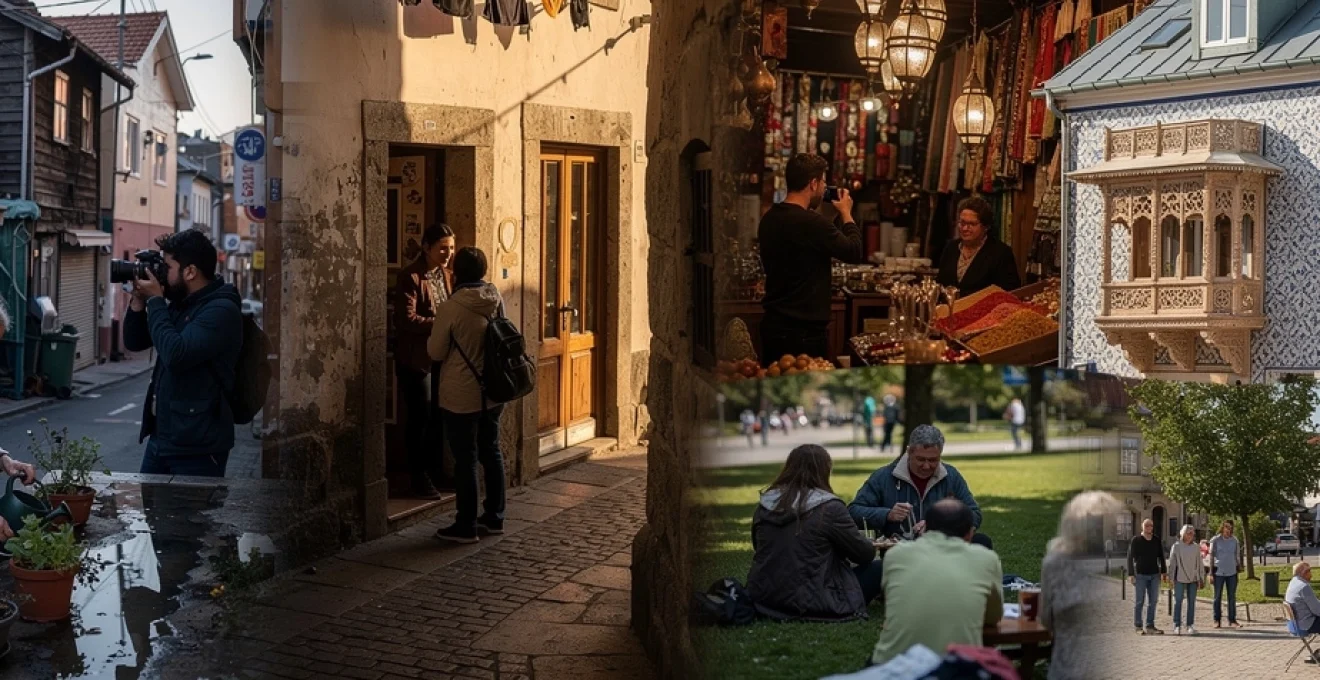
Across continents and cultures, extraordinary moments hide within ordinary days. A weathered doorway in Lisbon reveals centuries of stories through its cracked paint. Morning mist transforms a San Francisco street into an impressionist painting. These fleeting instances of beauty surround us constantly, yet modern life’s relentless pace often blinds us to their presence. The practice of noticing—truly seeing—the world’s subtle magnificence requires intentional observation and a shift in perspective. Whether you’re navigating crowded urban centres or exploring quiet neighbourhoods, cultivating awareness of aesthetic details enriches daily experiences in profound ways. This exploration examines how different global environments offer unique opportunities for discovering visual poetry in the mundane, from architectural fragments to atmospheric phenomena that transform familiar spaces into galleries of natural art.
Phenomenological approaches to mindful observation in urban environments
Urban landscapes present layered opportunities for aesthetic discovery when approached with phenomenological awareness. This philosophical framework emphasises direct experience and perception, encouraging observers to suspend preconceptions and encounter cityscapes with fresh eyes. Rather than rushing through streets as mere transit corridors, phenomenological observation transforms walking into an active engagement with spatial qualities, textures, and sensory information that typically escape notice.
The practice begins with slowing down. Research indicates that pedestrians in major cities walk approximately 10% faster than they did a decade ago, creating a perpetual motion that prevents meaningful observation. When you deliberately reduce your pace, peripheral vision expands, allowing architectural details, light patterns, and human interactions to emerge from the visual noise. This deceleration doesn’t require hours—even five minutes of intentional observation during a lunch break can shift your relationship with familiar environments.
Wabi-sabi philosophy: embracing imperfection in tokyo’s shitamachi districts
Tokyo’s historic shitamachi neighbourhoods embody wabi-sabi aesthetics, the Japanese philosophy celebrating impermanence, imperfection, and incompleteness. These downtown districts, concentrated in areas like Yanaka and Kagurazaka, preserve pre-war wooden structures where weathered materials tell temporal stories. Cracks in ceramic roof tiles, moss-covered stone lanterns, and faded shop curtains demonstrate beauty’s emergence through natural aging processes rather than despite them.
Observing wabi-sabi requires reframing conventional beauty standards. Instead of seeking pristine surfaces, you learn to appreciate patina as visual depth, asymmetry as organic authenticity, and simplicity as refined elegance. A wooden fence post, split and silvered by decades of sun exposure, becomes more compelling than its freshly-installed counterpart. This perspective shift proves particularly valuable in contemporary urban environments dominated by glass, steel, and synthetic materials designed to resist aging.
Visual anthropology techniques for street photography documentation
Visual anthropology methods, traditionally employed by researchers documenting cultural practices, offer powerful frameworks for everyday observation. These techniques emphasise contextual relationships, recurring patterns, and the significance of seemingly insignificant details. When you adopt an anthropological lens during daily routines, mundane scenes reveal cultural values, social dynamics, and historical continuities embedded in spatial arrangements.
Consider photographing the same street corner across different times of day for a week. Morning light illuminates distinct activities—vendors arranging produce, commuters queuing for buses, shutters rising on shopfronts. This systematic documentation unveils rhythms invisible during single observations, creating what anthropologists call « thick description » that captures layers of meaning beyond surface appearances. You don’t need professional equipment; contemporary smartphone cameras provide sufficient quality for this practice.
Chiaroscuro lighting patterns in mediterranean alleyways
Mediterranean urban design creates dramatic chiaroscuro effects—the interplay between intense light and deep shadow that classical painters exploited for emotional impact. Narrow alleyways in coastal cities like Dubrovnik, Valletta, or Chania function as natural studies in tonal contrast, where brilliant sunshine carves sharp-edged shadows across whitewashed walls and cobblestone pathways.
These lighting conditions shift throughout the day, offering different aesthetic experiences hourly. Mid-morning sun creates geometric shadow patterns from wrought-iron balconies, transforming blank walls into temporary art
patterns, while late-afternoon light softens edges and warms stone surfaces to a honeyed glow. By pausing at different intervals—every hour, or even every half-hour—you can witness how the same alleyway becomes a succession of distinct visual compositions. This is a practical way to train your eye to recognise that urban beauty is not static but constantly evolving with the sun’s angle and intensity.
To make the most of chiaroscuro in everyday life, you might choose one familiar route and consciously observe how light falls on it across a single week. Notice where shadows lengthen, where reflective windows intensify brightness, and where shaded recesses harbour cooler hues. Over time, your morning commute or evening walk can feel less like a routine and more like a living light installation that shifts with the seasons and weather conditions.
Sensory ethnography: documenting auditory landscapes in marrakech souks
While visual experiences often dominate discussions of beauty, sensory ethnography reminds us that soundscapes shape our perception of place just as powerfully. In Marrakech’s labyrinthine souks, the auditory environment forms a dense tapestry: metalworkers hammering copper trays, vendors calling out prices, scooters weaving through crowds, and the distant cadence of the adhan (call to prayer). Rather than treating this as background noise, sensory ethnography invites us to listen as carefully as we look.
You can apply the same mindset in your own city. Choose a busy marketplace, transit hub, or plaza, and spend five to ten minutes with your eyes partially closed, cataloguing distinct layers of sound. Which rhythms repeat? Where do human voices intersect with mechanical hums or natural elements like wind or birdsong? Recording short audio snippets on your phone and replaying them later can reveal patterns you missed in the moment, deepening your appreciation of how everyday soundscapes give emotional texture to urban life.
Architectural micro-details: vernacular design elements across continents
Beyond skylines and landmark buildings, the real character of a city often resides in small-scale architectural details. These vernacular elements—tiles, railings, balconies, door knockers, rooflines—carry regional histories and craft traditions that reward close inspection. By shifting your focus from grand monuments to micro-details, you begin to notice how culture, climate, and material availability converge in subtle but compelling ways.
Training yourself to observe these architectural micro-details can be as simple as looking one storey lower on facades you normally scan past. Instead of photographing an entire street, zoom in on a single balcony or doorway. Over time, you’ll build an intuitive library of visual motifs, from geometric patterns to floral carvings, that transforms even routine walks into informal design research and strengthens your ability to find beauty in everyday life around the world.
Azulejos tilework traditions in porto’s ribeira quarter
In Porto’s Ribeira quarter, azulejos—the iconic glazed ceramic tiles of Portugal—turn ordinary facades into elaborate canvases. Historically used to protect walls from moisture while moderating interior temperatures, these tiles evolved into highly sophisticated decorative systems. Blue-and-white narrative panels depict ships, saints, and pastoral scenes, while repeating geometric motifs create rhythmic patterns that shift with perspective and light.
When you walk through Ribeira with an observant eye, you’ll notice that no two tile compositions age in exactly the same way. Some panels are chipped or faded, revealing the underlying masonry; others have been partially replaced, creating subtle patchworks of old and new glazes. Photographing small sections—rather than entire walls—helps you appreciate the craftsmanship of individual tiles, from brushstroke variations to hairline cracks that form intricate, unintended designs over decades.
Hand-carved jharokha balconies of jaisalmer’s golden city
In Jaisalmer, Rajasthan, the sandstone jharokha balconies that protrude from havelis (traditional mansions) embody centuries of artisanal expertise. These projecting windows, framed by ornate latticed stonework, once allowed women to observe street life while remaining unseen. Up close, the carvings reveal floral motifs, geometric grids, and mythological figures rendered with astonishing delicacy in a material usually associated with mass and solidity.
To appreciate this vernacular design fully, it helps to look beyond the postcard view of Jaisalmer’s fort and focus on the negative spaces—the gaps between carved elements that filter light and air. Notice how the same balcony appears different in morning shadow, harsh midday sun, and the warm glow of sunset. You can apply this lesson anywhere: when you see a balcony or window grille in your own city, ask yourself how its design mediates privacy, ventilation, and social interaction, and how time has softened or sharpened its edges.
Art nouveau ironwork craftsmanship in brussels’ ixelles commune
Brussels’ Ixelles commune is a living archive of Art Nouveau ironwork, where stair railings, balcony guards, and door grilles twist into sinuous, plant-inspired forms. Architects like Victor Horta transformed functional metal components into expressive lines that seem to grow organically from masonry, blurring the boundary between structure and ornament. At street level, this means that even a short walk reveals a surprising diversity of ironwork patterns.
Instead of admiring these buildings only as facades, try isolating one element at a time. Trace the curve of a single railing with your eyes, noting how it thickens, thins, and curls back on itself, much like a vine. Consider how such details influence your emotional response to the street: would the same building feel as welcoming or poetic if the railing were a plain rectangle? This exercise sharpens your sensitivity to how even minor design decisions contribute to the overall beauty of urban environments.
Weathered patina development on copenhagen’s copper roofscape
Copenhagen’s historic roofscape, punctuated by church spires and civic buildings clad in copper, offers a slow-motion study in material transformation. Freshly installed copper shines with a warm metallic hue, but years of exposure to rain, salt air, and pollution gradually produce the characteristic green patina seen on many Scandinavian rooftops. This chemical change is not merely protective; it also gives the city its distinctive visual identity.
When you observe these roofs from a vantage point—perhaps a tower or hill—you can see a gradient of ages: some surfaces bright and new, others mid-transition with streaks of brown and green, and a few uniformly verdigris. This invites us to reconsider “aging” in our own built environments. Instead of viewing rust, discoloration, or surface wear as purely negative, we can recognise them as stages in an ongoing dialogue between material and climate, each phase adding nuance to the city’s aesthetic story.
Ephemeral natural phenomena: capturing transient atmospheric conditions
Some of the most compelling forms of everyday beauty are also the most fleeting. Atmospheric conditions—light quality, moisture levels, particulate matter—shift from moment to moment, creating effects that may never repeat in exactly the same way. Learning to notice and anticipate these ephemeral phenomena turns even familiar landscapes into sites of continuous discovery.
From a practical standpoint, this means paying attention to weather forecasts, seasonal cycles, and daily light patterns, then aligning your movements with them when possible. Doing so doesn’t require expensive equipment; even with a smartphone camera and basic awareness, you can cultivate a deeper connection to your surroundings by seeking out golden hours, fog banks, or night skies that reveal the atmosphere’s hidden choreography.
Golden hour wavelength distribution in santorini’s caldera basin
In Santorini’s caldera basin, the famed golden hour is not just a romantic cliché but a demonstrable play of light physics. As the sun dips lower, its rays pass through more of the Earth’s atmosphere, scattering shorter blue wavelengths and allowing longer red and orange wavelengths to dominate. Whitewashed buildings along the cliffside act as giant reflectors, amplifying warm tones and bathing alleys in a diffuse, honeyed glow.
To experience this effect mindfully, choose a single vantage point and remain there for the full duration of sunset rather than hopping between viewpoints. Watch how color temperature changes on specific surfaces—the dome of a church, a stone stairway, the water’s ripples—every few minutes. You can apply the same principle in your own city: seek elevated or reflective surfaces during golden hour, and notice how their hues shift in response to subtle changes in wavelength distribution, making everyday scenes feel cinematic.
Fog density variations through san francisco’s presidio forest
San Francisco’s Presidio offers a living laboratory for observing fog, a phenomenon shaped by ocean currents, air temperature, and topography. On some days, a dense marine layer blankets the forest, swallowing sound and desaturating color; on others, tendrils of mist weave between cypress trunks, creating layered depth and softening edges. Even within a single morning, fog density can vary dramatically as wind patterns shift.
If you walk the same trail on multiple foggy days, you’ll begin to recognise distinct “moods” of the forest: quiet and cocooned under heavy fog, mysterious and semi-transparent under patchy mist, or sharply defined when the fog suddenly lifts. Tracking these variations—mentally or in a simple journal—reinforces the idea that the beauty of everyday life is often tied to minute atmospheric changes we usually overlook as “just the weather.”
Bioluminescent plankton occurrences in vieques’ mosquito bay
In Vieques’ Mosquito Bay, microscopic dinoflagellates emit light when disturbed, turning every paddle stroke into a burst of electric blue. While this may seem far removed from daily life, it illustrates how complex interactions between organisms and environment can yield extraordinary sensory experiences. Water temperature, nutrient levels, and moonlight all affect the intensity of bioluminescence, making bright displays relatively rare and weather-dependent.
We can draw a practical lesson from this: some forms of beauty only appear when multiple conditions align. In our own routines, this might be the way streetlights reflect off rain-slicked pavement after a storm or how freshly fallen snow transforms traffic noise into a muted hush. By staying attuned to such “conditional” phenomena, we become more adept at recognising and appreciating transient wonders that many people pass by without noticing.
Aurora borealis visibility patterns across iceland’s þingvellir national park
Iceland’s Þingvellir National Park is renowned for aurora borealis displays, yet even there, visibility depends on geomagnetic activity, cloud cover, and light pollution levels. Solar particles colliding with atmospheric gases produce shifting curtains of green, pink, and violet that can appear and vanish within minutes. For locals, the aurora can become almost routine, but intentional observation restores its sense of awe.
Most of us may never live under regular auroral skies, but the principle remains applicable: many atmospheric phenomena—star visibility after a power outage, the clarity of air after rainfall, or the contrast of clouds at dawn—are contingent on timing and conditions. Setting occasional “sky appointments,” where you simply step outside at specific hours to look up, can reconnect you with these everyday cosmic performances, whether in a dark rural field or a city courtyard framed by high-rises.
Cultural rituals and performative daily practices in public spaces
Beyond physical environments, everyday beauty also arises from the repetitive, often understated rituals people enact in public spaces. Sociologists sometimes describe these movements as “micro-performances” that give rhythm and meaning to shared environments: morning exercises, market negotiations, communal chores. Observing these practices through a respectful, curious lens reveals how culture imbues routine actions with aesthetic and emotional resonance.
When we recognise these daily performances as worthy of attention—rather than dismissing them as background activity—we start to see our own habits differently as well. Even simple gestures like greeting a neighbour, buying coffee, or waiting at a crosswalk can be understood as part of a broader choreography of urban life, one that varies from city to city but shares a common human impulse toward ritual and connection.
Morning tai chi choreography in shanghai’s fuxing park
In Shanghai’s Fuxing Park, dawn brings groups of residents performing tai chi, sword forms, fan dances, and other exercises in unison. From a distance, these movements create flowing patterns across lawns and pathways; up close, you can see the concentration in each participant’s face, the synchronicity of breath and gesture, and the quiet social bonds that form through shared practice. The park becomes an open-air studio where bodies, trees, and morning light interact in a continuous, evolving composition.
Even if your local park hosts joggers instead of tai chi practitioners, you can adopt the same observational stance. Notice repetition: who appears at the same time each morning? How do their routines—stretching, dog walking, chatting on benches—form a kind of collective choreography? Recognising these patterns can make your own morning exercise or commute feel less solitary and more like participation in a subtle, ongoing public performance.
Ceremonial tea service aesthetics at kyoto’s urasenke foundation
At Kyoto’s Urasenke Foundation, the Japanese tea ceremony elevates everyday actions—boiling water, whisking matcha, offering a bowl to a guest—into a highly codified art form. Every element, from the texture of the ceramic bowl to the angle of the host’s bow, is designed to cultivate presence and mutual respect. Observing or participating in such a ceremony highlights how deliberate slowness and attention to detail can transform ordinary tasks into experiences of profound beauty.
You don’t need access to a formal tea school to apply these insights. Preparing your morning coffee or afternoon tea can become a micro-ritual if you approach it with similar care: choosing a favourite mug, noticing the sound of water pouring, appreciating the rising steam. By treating these daily acts as small ceremonies rather than mere refuelling, you weave intentional beauty into the fabric of your routine.
Collective laundry traditions at mumbai’s dhobi ghat
Mumbai’s Dhobi Ghat, often called the world’s largest open-air laundry, presents a vivid example of functional work taking on an almost sculptural quality. Rows of concrete wash pens, lines of billowing fabric, and workers rhythmically beating clothes against stone create a dynamic landscape of color and movement. From above, the scene resembles an abstract painting; on the ground, it reveals the coordination and community required to process thousands of garments daily.
Noticing the aesthetic dimension of such labour-intensive spaces encourages us to reframe similar sites in our own lives: laundromats, markets, construction zones. Instead of seeing only noise and clutter, we can look for patterns in color (rows of shirts, stacks of crates), rhythm (repetitive motions, machine cycles), and social interaction. This shift doesn’t romanticise hard work but acknowledges that human ingenuity and cooperation often produce unexpected forms of everyday beauty.
Botanical adaptations: flora integration within human settlements
Plants have an uncanny ability to find footholds in built environments, softening hard edges and reintroducing organic forms into concrete landscapes. From climbing vines on historic facades to spontaneous wildflowers in vacant lots, these botanical adaptations demonstrate resilience and opportunism. Observing how flora integrates with human settlements offers a powerful reminder that nature persists not just in designated parks but in cracks, courtyards, and window boxes.
Cultivating an eye for urban plant life can enrich day-to-day experiences wherever you live. As you walk through your neighbourhood, you might ask: where are plants asserting themselves against the built environment, and where are humans deliberately incorporating them into design? This dual perspective highlights both ecological processes and cultural attitudes toward greenery, revealing the many ways in which everyday beauty emerges at the interface of stone and stem.
Climbing bougainvillea formations on cartagena’s colonial façades
In Cartagena’s historic centre, vivid bougainvillea cascades over colonial facades, weaving magenta, orange, or fuchsia blossoms through wrought-iron balconies and weathered stucco. The plant’s thorny stems, trained over years, follow architectural lines yet also defy them, spilling around corners and framing doorways in irregular, exuberant shapes. This juxtaposition of disciplined pruning and wild growth creates a living ornament that changes with seasons and light.
When you encounter similar climbers in your own city—ivy on brick, jasmine over fences—try to notice both the human hand and the plant’s own agency. Where has the vine been guided, and where has it explored on its own? This perspective transforms a “nice facade” into an ongoing collaboration between gardener and organism, reinforcing the idea that everyday beauty often arises from negotiated relationships rather than fixed, finished designs.
Moss garden ecosystems in portland’s pearl district courtyards
Portland’s Pearl District, known for its converted warehouses and modern lofts, also hides small courtyard gardens where moss thrives in the Pacific Northwest’s damp climate. On shaded stones, retaining walls, and brick steps, moss creates soft, emerald carpets that mute hard surfaces and highlight subtle contours. Up close, these patches reveal tiny forests with their own micro-topography, water droplets, and sporophytes reaching upward like miniature trees.
Paying attention to such humble ecosystems trains you to appreciate low-profile forms of beauty that many people step over without a second thought. In any city with regular rainfall or humidity, you can seek out moss along sidewalks, under bridges, or in older cemeteries. Bringing your gaze down to ground level, rather than always scanning the horizon, uncovers a quieter world of textures and colours that reward patient observation.
Wildflower succession patterns in berlin’s gleisdreieck park
Berlin’s Gleisdreieck Park, built on former railway land, showcases how wildflowers colonise and transform disturbed ground. Different species dominate at various points in the growing season: early spring may belong to delicate blues and whites, while late summer fields glow with yellows and purples. These succession patterns create a dynamic mosaic that shifts not only month to month but year to year as management practices and seed banks evolve.
Tracking such changes—even informally with occasional photos—deepens your relationship with a place. You start to anticipate certain blooms the way you might anticipate annual festivals, understanding that the park’s beauty at any given moment is one chapter in a longer ecological narrative. This approach can be applied to roadside verges, vacant lots, or riverbanks near you, turning overlooked margins into sites of ongoing botanical drama.
Material weathering processes: textural evolution through environmental exposure
All materials change over time, and those transformations often generate some of the most compelling textures in our built environment. Sun bleaches paint; wind erodes stone; hands polish railings; graffiti is layered, painted over, and partially revealed again. These weathering processes are sometimes treated as problems to be fixed, yet they also record the passage of time in ways that can be visually and emotionally enriching.
Noticing material weathering is akin to reading a palimpsest—a manuscript written, erased, and written over again. When you train yourself to look for subtle stains, worn edges, and overlapping marks, walls and pavements become archives of human use and environmental forces. The chipped corner of a stair, for example, may testify to thousands of rushed footsteps; a discoloured patch on a facade might reveal where an old sign once hung, hinting at forgotten businesses or communities.
In practical terms, you can make a habit of revisiting the same surfaces at intervals—every few months or seasons—and noting new changes. Perhaps a metal bench has developed fine rust patterns after a rainy winter, or a wooden door has deepened in colour and texture with repeated varnishing and sun exposure. These observations remind us that cities are not static backdrops but evolving entities, shaped slowly yet ceaselessly by climate and human contact.
By embracing material weathering as a source of everyday beauty, we also cultivate patience and acceptance. Just as a patinated roof or worn threshold can feel more inviting than a flawless, untouched surface, recognising beauty in our surroundings’ imperfections can help us extend the same generosity to our own lives. In this way, the practice of observing texture and change becomes not merely an aesthetic exercise, but a quiet, ongoing lesson in how to live more attentively and appreciatively wherever we are.