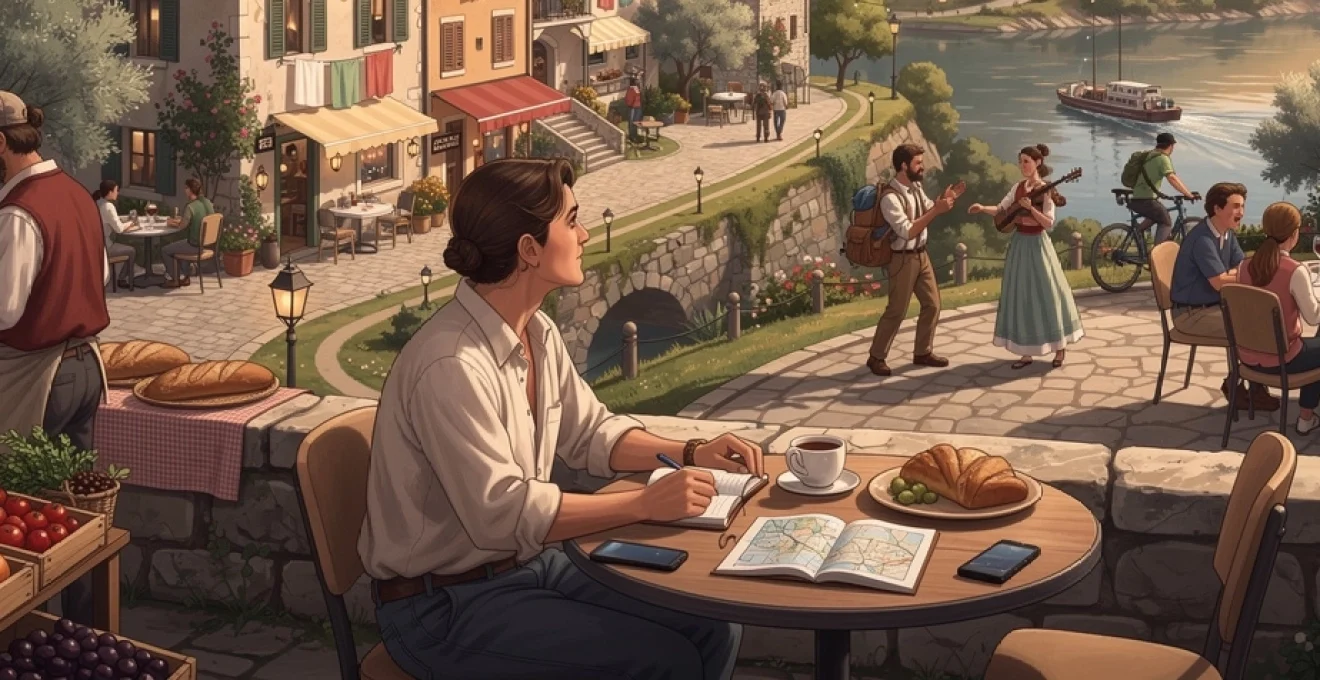
Modern travel has become a relentless pursuit of bucket-list destinations, Instagram-worthy moments, and exhaustive itineraries that promise to squeeze every attraction into impossibly short timeframes. Yet an increasing number of seasoned travellers are rejecting this frenetic approach, discovering instead that the most profound travel experiences emerge not from racing through cities but from pausing long enough to truly absorb them. This fundamental shift from quantity to quality represents more than a passing trend; it signals a return to the original purpose of travel—transformation, connection, and genuine understanding of places beyond our everyday existence.
The slow travel movement challenges the prevailing assumption that seeing more automatically equals experiencing more. Research from the Journal of Travel Research indicates that travellers who spend extended periods in fewer locations report 73% higher satisfaction rates than those following traditional multi-destination itineraries. This approach doesn’t merely offer relaxation; it fundamentally changes how you perceive, understand, and remember the places you visit.
Slow travel philosophy: deconstructing the mindset shift from tourist to cultural immersion
The philosophical foundation of slow travel rests on a deliberate rejection of extractive tourism—the practice of consuming destinations as commodities to be photographed and checked off lists. Instead, this approach embraces what anthropologists call deep travel, a practice rooted in ethnographic observation and participatory engagement with local cultures. The distinction between tourists and travellers has long been debated, but slow travel offers clear parameters: tourists observe from outside; slow travellers participate from within.
This mindset shift requires confronting what psychologists term achievement orientation in leisure—the compulsion to maximize productivity even during holidays. When you adopt slow travel principles, you’re essentially deprogramming decades of cultural conditioning that equates busyness with value. The transformation begins with accepting that experiencing one neighbourhood authentically delivers greater cultural capital than superficially visiting an entire city. This isn’t about laziness or lack of curiosity; it’s about understanding that genuine cultural comprehension requires temporal investment that conventional tourism timelines simply cannot accommodate.
The economic implications of this shift deserve consideration as well. Local communities benefit substantially more from slow travellers who patronize neighbourhood businesses repeatedly over weeks rather than tourists who concentrate spending in tourist districts during brief visits. A 2022 study by the European Travel Commission found that slow travellers contribute 240% more to local economies per capita than conventional tourists, despite often having smaller daily budgets. This occurs because extended stays naturally distribute spending across diverse local businesses rather than concentrating it within tourism-oriented establishments.
The essence of slow travel lies not in doing less, but in experiencing more deeply—trading breadth for depth, surfaces for substance, and photographs for memories that transform how you understand the world.
Adopting this philosophy means redefining what constitutes a successful journey. Success isn’t measured by monuments visited but by conversations held, routines established, and the subtle recognition you receive from the baker who now knows your usual order. It’s the difference between knowing Paris has the Eiffel Tower and understanding how Parisians actually live, work, and find joy in their arrondissements.
Strategic itinerary design for extended destination engagement
Conventional trip planning typically starts with selecting multiple destinations, then allocating days to each based on perceived importance. Slow travel inverts this formula entirely, beginning instead with temporal commitment—deciding how long you can travel—then selecting a single location worthy of that investment. This reversal fundamentally changes the planning process, shifting focus from logistical coordination to experiential depth.
The strategic approach to slow travel itineraries involves three core planning phases: location selection based on personal resonance rather than popularity, temporal structuring that allows for spontaneity and routine development, and intentional avoidance of pre-booking activities beyond initial accommodation. This flexibility proves essential because authentic experiences often emerge unexpectedly through local recommendations, chance encounters, and developing interests that couldn’t be anticipated during initial planning stages.
Micro-destination selection: focusing on single neighbourhoods and villages
Rather than choosing Rome, choose Trastevere. Instead of Portugal, select the Alentejo region. This geographical narrowing might seem limiting, but it actually expands experiential possibilities exponentially. When you commit to a micro-destination, you’re granting
that place permission to unfold at human speed. You start to recognize the cadence of morning deliveries, the way light moves across the same square, the subtle differences between weekday and weekend energy. Over time, what began as a dot on the map becomes a living ecosystem you can navigate without a phone in your hand. This is the heart of slow travel: allowing a single neighbourhood, village, or valley to reveal its layers through repeated, unhurried encounters.
When choosing a micro-destination for slow travel, prioritize density of everyday life over density of attractions. Look for places with a local market, a walkable core, accessible public transport, and at least a few independent cafés or bars where people linger. Tourist reviews might dismiss such places as “nothing to do”, which is precisely what makes them fertile ground for cultural immersion. You are not looking for a checklist; you are looking for a place where you can build a temporary, lived-in routine.
One practical approach is to map your interests—food, crafts, music, nature trails—and then search for smaller towns or neighbourhoods known for those specific qualities rather than for global fame. Instead of heading straight to Florence, for example, you might base yourself in a Tuscan hill town within train distance, using the city as an occasional excursion rather than your primary focus. Over a two- or three-week stay, you will very likely realize that the quiet streets, the baker’s morning greeting, and the market vendor who remembers your preferred tomatoes become more meaningful than any iconic landmark.
Duration optimisation: spending three weeks in one location versus multi-city sprints
Slow travel demands an honest reckoning with time. The traditional model—four cities in ten days, internal flights, and daily hotel changes—creates what cognitive psychologists call “experience compression”, where memories blur and stress levels spike. In contrast, committing three weeks to a single location allows your nervous system to downshift, your curiosity to deepen, and your sense of belonging to grow. Instead of spending energy on constant transitions, you invest that energy in understanding context: history, social norms, and the subtle rituals of everyday life.
From a purely practical standpoint, longer stays are remarkably efficient. Once you remove repeated check-ins, transfers, and packing cycles, you reclaim hours—sometimes entire days—of your trip. A 2023 survey by Booking.com found that travellers on stays of 14 nights or more reported 40% lower perceived travel fatigue than those moving every two to three days. That reclaimed bandwidth can be redirected into morning language exchanges, slow café conversations, or simply wandering with no destination in mind, which are precisely the conditions under which serendipity thrives.
If committing three weeks to one place feels daunting, consider a hybrid model: one primary base for the majority of your time, plus one shorter side trip. The key is to resist the urge to “add just one more city” until your itinerary resembles a logistical puzzle rather than a journey. Ask yourself: would you rather say you have been to six cities, or that you actually know one? When you frame time as your main currency instead of miles, extending your stay in a single destination suddenly feels like a luxury rather than a sacrifice.
Seasonal timing and off-peak travel windows for authentic experiences
The art of slowing down while traveling is inseparable from the seasons. Peak periods—summer holidays, major festivals, long weekends—tend to accelerate destinations, pushing locals into survival mode and travellers into queues, crowds, and inflated prices. In contrast, travelling in shoulder or off-peak seasons often reveals a more authentic, less performative version of a place. Streets are less congested, conversations less hurried, and you are more likely to encounter people with time to talk rather than just transact.
From an experiential perspective, off-peak travel windows encourage you to align with local rhythms rather than forcing your own. Visit a Mediterranean fishing village in November and you’ll see the real economy at work: boats coming in, cafés populated mainly by residents, and menus shifting with colder weather. According to the World Tourism Organization, off-season travellers not only spend more per day locally but also report higher levels of perceived cultural authenticity. Why? Because the destination is no longer staged primarily for outsiders; it is simply going about its life.
There are, of course, trade-offs: shorter days, cooler temperatures, or the occasional closed restaurant. Yet these constraints can actually support slow travel, limiting the temptation to over-schedule and inviting more indoor, community-based experiences—concerts, workshops, or lingering in bookshops and cafés. When you plan a slow travel itinerary, start not with dates of school holidays but with questions like: when does the olive harvest happen? When are the grape crushes? When do locals celebrate their lesser-known saints’ days? Aligning your timing with these quieter, hyper-local events often yields the most memorable, grounded experiences.
Accommodation anchoring: choosing homestays, agriturismos, and long-term rentals
In slow travel, accommodation is not just a place to sleep; it is your primary interface with the destination. Hotels optimized for quick turnover and anonymous stays tend to reinforce a tourist bubble, while homestays, agriturismos, and long-term rentals invite you to participate in daily life. When you stay in an Italian agriturismo, for example, your morning view might include vineyards or vegetable plots you’ll later taste at dinner, closing the loop between landscape, labour, and cuisine. That sense of continuity is difficult to achieve in a chain hotel overlooking a motorway.
Choosing an “anchor” accommodation for at least a week reshapes your behaviour. You learn where to buy bread, how the garbage system works, when neighbours leave for work, and which cafés fill up with locals after school or before church. These micro-observations turn a generic destination into a specific, lived-in place. Platforms that specialize in medium- to long-term rentals, along with local guesthouses, can be powerful tools for this style of travel, particularly when you prioritize hosts who live on-site or nearby and are willing to share their own routines and recommendations.
There are tangible economic and environmental advantages as well. Weekly or monthly rates usually cost less per night than short hotel stays, freeing budget for experiences like cooking classes or language lessons. Staying put also reduces your transport-related emissions significantly; a 2021 study by the European Environment Agency found that cutting one intra-European flight from a two-week trip reduces the journey’s carbon footprint by up to 40%. In slow travel, where you sleep is not just a logistical choice—it’s a strategic decision that shapes how deeply you can root into a place.
Practicing deep locality: embedding yourself in community rhythms
Once you have chosen a micro-destination and anchored your accommodation, the next phase of slow travel is what we might call practicing deep locality. This means consciously shifting from spectator to participant, from passive consumer to active neighbour. Rather than chasing novelty at every turn, you start to repeat certain actions: visiting the same bakery, walking the same riverside path, sitting at the same café table. At first this may feel counterintuitive—“Shouldn’t I be doing something new every day?”—but repetition is what transforms unfamiliar streets into a temporary home.
Anthropologists often emphasize “participant observation” as a method for understanding cultures, and slow travel borrows directly from this approach. You don’t simply observe the market; you buy your vegetables there daily. You don’t just photograph a local festival; you ask a neighbour what it means and how to participate respectfully. Over time, you tune into the invisible schedule that governs a community: when the shutters close, when the children play in the square, when the older generation gather to talk. In this way, you are not just visiting a location; you are learning its rhythm.
Daily routines at local markets: the mercato di testaccio model in rome
Few places reveal a community’s soul as clearly as its markets. Consider Rome’s Mercato di Testaccio, often cited as a model for integrating tradition with contemporary urban life. At first glance, it’s a collection of produce stalls, but spend several mornings there and you’ll notice an intricate choreography: nonnas inspecting artichokes with forensic precision, workers grabbing espresso and panini before their shifts, and schoolchildren weaving between stalls on their way home. This is slow travel in microcosm—a place you could rush through in 20 minutes, or inhabit deeply over weeks.
Building a daily or near-daily market routine transforms the way you eat, budget, and connect. Instead of relying on anonymous supermarkets, you develop relationships with specific vendors who begin to make recommendations based on what is truly in season. A 2020 study on food tourism found that travellers who integrated local markets into their everyday routines reported a 55% higher sense of “place attachment” than those who only dined in restaurants. Markets like Testaccio’s also function as informal language schools, where you can practice simple phrases repeatedly in low-stakes situations and receive instant feedback—smiles, corrections, or the occasional recipe tip.
To adopt the Mercato di Testaccio model wherever you go, start by identifying the nearest market and committing to buy at least one item there every day—fruit, bread, flowers, or even just a coffee at an in-market bar. Arrive early, when locals shop, rather than at midday when crowds peak. Observe unspoken rules: how people queue, how they order, how they greet each other. Over a few days, you’ll move from outsider watching a performance to a recognizable presence participating in the daily script.
Language immersion through conversational practice and regional dialect exposure
Language is the operating system of culture, and slow travel offers a rare opportunity to install at least a partial version of it. While fluency is unrealistic on short trips, meaningful conversational competence is surprisingly attainable when you stay put and practice daily. Instead of relying on translation apps for every interaction, you begin to assemble a toolkit of phrases for greetings, ordering food, asking directions, and expressing gratitude. Each successful exchange is a small victory—and a small bridge into the local mindset.
Interestingly, it is often the regional dialects rather than standard textbook language that reveal the most about a place. In Andalusia, you’ll hear dropped consonants and expressive idioms; in Naples, a passionate local dialect that carries centuries of history. At first, this can be disorienting—“Why doesn’t this sound like my app?”—but with repeated exposure, your ear starts to adapt. Linguists call this process accommodation, and it is one of the most intimate forms of cultural immersion: you are literally tuning your perception to the community around you.
Practical strategies can accelerate this immersion. Signing up for a short local language course, even just a week, gives you structure and a base of fellow learners. Beyond that, micro-practices—such as committing to order every coffee or bus ticket in the local language—compound quickly. Could you challenge yourself to have one five-minute conversation with a local each day, however imperfect? Those imperfect conversations often become the most memorable travel moments, and they anchor your experience in human connection rather than consumption.
Establishing third places: cafés, tavernas, and neighbourhood gathering spots
Sociologist Ray Oldenburg popularized the concept of “third places”—informal public spaces beyond home (first place) and work (second place) where community life happens. For slow travellers, establishing a third place is a powerful way to plug into local social currents. This might be a taverna where older men play cards every evening, a café where freelancers and students linger with laptops, or a park bench that reliably fills with dog walkers at dusk. What matters is not the venue itself, but your repeated presence there.
Returning to the same third place over multiple days or weeks generates what psychologists call “weak ties”—casual relationships that, while not intimate, significantly increase your sense of belonging. The barista who starts your espresso before you order, the bartender who remembers your preferred wine, the dog owner who nods hello each evening: these micro-interactions stitch you into the social fabric. A 2019 study on urban wellbeing found that people with a strong sense of third-place connection reported higher life satisfaction, even when they knew few people by name.
To identify your third place while traveling slowly, pay attention to where locals linger rather than rush. Avoid venues explicitly designed for tourists and look for spaces where time seems to stretch—where people read, chat, or simply sit. Once found, go back. Bring a book, a notebook, or nothing at all. Resist the urge to treat the café as mere fuel stop; think of it instead as your temporary living room, a vantage point from which to observe and gently participate in everyday life.
Participating in local festivals and non-touristic cultural ceremonies
Festivals, rituals, and ceremonies offer a condensed, symbolic expression of a community’s values and history. Yet slow travel distinguishes between consuming these events as spectacle and participating in them respectfully. Well-known festivals—from Spain’s Semana Santa to Japan’s Gion Matsuri—now attract global audiences, and while they can still be profound, their scale can make genuine engagement difficult. Smaller, lesser-known events—a village harvest festival, a local saints’ day procession, or a neighbourhood iftar during Ramadan—often provide a more intimate, less mediated experience.
How do you access these non-touristic moments without intruding? The key is relational entry. Neighbours, hosts, and café regulars are often your best guides, especially if you express genuine curiosity rather than checklist urgency. Ask open questions: “Is there anything special happening in the village this month?” or “Are there any traditions I should know about while I’m here?” Many communities are proud to share their customs when approached with humility and a willingness to learn and adapt your behaviour.
When you do participate, prioritize observation before documentation. Put the camera away for at least the first hour; watch who leads, who follows, when people clap or remain silent. Dress modestly and in line with local norms, and ask permission before photographing individuals. Think of yourself not as a consumer of culture but as a temporary guest at a family gathering—your primary role is to honour the occasion, not to extract content from it. When approached this way, even a small village ceremony can leave a deeper imprint than the most famous attractions.
Mindful movement: transportation methods that encourage contemplation
The way you move through a landscape shapes the way you experience it. High-speed trains, budget flights, and express buses prioritize efficiency, often compressing hundreds of kilometres into a blur outside the window. Slow travel, by contrast, asks a different question: not “How quickly can I get there?” but “What might I discover if I give the journey as much importance as the destination?” Mindful movement transforms transport from a logistical necessity into a core part of the travel experience.
Choosing slower modes of transportation—walking, cycling, regional trains, riverboats—acts like switching from fast-forward to real-time. You notice terrain shifts, architectural changes, and subtle transitions in dialect and cuisine that high-speed travel flattens or erases. Environmental data underscores the benefits: according to the European Environment Agency, travelling by train can reduce CO₂ emissions per passenger kilometre by up to 90% compared with flying. Yet beyond sustainability metrics, the subjective experience of moving slowly—of watching hills rise gradually or a river widen kilometre by kilometre—creates a narrative continuity that many modern journeys lack.
Walking pilgrimages: the camino de santiago and via francigena as slow travel archetypes
Walking pilgrimages represent one of the oldest and purest forms of slow travel. Routes like Spain’s Camino de Santiago or Italy’s Via Francigena predate modern tourism entirely, built around spiritual intention rather than sightseeing. Today, many walkers are secular, yet the core structure—moving at three to five kilometres per hour, day after day—still exerts a powerful psychological effect. Your world shrinks to essentials: the next village, the next meal, the next bed. In this stripped-down context, even small encounters—a shared table, a conversation on a dusty road—take on amplified meaning.
Studies on long-distance walking, including research published in Frontiers in Psychology, have documented reductions in stress, improvements in mood, and heightened feelings of connectedness after multi-day treks. On the Camino, the ritual of arriving in a new town each afternoon, washing clothes, and sharing a communal dinner with fellow pilgrims creates a temporary, international community bound by shared pace rather than shared background. On the Via Francigena, passing through tiny Italian villages that rarely see mass tourism, you experience hospitality that feels personal rather than transactional.
Of course, full-length pilgrimages require time and physical preparation, but you can apply the same principles in shorter segments. Walking a three-day stretch of the Camino or a week on the Via Francigena gives you a taste of this contemplative rhythm. The question shifts from “How many sites did I see?” to “How did the landscape change under my feet? Who did I meet on the way?” In this sense, pilgrimage is not just a route; it is a template for any travel that prioritizes movement at human speed.
Regional rail networks: using trenitalia and renfe for scenic, unhurried journeys
In much of Europe, regional rail networks offer an ideal compromise between speed and slowness. Systems like Italy’s Trenitalia regionale lines or Spain’s Renfe Media Distancia trains connect smaller towns and rural areas at a pace that allows you to actually see the countryside. Instead of flying from Rome to Florence, for instance, a regional train threads through Umbrian hills and Tuscan vineyards, turning “in-between” space into part of your narrative. You are not just teleporting from city to city; you are watching the fabric that binds them.
From a slow travel perspective, regional trains also encourage more spontaneous itineraries. You can hop off at an unplanned stop, explore a town for a few hours, and catch a later train—something far harder with flights or long-haul buses. A 2022 report from the European Commission noted a 17% increase in leisure travellers choosing regional rail over domestic flights, citing comfort, scenic value, and reduced stress as primary reasons. The ability to read, journal, or simply gaze out of the window while covering distance makes rail travel a natural fit for contemplative journeys.
To maximize the benefits of regional rail, consider basing yourself in a smaller hub town and using trains for day trips rather than constantly changing hotels. Study local timetables, note slower scenic routes, and embrace occasional delays as part of the experience rather than an obstacle. When your goal is the art of slowing down while traveling, a 20-minute delay can become a bonus chapter—an extra stretch of time to observe fellow passengers, read another few pages, or simply sit with your thoughts.
Cycling tourism infrastructure: EuroVelo routes and dedicated greenways
Cycling occupies a unique middle ground between walking and motorized transport. You move fast enough to cover meaningful distances, yet slow enough to smell vineyards, hear birdsong, and stop whenever something catches your eye. Across Europe, networks like EuroVelo—and countless national greenways—have transformed cycling from a niche pursuit into a mainstream form of sustainable, slow travel. Routes are often designed to avoid heavy traffic, following rivers, disused railway lines, or coastal paths that offer uninterrupted immersion in landscape.
Cycling days create a distinct rhythm: pack your panniers, ride for a few hours, pause in a village for coffee or lunch, then continue on to your next stop. Unlike road trips, where the car often becomes a barrier between you and your surroundings, the bicycle keeps you exposed and accessible. Locals are more likely to strike up conversations, offer directions, or point out hidden spots when you roll up quietly on two wheels rather than pull in with a car. In countries like the Netherlands, Denmark, and Germany, extensive cycling infrastructure means you can traverse regions almost entirely on dedicated paths, decoupled from the stress of sharing space with high-speed vehicles.
If you are new to cycling tourism, you don’t need to start with a multi-week expedition. A long weekend following a well-marked greenway—such as sections of EuroVelo 6 along the Loire or Danube—gives you a sense of the mental shift that occurs when your day’s progress depends on your own pedalling. Packing light, planning conservative daily distances, and allowing time for unplanned stops all support the slow travel ethos. Think of your bicycle not as a tool for achieving athletic goals, but as a moving balcony from which to watch the world.
River and canal navigation: barging through burgundy and dutch waterways
Waterways offer one of the most literal expressions of slow travel: you move at the speed of the current or the canal lock, with little ability—or desire—to rush. Barging through Burgundy’s canals or drifting along Dutch waterways transforms travel into an exercise in patient presence. Days are structured around simple tasks: navigating locks, mooring in small towns, shopping for provisions, cooking onboard, and taking evening walks along towpaths. The landscape unfolds gradually, fields giving way to villages, then to stretches of forest or vineyards.
River and canal journeys invert the usual relationship between accommodation and transport; your boat is both your moving home and your means of getting around. This continuity fosters a rare sense of groundedness even as you change location each day. Research into “blue space” exposure—time spent near water—suggests significant benefits for mental wellbeing, including reduced anxiety and increased feelings of calm. When combined with the slow mechanics of canal travel, these effects are amplified: you are not merely looking at water; you are living with it as your temporary environment.
Practical considerations include learning basic navigation skills, understanding local regulations, and embracing the inherent unpredictability of water levels and weather. Yet these very constraints reinforce the slow travel mindset. When a lock schedule dictates your departure time or a misty morning encourages a late start, you are reminded that you are moving within an ecosystem, not above it. The question becomes less “How far can we go today?” and more “What is this stretch of river inviting us to notice?”
Culinary deep dives: gastronomic exploration as time-intensive practice
Food is often the most direct and memorable expression of place, yet conventional tourism tends to reduce culinary experience to a checklist of famous dishes and restaurants. Slow travel reframes gastronomy as an extended conversation rather than a series of photo-ready meals. Instead of chasing the most “Instagrammable” plate in town, you might eat at the same neighbourhood trattoria multiple times, watch how the menu changes with the weather, and learn the names of the people in the kitchen. Over time, you come to understand not just what people eat, but why—how climate, history, and economy shape what appears on the table.
Engaging deeply with local food culture requires time: time to explore markets, to ask questions, to experiment in your own temporary kitchen, and to return to places that feel right. A 2021 study in the International Journal of Gastronomy and Food Science found that travellers who participated in hands-on culinary activities—cooking classes, farm visits, wine harvests—reported significantly higher levels of cultural understanding than those who only dined out. In other words, learning to cook a single regional dish with a local might teach you more about that region than sampling ten different restaurants in a rush.
Multi-course dining rituals: understanding italian pranzo and spanish sobremesa culture
In many cultures, slow food is not a trend but a built-in social technology. Take the Italian pranzo, a multi-course midday meal that, in smaller towns and rural areas, can stretch for hours. Or consider the Spanish sobremesa, the unhurried conversation that follows a meal, sometimes lasting longer than the eating itself. These rituals function as collective pauses in the day—a counterweight to constant motion. Participating in them as a traveller means aligning your schedule with local mealtimes rather than forcing your usual routine onto a new environment.
Experiencing pranzo properly might mean accepting that some shops will be closed in the early afternoon and planning your day around a long, seated meal instead of a quick sandwich. In Spain, joining sobremesa culture requires resisting the urge to ask for the bill immediately and allowing silence, digression, and storytelling to unfold at the table. This can be challenging if you are accustomed to viewing meals as refuelling stops, but it is precisely in this shift—from efficiency to enjoyment—that slow travel’s transformative power lies.
One way to integrate these multi-course rituals into your itinerary is to designate certain days as “long lunch days”, where the main activity is the meal itself. Choose a family-run restaurant, arrive without time pressure, and let the staff guide you through local specialties. Ask about the origins of dishes, seasonal ingredients, or traditional holiday meals. By turning lunch into your primary destination, you allow space for the kind of extended, meandering interactions that rarely occur within hurried dining windows.
Cooking classes and farm-to-table workshops in tuscany and provence
Cooking classes and farm-to-table workshops bridge the gap between consumer and producer, making visible the labour and knowledge behind each dish. In regions like Tuscany and Provence, such experiences often begin in the garden or field: harvesting vegetables, picking herbs, or visiting nearby farms to understand animal husbandry practices. Only then do you move into the kitchen, where techniques are demonstrated not as abstract recipes but as responses to specific ingredients and seasons.
For slow travellers, these workshops offer more than new skills; they create narrative anchors. Years later, you may forget the exact names of the villages you visited, but you will likely remember how to make panzanella with stale bread and sun-soaked tomatoes, or how the scent of Provençal thyme filled the air as you cooked. A 2022 survey by a major culinary travel agency reported that 68% of participants in farm-to-table experiences went on to seek out local producers more intentionally in their future travels, suggesting that these practices can permanently shift consumption habits.
When selecting a cooking class or workshop, prioritize smaller groups, locally-owned operations, and experiences that include some element of sourcing or harvesting. Ask whether the recipes taught are truly local and seasonal, and whether instructors are from the region or deeply rooted in its traditions. The goal is not to accumulate certificates, but to participate in a living chain of knowledge that has often been passed down through families for generations.
Wine terroir education: extended vineyard visits in rioja and douro valley
Wine regions like Spain’s Rioja and Portugal’s Douro Valley exemplify how landscape, climate, and human practice intertwine over centuries. A quick tasting can introduce you to flavours; an extended, slow engagement with the region introduces you to relationships. Staying several days near a cluster of vineyards allows you to visit the same estate more than once, observe different stages of the winemaking process, and ask increasingly sophisticated questions as your understanding deepens.
Terroir—a French term encompassing soil, climate, topography, and human intervention—cannot be grasped in a single sip. Walking between vines at different times of day, feeling the temperature shifts, noting how wind and river patterns change, you begin to appreciate why grapes respond as they do. Producers often light up when visitors show interest beyond the standard tasting script, and multi-day visitors may be invited to see barrel rooms, participate in small tasks, or taste experimental batches not yet on the market.
To practice wine education as slow travel rather than wine tourism as checklist, limit the number of estates you visit and expand the time you spend at each. Choose family-run bodegas or quintas alongside larger, more polished operations, and ask about the history of the land, not just the labels. Could you return to the same vineyard at harvest time one year and pruning season the next? Such longitudinal engagement, while not always feasible, represents the ultimate expression of slow travel: a relationship with a place that unfolds over years rather than days.
Digital detachment strategies for enhanced present-moment awareness
In an era where smartphones have become both map and memory, digital detachment may be the most radical aspect of slow travel. Constant connectivity encourages what researchers call “continuous partial attention”—a state in which you are never fully present where you are. Notifications tug you back to your home life; the compulsion to document drags you into the future, imagining how your experience will look on a screen. The result is a strange absence: you are physically present in a foreign city, yet mentally split across multiple timelines and locations.
Slow travel invites you to reverse this dynamic, using technology deliberately rather than reflexively. One effective strategy is to establish “connection windows”—specific times of day when you check messages, post updates if you wish, and handle logistics, while keeping your phone in airplane mode the rest of the time. This simple boundary can dramatically change your sensory experience of a place. You hear more street sounds, notice more facial expressions, and experience what psychologists call “soft fascination”—a gentle, restorative attention drawn to clouds, trees, or waves instead of screens.
Many travellers find it helpful to carry an analog backup for key functions: a paper map, a printed reservation, a small notebook for directions and phone numbers. This reduces dependence on your device as a single point of failure, making it easier to put it away without anxiety. If full digital detox feels unrealistic—especially for remote workers or those with caregiving responsibilities—consider a tiered approach: start by removing social media apps, then disabling push notifications, and finally experimenting with half or full days offline. Ask yourself: what am I afraid of missing if I put my phone down, and what am I already missing by never doing so?
Psychological reframing: managing FOMO and embracing selective experience
Perhaps the most challenging aspect of slow travel is not logistical but psychological. We live in a culture that equates more with better, and nowhere is this more visible than in travel, where the pressure to see “everything” generates a chronic Fear of Missing Out (FOMO). Social media amplifies this anxiety, presenting curated highlight reels that make any single experience feel insufficient. If you spend three weeks in one village, are you wasting your precious vacation days when you could be ticking off multiple capitals instead?
Managing FOMO requires a deliberate reframing of what counts as value. Instead of asking “How many places did I visit?” you might ask “How deeply did I experience the places I chose?” Cognitive psychologists suggest that satisfaction increases when we align our actions with intrinsic values—connection, learning, rest—rather than extrinsic metrics like numbers and status. In travel terms, that might mean choosing a long walk with one local friend over a whirlwind tour of ten attractions with strangers, or spending a rainy afternoon reading in a café instead of forcing yourself through a museum because “that’s what you’re supposed to do here.”
One practical tool is what we could call “selective experience design”. Before or at the start of your trip, identify three to five things you most want to feel or explore—perhaps slowness itself, language learning, local food culture, or time in nature. Use these as your compass rather than online top-10 lists. When opportunities arise, ask: does this choice move me toward or away from my chosen themes? This simple filter helps you say “no” without guilt, knowing that each no protects the yes you have already committed to.
Ultimately, embracing slow travel means accepting that you will always miss far more than you see—and understanding that this is not a flaw but a feature. Every journey is, by definition, selective. You can skim a vast surface or dive deeply into a small pool; you cannot do both at once. When you allow yourself to dive—to know one neighbourhood, one market, one river bend, or one family-run restaurant intimately—you trade the illusion of total coverage for the reality of meaningful connection. And in a world that constantly urges you to speed up, that choice to slow down may be the most radical, and rewarding, travel decision you can make.