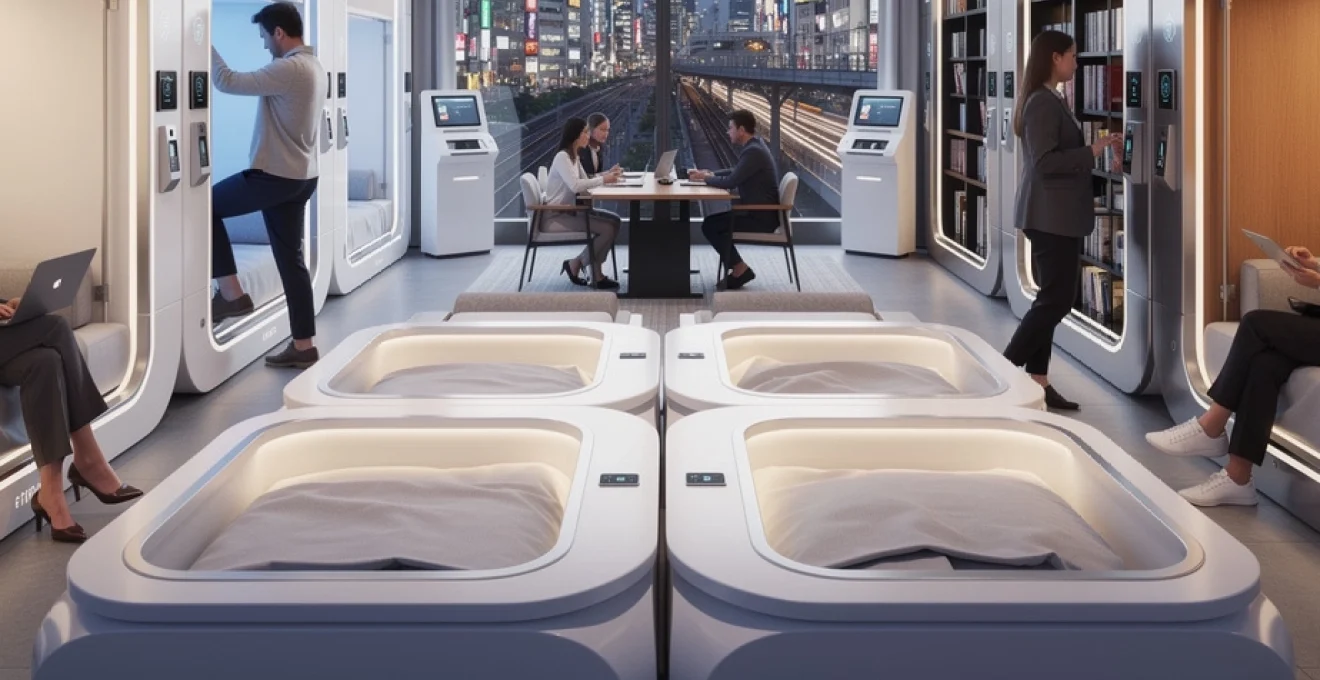
# Capsule hotels in Tokyo and the future of compact living
Tokyo’s skyline tells a story of architectural innovation driven by necessity. In a metropolis where land values in districts like Ginza reached ¥21,560,000 per square metre in 2017, the imperative to maximise every centimetre of space has produced some of the world’s most ingenious design solutions. Among these, capsule hotels stand as perhaps the most iconic response to urban density challenges—compact sleeping pods that distil accommodation to its essential function whilst incorporating cutting-edge technology and thoughtful design. What began as emergency shelter for salaryman who missed the last train home has evolved into a sophisticated hospitality segment that’s now influencing micro-living concepts worldwide.
The capsule hotel phenomenon represents far more than budget accommodation. It embodies a fundamental reimagining of what constitutes necessary living space, challenging assumptions about privacy, community, and the relationship between human occupants and their built environment. As global cities grapple with housing affordability crises and sustainable development imperatives, Tokyo’s five-decade experiment with capsule accommodation offers valuable insights into high-density living solutions that don’t compromise on comfort or technological sophistication.
Architectural evolution of capsule hotels: from kisho kurokawa’s 1979 capsule inn osaka to modern pod design
The genesis of capsule hotels traces directly to Japan’s post-war architectural avant-garde, specifically the Metabolist Movement that emerged in 1960. This radical collective of architects and designers envisioned cities as living organisms capable of growth, adaptation, and metabolic renewal. Their philosophy rejected static architectural permanence in favour of modular, replaceable components that could evolve with societal needs—a prescient vision in earthquake-prone Japan where impermanence has always been a cultural reality.
The world’s first commercial capsule hotel opened in Osaka in 1979, designed by architect Kisho Kurokawa, who had already demonstrated his metabolist credentials with the extraordinary Nakagin Capsule Tower in Tokyo’s Ginza district seven years earlier. That groundbreaking residential tower comprised 140 prefabricated capsules bolted onto two concrete cores, each unit theoretically removable and replaceable. Though the building’s maintenance challenges eventually led to its demolition in 2022, it established the conceptual framework for all subsequent capsule architecture: maximum functionality within minimum volume, enabled by precise ergonomic calculation and technological integration.
Kurokawa’s hospitality capsule design differed significantly from his residential tower. Where Nakagin’s units measured approximately 10 square metres with ensuite bathrooms, hotel capsules stripped accommodation to its absolute essence—a sleeping chamber with integrated lighting, ventilation, and minimal personal storage. This reduction wasn’t deprivation but distillation, informed by careful study of ship cabins and aircraft sleeper berths where spatial efficiency had been refined over decades of transport engineering.
Metabolist movement influence on nakagin capsule tower and hospitality Micro-Architecture
The Metabolist philosophy profoundly shaped capsule hotel development beyond mere aesthetics. Kurokawa and his contemporaries believed that architecture should respond dynamically to human needs rather than imposing static forms upon inhabitants. This meant designing systems that could be upgraded, modified, or entirely replaced as technology and social patterns evolved—a concept particularly relevant in Japan’s rapidly changing post-war economy.
Nakagin Capsule Tower embodied these principles through its unprecedented modular construction. Each capsule was fabricated off-site, transported complete with fitted interiors, and attached to the building’s structural cores using just four high-tension bolts. This approach theoretically allowed individual units to be swapped out every 25 years, though economic and technical realities prevented this vision from materialising. Nevertheless, the tower demonstrated that residential architecture could function like consumer electronics—upgradeable components within a permanent infrastructure framework.
The hospitality capsule model adopted metabolist principles differently. Rather than individual ownership requiring long-term replaceability, hotel capsules prioritised standardisation and ease of maintenance. The pods became interchangeable units within a hospitality system, with technological upgrades implemented across entire floors rather than individual chambers. This shift from metabolist idealism to operational pragmatism established the template for modern capsule hotel chains, where design consistency and efficient houseke
keeping operations underpin the overall guest experience. In this sense, capsule hotels are closer to data centres than traditional inns: compact units plugged into a larger infrastructural grid of services, technology, and shared amenities.
Dimensional standards: 2.0m × 1.0m × 1.25m capsule specifications and space optimisation
From the outset, capsule hotels in Tokyo have relied on tight dimensional standards to balance comfort, safety, and profitability. A typical first-generation capsule measured around 2.0m × 1.0m × 1.25m, just large enough for an adult to lie down, sit up, and access basic controls without wasted volume. This “bed-plus-20%” rule of thumb has endured because it stems from careful anthropometric studies: how far the average arm reaches, how much headroom is needed to sit upright, and how air circulates efficiently in a confined shell.
In practical terms, such compact dimensions allow operators to stack capsules in double rows along corridors, often reaching densities of 40–60 pods per floor in central Tokyo sites. When land costs can exceed ¥10 million per square metre in prime districts, every additional capsule adds significant potential revenue. Yet these tiny volumes are not simply coffins for sleep; integrated storage niches, fold-down shelves, and recessed lighting turn each pod into a micro-environment optimised for a single function. You could think of them as the architectural equivalent of a smartphone app—designed to do one thing very well.
Modern capsule hotels have gently stretched these standards without losing the core principle of minimalism. Many Tokyo properties now offer larger “semi-double” pods around 2.2m long and 1.2m wide, sometimes with an internal height of 1.25–1.4m to reduce any sense of claustrophobia. These expanded capsules can accommodate bulkier travellers and small luggage while still preserving the dense spatial grid that makes the business model viable. The trade-off between pod size and pod count is constantly recalibrated using occupancy data and guest feedback, a process made easier by digital booking platforms and property management systems.
Space optimisation extends beyond the pod itself into circulation, locker placement, and shared bathrooms. Corridors are often kept to the minimum code-compliant width, while luggage storage is relocated to separate locker zones, freeing the capsule volume for rest alone. For guests, this means accepting that “your room” is not a room at all but a node in a network of spaces—sleep here, wash there, work and socialise somewhere else. As urban housing costs rise worldwide, this networked approach to space may foreshadow how future micro-apartments and co-living concepts are organised.
Modular construction techniques using FRP and aluminium composite materials
If Nakagin’s steel capsules were the analog era of modular architecture, today’s capsule hotels in Tokyo represent the lightweight, digital upgrade. Contemporary pods are typically formed from fibre-reinforced plastic (FRP) shells or aluminium composite panels mounted on steel frames, materials chosen for their strength-to-weight ratio, fire performance, and ease of cleaning. Factory prefabrication allows entire capsule units—including lighting conduits, ventilation ducts, and control panels—to be built and tested off-site before being craned or slid into position.
FRP has become particularly popular because it can be moulded into seamless curved interiors, eliminating dirt-trapping joints and making housekeeping faster and more hygienic. From a guest’s perspective, this creates the smooth, cocoon-like feeling many associate with “sleeping in a spaceship.” For operators, it shortens construction timelines and reduces disruption in dense Tokyo neighbourhoods where on-site building activity is tightly regulated. When a hotel chain wants to refresh its brand, it can replace internal pods much like upgrading hardware inside a fixed server rack.
Aluminium composite materials contribute to both structure and aesthetics. Their thin profiles and high rigidity allow for slim partitions, increasing usable interior volume, while various coatings provide resistance to humidity and cleaning chemicals. Importantly, these modular construction techniques also improve life-cycle sustainability. Damaged capsule components can be swapped out without demolishing an entire floor, and standardised parts can be reused across multiple properties. In a city where buildings have historically had short lifespans, such modularity helps extend functional life while adapting to new fire safety rules or accessibility standards.
Looking ahead, we are beginning to see experimental prototypes that combine FRP shells with embedded sensors, LED panels, and acoustic dampening layers. Imagine a capsule that can report its own maintenance needs, adjust reverberation for a quieter sleep, or even project personalised ambient scenes onto its walls. The same industrial design logic that once shaped airplane cabins and ship berths is now converging with smart materials to define the next generation of compact living environments in Tokyo and beyond.
Contemporary reimagining at nine hours shinjuku and anshin oyado premium nihonbashi
While the earliest capsule hotels targeted budget-conscious salarymen, recent properties such as Nine Hours Shinjuku and Anshin Oyado Premium Nihonbashi represent a deliberate design pivot. These operators have reframed capsule accommodation as part of a lifestyle experience, blending minimalism with hospitality touches more commonly associated with boutique hotels. The result is a product that appeals as much to international tourists and digital nomads as to domestic business travellers.
Nine Hours Shinjuku, for instance, is built around a simple narrative: one hour to shower, seven hours to sleep, and one hour to get ready—“nine hours” as an idealised urban rest cycle. Its capsules are finished in stark black and white, with clean lines and indirect lighting that emphasise calm rather than clutter. Wayfinding is intuitive, and the building’s circulation is zoned to separate noisy and quiet functions. For travellers navigating Tokyo for the first time, this clarity can feel like a welcome antidote to the city’s sensory overload.
Anshin Oyado Premium Nihonbashi takes a different approach, layering on amenities that make the compact footprint feel indulgent rather than spartan. Think large communal baths, complimentary drinks, manga libraries, massage chairs, and high-quality mattresses—features that turn a quick overnight stay into an almost onsen-like retreat. The design language is warmer, with wood accents and soft lighting that evoke traditional ryokan hospitality in a hyper-urban format. It’s a reminder that compact does not have to mean cold.
Both properties show how capsule hotels in Tokyo have moved up the value chain. By investing in design, sleep quality, and curated shared spaces, they can command higher nightly rates while still undercutting traditional hotels in the same neighbourhoods. For you as a guest, this means the choice is no longer between “cheap but cramped” and “spacious but expensive.” Instead, you can opt for a carefully designed micro-environment that trades square metres for thoughtful details and strategic luxury.
Tokyo’s leading capsule hotel operators: first cabin, nine hours, and book and bed tokyo market positioning
First cabin’s Aviation-Inspired cabin classes and tiered pricing models
Among Tokyo’s capsule hotel brands, First Cabin occupies a distinctive niche by borrowing its entire design and pricing logic from aviation. Rather than “pods” or “capsules,” it offers guests a choice between Economy, Premium Economy, Business, and First Class cabins—each representing a different balance between footprint, privacy, and price. This tiered model bridges the gap between classic capsule hotels and budget business hotels, capturing demand from travellers who want more than a pod but less than a full room.
In spatial terms, First Cabin’s Economy class is closest to a traditional capsule, while Business and First Class cabins resemble compact hotel rooms with open ceilings and shared bathrooms. The consistent aviation theme—complete with check-in counters that evoke airport lounges—helps guests intuitively understand what they’re buying. If you’ve ever weighed up an airline seat upgrade, you’ll recognise the same psychology at work here. For the operator, this segmentation maximises revenue per square metre by encouraging upsells without adding the overheads of entirely separate room types.
From a market positioning perspective, First Cabin often targets transit hubs and business districts: Haneda Airport, Akihabara, and other nodes where time-pressed travellers value speed and predictability. Nightly rates slot between classic capsule prices and mid-range hotels, supported by flexible options like day-use plans and short naps. This versatility is particularly attractive in Tokyo, where missed last trains remain a fact of life and airport connections can span awkward hours. As cities elsewhere look to replicate the model, First Cabin demonstrates how branding and spatial gradation can make compact living feel aspirational, not just economical.
Nine hours’ minimalist aesthetic and panasonic sleep technology integration
Nine Hours has built its brand on radical simplicity: monochrome interiors, uniform pods, and a laser focus on the act of sleeping itself. But beneath this apparent austerity lies a sophisticated integration of Japanese sleep research and technology partnerships, most notably with companies such as Panasonic. Several Nine Hours locations in Tokyo have trialled enhanced lighting and soundscapes designed to support the body’s circadian rhythm, shifting colour temperatures and brightness levels to mimic natural dawn and dusk.
In practice, this means that your capsule experience can be subtly tuned to improve rest, even if you’re crossing time zones or arriving late at night. Some prototypes have incorporated sensors to track temperature, humidity, and in some cases even movement patterns, feeding anonymised data back into algorithms that refine environmental presets. While privacy considerations are carefully managed, this convergence of sleep science and IoT infrastructure hints at a future where compact accommodation might deliver a better night’s rest than many spacious but poorly designed hotel rooms.
Nine Hours’ minimalist aesthetic also carries operational advantages. Uniform pod layouts simplify cleaning and maintenance, while monochrome palettes hide wear and visually declutter corridors. For guests, the stripped-back design reduces decision fatigue: lockers are where you expect them, light controls are standardised, and signage is icon-based to transcend language barriers. In a dense, sometimes confusing metropolis, this calm rationality becomes a core part of the company’s value proposition. You are not paying for decorative excess; you are paying for streamlined, predictable recovery time.
Book and bed tokyo’s hybrid Co-Working library concept in ikebukuro
Book and Bed Tokyo approaches compact living from an entirely different angle: instead of starting with beds and adding lifestyle elements, it starts with a bookstore and hides the beds inside the bookshelves. Its flagship in Ikebukuro (and subsequent branches) positions itself as an “accommodation bookshop,” where the primary attraction is the act of browsing, reading, and dozing off surrounded by thousands of titles. Capsules are tucked between shelves like secret compartments, turning the whole space into a three-dimensional reading nook.
This hybrid co-working and hospitality model cleverly monetises time in multiple ways. Daytime visitors pay for lounge access, Wi-Fi, and workspace; overnight guests pay to sleep in the same environment once the lights dim. For remote workers and creative professionals, it offers a flexible “third place” that is part cafe, part library, part hostel. You could brainstorm a project at a shared table, nap in your capsule, then wake up and resume work without ever leaving the building.
From a branding standpoint, Book and Bed Tokyo has succeeded by leaning into a specific cultural archetype: the bookworm who falls asleep with a novel in hand. Social media imagery of shelves stretching into the distance, punctuated by small sleeping alcoves, has helped the concept spread far beyond Japan’s borders. As compact living evolves, we may see more such themed micro-hotels that double as co-working or cultural spaces, using the capsule as just one element in a broader experiential offer.
Gender-segregated floor planning and Female-Only capsule hotel proliferation
One striking feature of capsule hotels in Tokyo is the near-universal reliance on gender-segregated floors or entire properties. This planning strategy emerged partly from cultural norms around bathing and sleeping, and partly from safety considerations for solo female travellers. Many operators now dedicate at least one floor—or in some cases an entire building—to women only, with controlled access, enhanced security, and amenities tailored to their needs.
Female-only capsule hotels such as Nadeshiko Hotel Shibuya or Akihabara Bay Hotel typically offer extra vanity space, better lighting around mirrors, secure locker areas, and sometimes curated amenities like skincare products or rental yukata. Design cues may be softer and warmer, but the core efficiency of the capsule grid remains. For women visiting Tokyo on business or exploring the city solo, this model can provide an affordable alternative to more expensive hotels while still feeling comfortable and secure.
From an architectural standpoint, gender-segregated planning affects circulation, egress routes, and placement of shared functions like baths and lounges. Fire exits must accommodate separate floors while still complying with Tokyo’s stringent codes, and access control systems must be robust without impeding emergency evacuation. As more cities worldwide experiment with capsule-style lodging, they will need to grapple with similar questions: how do you create compact, shared environments that respect privacy, inclusivity, and safety for diverse user groups?
Smart technology integration: IoT climate control, automated Check-In systems, and biometric security
Technology has always been intertwined with the appeal of capsule hotels, but recent advances in IoT and automation are pushing the model into new territory. In many modern Tokyo properties, your smartphone or a tablet issued at check-in becomes a universal remote for your stay. You can adjust capsule lighting, set wake-up times, control ventilation, and in some cases manage in-pod entertainment without touching a physical switch. This not only reduces hardware costs but also allows operators to fine-tune energy usage across hundreds of pods in real time.
Smart climate control is particularly important in such small volumes. Sensors monitor temperature, humidity, and CO₂ levels, feeding back to central systems that regulate fresh air supply and fan speeds. Rather than blasting air conditioning across an entire floor, the system can target specific zones or even individual capsules where occupancy is detected. For guests, this translates into fewer stuffy nights; for operators, it can cut utility bills significantly—a critical factor in high-density buildings where margins depend on energy efficiency.
Automated check-in and access control further streamline the capsule hotel experience. Self-service kiosks in lobbies allow you to scan a QR code, passport, or reservation number, receive a keycard or digital access code, and head straight to your floor without waiting in line. In some pilot projects, biometric authentication—such as facial recognition or fingerprint scanning—is used to unlock lockers and capsules, though Japanese privacy regulations currently limit widespread deployment. The broader trend is clear: as labour shortages and rising wages challenge Japan’s hospitality sector, automation helps maintain service levels without dramatically increasing staffing costs.
Importantly, these systems also generate data that can inform future micro-living design. By aggregating anonymised usage patterns—when guests adjust temperatures, how long they spend in showers, which floors fill up first—operators gain insights into behaviour within compact spaces. This information can then feed into the planning of next-generation capsule hotels or even small urban apartments. In a sense, every capsule stay becomes a tiny experiment in how people actually live, sleep, and move in constrained environments.
Zoning regulations and tokyo metropolitan building code compliance for capsule accommodation
Behind the sleek pods and minimalist corridors lies a complex regulatory landscape. Capsule hotels in Tokyo must navigate both national building codes and local zoning ordinances, which were originally written with conventional hotels and dormitories in mind. To operate legally, a capsule property generally needs to obtain a hotel or lodging business licence under Japan’s Inns and Hotels Act, comply with fire safety regulations, and meet specific requirements for corridor widths, emergency exits, and ventilation.
One of the most critical issues is fire safety. Because capsules concentrate large numbers of sleeping guests in a small footprint, Tokyo fire authorities pay close attention to materials, sprinkler coverage, smoke detection, and egress times. Non-combustible or fire-retardant finishes are mandatory, and capsules must not impede escape routes. You may have noticed that capsule doors are typically curtains or non-locking shutters; this is not just cultural but also regulatory, ensuring that emergency responders can access each pod quickly if needed.
Zoning regulations determine where capsule accommodation can be located in the first place. In commercial districts around Shinjuku, Shibuya, and Ueno, mixed-use zoning makes it easier to convert office floors into capsule hotels, provided that noise and privacy standards for neighbours are respected. In more residential wards, restrictions can be tighter, limiting building heights or the proportion of a structure that can be used for lodging. As demand for compact accommodation grows, Tokyo’s planners face a balancing act: encouraging efficient land use while preventing over-concentration of transient guests in any one neighbourhood.
Compliance also extends to accessibility and hygiene. Shared bathrooms must meet minimum fixture counts relative to guest capacity, and circulation paths must accommodate mobility-impaired users where feasible. For operators, this sometimes means sacrificing a few capsules to widen corridors or install lifts, reducing headline density but ensuring long-term legality and inclusivity. For cities elsewhere considering capsule-style developments, Tokyo’s regulatory evolution offers a valuable case study in how codes can adapt to new spatial typologies without compromising public safety.
Global adaptation of japanese capsule model: yotel, CitizenM, and european Micro-Hotel chains
Yotel’s premium cabin concept at london gatwick and amsterdam schiphol
As the idea of compact, high-efficiency accommodation spread beyond Japan, one of the earliest and most influential adopters was Yotel. Launching its “premium cabins” at London Gatwick and Amsterdam Schiphol airports, Yotel took inspiration from Japanese capsule hotels but upscaled the formula for western expectations. Instead of 2.0m × 1.0m pods, guests book 7–10 square metre rooms equipped with proper beds, ensuite bathrooms, and integrated work surfaces—all meticulously planned to avoid wasted space.
These airport Yotels serve a similar function to Tokyo’s train-station-adjacent capsule hotels: they catch travellers in transit, offering flexible stays charged by the hour as well as overnight. The difference lies in the level of privacy and amenity. Sliding doors with locks, private showers, and soundproofing cater to a clientele less accustomed to communal bathing or open corridors. Yet the principle remains recognisably Japanese: maximum utility within a micro-footprint, located exactly where time and space are at a premium.
From a design standpoint, Yotel’s cabins illustrate how the capsule concept can be culturally localised. Mood lighting, fold-away furniture, and wall-mounted storage all echo the efficiency of Tokyo’s pods, but the extra square metres accommodate luggage, families, and accessibility requirements common in European and North American markets. If you’ve ever wondered what a “westernised capsule hotel” looks like, an airport Yotel is a good starting reference.
Podshare los angeles and Co-Living Subscription-Based sleeping pods
On the other side of the spectrum, ventures like PodShare in Los Angeles have adapted the capsule idea to address housing accessibility rather than transient travel. PodShare offers open-plan sleeping pods—essentially bunk beds with partial enclosures—within communal live-work spaces. Members pay subscription fees that cover not just a bed but also co-working areas, kitchens, and social programming. In effect, the company turns the logic of capsule hotels into a long-stay co-living model.
While the aesthetic and privacy levels differ from Tokyo’s capsule hotels, the underlying economics are similar: high bed density in central locations makes urban living viable for people who might otherwise be priced out. For residents, the trade-off is limited personal space in exchange for a network of shared resources and community. You could think of it as a cross between a hostel and a members’ club, where the “capsule” is less a cocoon and more a sleeping berth within a constantly active environment.
PodShare and similar projects highlight both the opportunities and controversies of micro-living. Critics argue that such dense arrangements risk normalising cramped conditions as a permanent solution to housing crises, while proponents see them as pragmatic, flexible options in overheated rental markets. As cities experiment with subscription-based sleeping pods, they will need to draw lessons from Japan’s long experience: clear codes, robust safety standards, and transparent expectations are essential to prevent exploitation.
Cityhub amsterdam’s gamification features and social hostel hybrid model
CityHub Amsterdam presents yet another interpretation of the capsule model, pitched squarely at tech-savvy millennials and Gen Z travellers. Its “hubs” are compact private cabins arranged within a larger social hostel environment, controlled almost entirely via a smartphone app. Guests check in digitally, access their hubs with RFID wristbands, and use an app-based concierge to find local recommendations, purchase drinks, or chat with other guests. The experience borrows heavily from the gamification techniques of mobile platforms.
In design terms, the hubs are larger than Japanese capsules but still far smaller than standard hotel rooms, allowing CityHub to achieve high bed densities in prime neighbourhoods. Neon accent lighting, colourful signage, and Instagram-friendly common areas reinforce the brand’s playful identity. The combination of private sleeping space and strongly curated social zones mirrors Tokyo’s newer capsule hotels, which increasingly market themselves as community hubs rather than mere crash pads.
CityHub’s success suggests that when micro-accommodation is paired with digital engagement and strong branding, it can compete head-on with both traditional hostels and budget hotels. For travellers, this means you no longer have to choose between privacy and sociability; you can sleep in a pod-sized room and still enjoy a curated social experience that feels more like a game than a transaction.
Regulatory barriers: building codes and fire safety standards in western markets
Despite growing interest, the Japanese capsule model has not been adopted wholesale in many Western cities, largely due to regulatory hurdles. Building codes in Europe and North America were typically drafted with larger hotel rooms and conventional dormitories in mind, specifying minimum room sizes, window requirements, and occupancy limits that clash with the idea of 2.0m × 1.0m pods. Fire safety rules often demand specific escape distances, natural light provisions, and door hardware that are difficult to reconcile with stacked capsules and curtain closures.
As a result, many “capsule-inspired” projects outside Japan compromise by offering slightly larger micro-rooms with full-height walls, dedicated escape routes, and sprinklers in each unit. While this improves perceived safety and aligns with local expectations, it reduces the economic advantage that made capsule hotels successful in Tokyo’s ultra-expensive districts. Operators must therefore work harder on branding, technology, and service differentiation to justify their existence beyond mere density.
There are signs, however, that regulators are starting to engage with micro-accommodation more flexibly. Some cities have introduced special categories for “sleeping pods” in co-working spaces or short-stay transit hotels, setting tailored standards for ventilation, fire detection, and supervision. The key lesson from Tokyo is that stringent safety and high density are not mutually exclusive—but achieving both requires specific design guidelines rather than trying to retrofit decades-old hotel regulations onto a fundamentally different typology.
Economic viability: revenue per square metre analysis and urban real estate density solutions
At the heart of the capsule hotel model lies a straightforward economic equation: how much revenue can you generate per square metre of floor area? In central Tokyo, where land and construction costs are among the highest in the world, this metric is often more important than room rate alone. By fitting two rows of capsules along a corridor and stacking them vertically, operators can easily triple or quadruple the number of sellable “units” compared with a traditional hotel layout on the same footprint.
Consider a simplified example. A 500-square-metre floor might accommodate 20–25 conventional business hotel rooms once you factor in bathrooms and circulation, whereas a capsule configuration on the same floor might host 60–80 pods plus shared facilities. Even if the nightly rate per capsule is half that of a regular room, the aggregate revenue per floor can be significantly higher—especially when high occupancy is maintained through transit traffic and flexible short-stay plans. This is why capsule hotels cluster around major hubs like Shinjuku Station, Tokyo Station, and Haneda Airport, where demand is both constant and time-sensitive.
Of course, density is not a free lunch. More pods mean higher upfront investment in fire safety systems, ventilation, and durable finishes, as well as increased wear and tear. Operating margins also depend on efficient housekeeping and laundry processes; cleaning 80 capsules takes more coordination than 20 rooms, even if each pod is smaller. Smart design—such as washable FRP interiors, centralised bathrooms, and automated check-in—helps offset these costs by minimising labour per guest-night.
From a broader urban planning perspective, capsule hotels contribute to Tokyo’s real estate density solutions by absorbing transient demand without permanently displacing long-term housing. Instead of converting entire apartment buildings into short-term rentals, developers can dedicate specific floors or structures to high-turnover capsule accommodation while preserving residential stock elsewhere. As more global cities wrestle with the impact of tourism on housing affordability, this separation of functions could prove instructive.
For you as a traveller or resident, the rise of capsule and pod-style accommodation means more options across the price and comfort spectrum. You might use a capsule hotel in Tokyo as an affordable base in a prime neighbourhood, a strategic nap spot between flights, or even as inspiration for how little space you actually need at home. In an era of urbanisation, climate constraints, and shifting work patterns, the lessons embedded in these compact pods—ergonomics, modularity, and smart technology—are likely to resonate far beyond the narrow corridors where the concept first took shape.