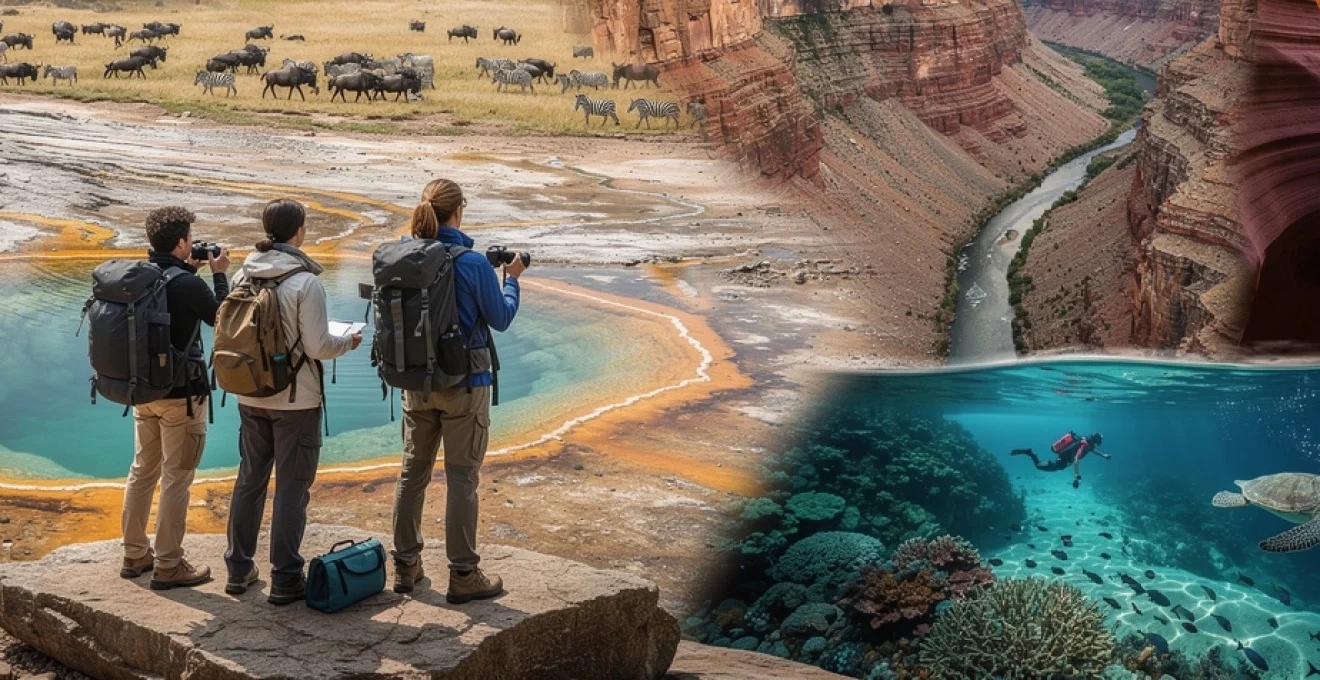
Travel has evolved beyond simply visiting destinations; it has transformed into an immersive experience where the natural world takes centre stage. Modern travellers increasingly seek authentic encounters with pristine ecosystems, geological wonders, and wildlife habitats that offer profound connections to our planet’s most spectacular phenomena. This shift represents a fundamental change in how people approach exploration, moving from passive observation to active engagement with nature’s intricate systems.
The concept of nature-centric travel encompasses everything from tracking apex predators in their natural territories to witnessing geological processes that have shaped continents over millions of years. These journeys offer participants unique opportunities to understand complex ecological relationships, observe evolutionary adaptations in real-time, and experience the raw power of natural forces that continue to sculpt our planet.
Immersive wildlife encounters in pristine national park ecosystems
National parks represent some of the world’s most carefully preserved ecosystems, offering travellers unprecedented access to wildlife behaviour patterns and ecological interactions. These protected areas function as living laboratories where visitors can observe natural processes without the interference of human development. The experience transforms from simple wildlife viewing into comprehensive ecosystem education, where each species plays a crucial role in maintaining environmental balance.
Wildlife encounters in these pristine environments provide insights into animal behaviour that remain impossible to replicate in artificial settings. Visitors witness predator-prey relationships, territorial disputes, mating rituals, and seasonal migration patterns that have evolved over thousands of years. These observations offer profound understanding of how species adapt to environmental challenges and maintain population stability within their natural habitats.
Yellowstone’s geothermal phenomena and apex predator behaviour patterns
Yellowstone National Park exemplifies how geological activity directly influences wildlife distribution and behaviour patterns. The park’s extensive geothermal features create unique microenvironments that support diverse species communities. Visitors can observe how wolves, grizzly bears, and bison utilise these thermally influenced areas for survival advantages, particularly during harsh winter conditions.
The reintroduction of wolves to Yellowstone in 1995 provides ongoing opportunities to study predator-prey dynamics in real-time. Travellers witness how wolf pack behaviour affects elk migration routes, which subsequently influences vegetation patterns and river systems through what scientists term the « trophic cascade effect. » This interconnectedness demonstrates how apex predators serve as ecosystem engineers, shaping entire landscapes through their hunting patterns.
Serengeti migration corridors and seasonal ungulate movement dynamics
The Great Migration represents one of nature’s most spectacular phenomena, involving over 1.5 million wildebeest, 400,000 zebras, and 300,000 Thomson’s gazelles moving across the Serengeti ecosystem annually. This massive movement follows ancient pathways that respond to seasonal rainfall patterns and grassland regeneration cycles. Visitors experience the raw intensity of survival as herds navigate river crossings, predator territories, and resource competition.
Timing becomes crucial for travellers seeking optimal migration viewing opportunities. The movement follows predictable seasonal patterns: calving occurs in the southern Serengeti between January and March, followed by northward movement towards the Masai Mara between July and September. Understanding these patterns allows visitors to position themselves strategically to witness river crossings, predation events, and the constant struggle between herbivore survival and carnivore success.
Galápagos endemic species conservation zones and darwin’s finch adaptation studies
The Galápagos Islands continue to serve as evolution’s laboratory, where visitors observe speciation processes that inspired Darwin’s groundbreaking theories. Each island’s unique environmental conditions have produced distinct evolutionary adaptations, creating species found nowhere else on Earth. Marine iguanas demonstrate saltwater adaptation, giant tortoises showcase island gigantism, and Darwin’s finches display rapid evolutionary responses to environmental changes.
Recent research reveals that Darwin’s finches can evolve measurable changes within single generations in response to drought conditions or food source availability. Visitors witness these adaptive processes firsthand, observing beak size variations, feeding behaviour modifications, and territorial adaptations that occur in real-time. Conservation tourism in these zones directly contributes to ongoing research efforts while providing travellers with unparalleled educational experiences.
Kruger national park’s big five territorial ranges and nocturnal tracking methodologies
Guided night drives in Kruger transform the savanna into a living theatre where nocturnal behaviour becomes visible. Using red-filtered spotlights and telemetry equipment, expert trackers follow lions, leopards, and hyenas as they patrol their territorial ranges, hunt, and interact with rival predators. Travellers gain insight into scent-marking strategies, vocal communication, and boundary disputes that determine access to prey and water sources. This level of observation reveals how territoriality structures the entire ecosystem, shaping herbivore distribution and influencing vegetation recovery cycles.
Participating in ethical tracking experiences also helps visitors understand the importance of minimising disturbance while maximising data collection. Many lodges now collaborate with conservation biologists, recording GPS locations, behaviour notes, and even acoustic data during game drives. As a traveller, you are not just a spectator but a temporary field assistant, contributing to long-term monitoring of apex predator populations and their shifting ranges in response to climate variability and human pressures beyond park boundaries.
Geological formations as primary travel destinations and experiential focal points
For many modern travellers, geology itself has become the primary reason to journey rather than a passive backdrop for photographs. Mountain ranges, canyons, volcanoes, and glaciers act as narrative anchors for entire itineraries, inviting you to read the Earth’s history layer by layer. When you stand at the edge of a caldera or trace your hand across a 200‑million‑year‑old rock face, you engage directly with processes that usually unfold too slowly for human perception.
Geology-focused travel reframes landscapes as dynamic characters, each with a distinct origin story shaped by plate tectonics, erosion, and climatic shifts. Guided hikes, interpretive trails, and citizen science projects help you decode these stories through stratigraphic sequences, fault lines, and mineral compositions. Instead of simply “seeing the sights,” you learn to recognise how glaciers carve valleys, how rivers migrate, and how volcanic eruptions build entire islands over millennia. This perspective turns every viewpoint into a field site and every photograph into a data point in Earth’s evolving narrative.
Iceland’s mid-atlantic ridge volcanic activity and glacial retreat documentation
Iceland sits astride the Mid‑Atlantic Ridge, where the North American and Eurasian plates are slowly diverging at a rate of around 2 centimetres per year. Travellers can walk between these plates in Þingvellir National Park, observe active geothermal fields, and visit recent lava flows that still radiate residual heat beneath hardened crusts. Eruptions such as Eyjafjallajökull in 2010 and the ongoing Fagradalsfjall volcanic systems have highlighted how a remote island nation can suddenly influence global air travel and climate discussions.
At the same time, Iceland’s glaciers are among the most visible indicators of climate change impact tourism. Many guided trips now include glacial retreat documentation, where visitors compare historic photographs with current ice margins and help record GPS coordinates of glacier fronts. Joining a glaciology-focused hike allows you to learn how crevasse patterns, moraine ridges, and meltwater channels reveal the pace of ice loss. In this way, you move from being a casual observer of dramatic landscapes to an informed participant in monitoring one of Europe’s fastest‑changing cryospheric environments.
Grand canyon’s stratigraphic layers and colorado river erosion processes
The Grand Canyon offers one of the most accessible cross‑sections of Earth’s crust, exposing nearly two billion years of geological history in a single panorama. Each coloured band of rock tells a chapter of the continent’s evolution, from ancient seabeds to desert dunes compacted into sandstone. Standing at the rim, travellers can trace these stratigraphic layers while guides explain how unconformities, fossil records, and mineral content help reconstruct past climates and ecosystems.
For those who venture below the rim, rafting the Colorado River reveals erosion processes in action. Over 5 million annual visitors come to the park, but only a fraction experience the canyon from water level, where you can see how sediment transport, flash floods, and seasonal discharge continue to deepen and widen the gorge. Multi‑day river expeditions often include simple field experiments—such as measuring water temperature or sediment load—that illuminate how a single river system can sculpt one of the world’s most iconic geological formations over millions of years.
Patagonia’s torres del paine granite spire formation and tectonic history
Patagonia’s Torres del Paine National Park is dominated by jagged granite spires that rise abruptly from glacial valleys, creating one of the most recognisable skylines in South America. These towers are the exposed cores of ancient magma chambers, slowly revealed as softer surrounding rock eroded away. When you trek the famous “W” or “O” circuits, every viewpoint becomes a lesson in intrusive igneous processes, differential erosion, and the sculpting power of ice.
The region’s broader tectonic history is equally compelling. Patagonia sits near the boundary of the Nazca, South American, and Antarctic plates, a zone of complex subduction and uplift. Guides often use simple analogies—like pushing sheets of paper together—to explain how folding, faulting, and uplift created the Andes and associated Patagonian ranges. As you cross hanging valleys, moraines, and glacial lakes with milky turquoise water, you witness how recent glaciations have polished, carved, and reworked this tectonic framework into today’s dramatic trekking landscape.
Antelope canyon’s slot canyon light beam photography and navajo sandstone weathering
Antelope Canyon in Arizona showcases how water, time, and sand can transform relatively soft Navajo Sandstone into flowing, sculpted passageways. Flash floods carrying abrasive sediment have etched narrow corridors with smooth, wave‑like surfaces that appear almost liquid in low light. Walking through these slot canyons, you move inside the rock itself, effectively stepping into a three‑dimensional cross‑section of weathering processes.
The canyon is also a prime example of how nature‑centric travel intersects with photography‑driven tourism. Iconic light beams that filter through narrow openings have made Antelope Canyon one of the most photographed geological formations in the world. Professional guides now play a crucial role in managing visitor flow, explaining flash flood risks, and educating travellers about the delicate sandstone structures. Understanding how a single intense storm can reshape the canyon overnight gives you a deeper appreciation of the power behind those famous light‑beam images.
Marine ecosystem tourism and underwater biodiversity exploration techniques
Marine ecosystems offer some of the most immersive forms of nature‑centric travel, inviting you to enter environments where humans are strictly temporary visitors. Coral reefs, kelp forests, and pelagic zones host complex food webs and symbiotic relationships that remain hidden from view unless you strap on a mask or scuba tank. As you descend beneath the surface, the ocean stops being a flat, blue horizon and becomes a multi‑layered habitat structured by light, temperature, and pressure.
Underwater biodiversity exploration now extends far beyond casual snorkelling. Citizen science dive programmes, reef health monitoring projects, and marine megafauna tagging initiatives allow travellers to contribute to research on everything from coral bleaching to shark migration routes. Techniques such as transect surveys, photo‑identification, and acoustic monitoring are increasingly accessible to recreational divers with proper training. In many destinations, your holiday dive log doubles as a dataset that helps scientists track the health of marine protected areas in real time.
Forest canopy research tourism and arboreal ecosystem study programmes
Forest canopies, once considered the “last biotic frontier,” are now opening to travellers through carefully designed research tourism programmes. High‑level walkways, canopy towers, and rope‑based access systems provide safe entry into arboreal zones that host up to half of all terrestrial species in some tropical forests. When you step onto a swaying platform 40 metres above the ground, you realise that the forest you see from a roadside viewpoint is only the understory of a much more complex, multi‑layered ecosystem.
Canopy research tourism typically integrates guided observation with hands‑on learning. Participants might assist with insect sampling, epiphyte surveys, or microclimate measurements, helping to build long‑term datasets on biodiversity and forest health. These programmes often emphasise the role of canopy processes in global carbon cycling, water regulation, and climate resilience. By watching how orchids, bromeliads, birds, and arboreal mammals interact at eye level, you gain a new perspective on why intact forest canopies are essential for both local communities and planetary systems.
Astronomical dark sky reserves and celestial event travel planning methodologies
When light pollution fades, the night sky reclaims its role as a powerful main character of travel experiences. International Dark Sky Reserves and Parks—from Namibia’s NamibRand to New Zealand’s Aoraki Mackenzie—offer conditions where the Milky Way casts faint shadows and meteor showers become immersive, horizon‑to‑horizon displays. In these places, astronomy tourism blends scientific interpretation with a sense of awe that many travellers describe as life‑changing.
Planning a trip around celestial events requires a different methodology than standard sightseeing. Instead of museum opening hours, you track moon phases, meteor shower peaks, and planetary conjunctions. Astrophotography workshops teach you how to translate faint nebulae and star trails into long‑exposure images, while observatory visits provide access to telescopes that reveal galaxies millions of light‑years away. As you learn to read star charts and mobile sky‑mapping apps, the night sky stops being a random scatter of lights and becomes a navigable, story‑rich landscape in its own right.
Climate change impact tourism and environmental monitoring expeditions
Climate change impact tourism focuses on places where environmental shifts are visible within a human lifetime—retreating glaciers, bleaching coral reefs, thawing permafrost, and shifting species ranges. While there is a legitimate concern about “disaster tourism,” well‑designed expeditions emphasise education, monitoring, and mitigation rather than spectacle. They invite you to witness changes firsthand, ask difficult questions about our collective footprint, and contribute to baseline data that will guide future conservation strategies.
Environmental monitoring expeditions often integrate simple but rigorous scientific protocols into daily activities. Travellers might help record glacier snout positions, log sea surface temperatures, count nesting seabirds, or document plastic debris along remote shorelines. These seemingly small actions, repeated across years and participants, create time series that researchers can use to track warming trends, ecosystem responses, and conservation outcomes. In this way, your journey becomes part of a long‑term narrative about how Earth’s “main characters”—its oceans, forests, ice sheets, and atmosphere—are responding to the pressures of the Anthropocene, and how we choose to respond in return.