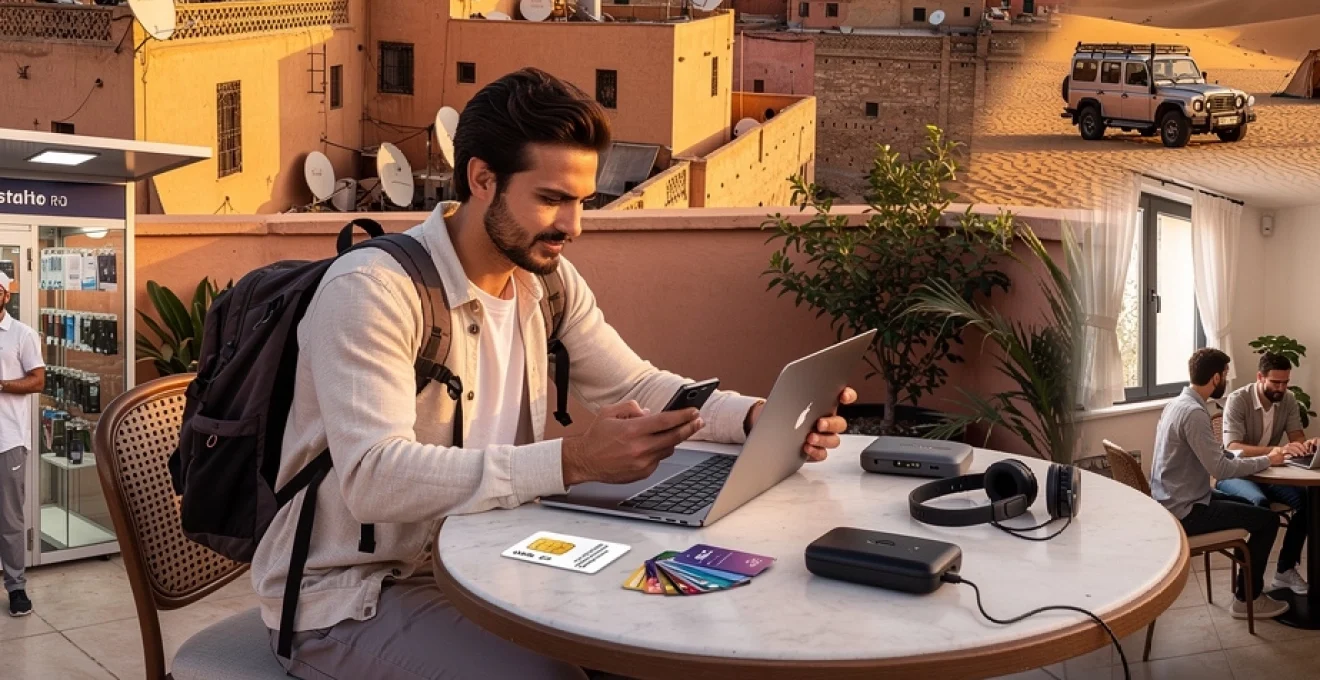
Morocco’s enchanting medinas, sweeping desert landscapes, and vibrant coastal cities attract millions of visitors annually, yet one challenge remains consistent across all traveller experiences: maintaining reliable internet connectivity. In an era where digital access has become as essential as accommodation and transport, understanding Morocco’s telecommunications landscape is crucial for a seamless journey. Whether you’re navigating the labyrinthine streets of Fes using Google Maps, coordinating with your riad host via WhatsApp, or sharing stunning sunset photographs from the Sahara Desert on Instagram, consistent internet access transforms your travel experience from potentially stressful to genuinely enjoyable.
The Moroccan telecommunications sector has undergone remarkable modernisation over the past decade, with substantial infrastructure investments by the three primary operators: Maroc Telecom, Orange Morocco, and Inwi. These providers collectively serve over 48 million mobile subscriptions in a country with approximately 37 million inhabitants, indicating the high penetration rate and competitive market dynamics. For international travellers, this competitive environment translates into affordable data packages, extensive coverage in urban centres, and increasingly reliable connectivity even in traditionally remote areas. Understanding your options—from traditional prepaid SIM cards to cutting-edge eSIM technology—ensures you select the solution perfectly aligned with your travel duration, data requirements, and budget constraints.
Moroccan mobile network infrastructure: maroc telecom, orange, and inwi coverage analysis
Morocco’s telecommunications infrastructure represents a fascinating study in emerging market digital transformation. The three dominant carriers each command substantial market share, with Maroc Telecom historically maintaining the largest subscriber base at approximately 19 million users, followed by Orange Morocco with roughly 13 million, and Inwi with around 16 million subscribers. These figures fluctuate quarterly as promotional campaigns and network improvements shift consumer preferences, yet all three providers offer comparable service quality in major metropolitan areas.
The regulatory framework governing Moroccan telecommunications falls under the jurisdiction of the Agence Nationale de Réglementation des Télécommunications (ANRT), which ensures competitive pricing, service quality standards, and consumer protection measures. ANRT’s oversight has facilitated consistent network expansion, particularly in rural areas previously underserved by mobile connectivity. For travellers, this regulatory environment means transparent pricing structures, standardised registration procedures, and recourse mechanisms should service issues arise—though such problems remain relatively uncommon for short-term visitors.
4G LTE and 5G network availability in marrakech, casablanca, and fes
Major Moroccan cities enjoy robust 4G LTE coverage, with download speeds routinely exceeding 20-30 Mbps in Casablanca, Marrakech, Rabat, and Fes. These speeds prove more than adequate for video streaming, high-resolution image uploads, and bandwidth-intensive applications. Maroc Telecom launched Morocco’s first commercial 5G network in 2023, initially focusing deployment in Casablanca’s business districts and gradually expanding to other major urban centres. Early 5G subscribers report impressive speeds exceeding 400 Mbps under optimal conditions, though coverage remains limited to specific zones within major cities.
For most travellers, 4G LTE connectivity provides entirely sufficient performance for typical use cases. The notable exception involves remote workers or digital nomads requiring consistent high-bandwidth connections for video conferencing or large file transfers. In such scenarios, identifying accommodation with dedicated fibre-optic internet—increasingly common in upscale riads and modern apartments—becomes essential. Urban coverage maps show that all three operators provide near-universal 4G access throughout Marrakech’s Gueliz and Hivernage districts, Casablanca’s Maarif and Anfa neighbourhoods, and Fes’s Ville Nouvelle areas, with more variable performance within historic medina quarters where dense construction can impede signal penetration.
Rural connectivity challenges in atlas mountains and sahara desert regions
Connectivity diminishes markedly once you venture beyond Morocco’s urban corridors. The High Atlas Mountains present particular challenges, with coverage frequently dropping to 3G or Edge networks in mountain villages, and complete signal absence in remote valleys and high-altitude trekking routes. Travellers planning multi-day treks through regions like Toubkal National Park should anticipate extended offline periods and plan accordingly by downloading offline maps, sharing itineraries with
trusted contacts before departure. Sahara Desert regions such as Erg Chebbi near Merzouga and Erg Chigaga outside M’Hamid typically enjoy intermittent 3G or 4G coverage along main access roads and near established camps, but you should not rely on constant service once deep into the dunes. Inwi and Orange sometimes outperform Maroc Telecom in specific rural pockets, yet Maroc Telecom generally maintains the broadest footprint in sparsely populated zones. As a rule of thumb, you can expect stable mobile internet connectivity in towns and along major highways, with connectivity becoming patchy to non-existent once you move into off-road tracks, high passes, and isolated oases.
To mitigate rural connectivity challenges in Morocco, download offline navigation tools like Google Maps offline areas or Maps.me before leaving urban centres. Inform your accommodation or tour operator of your itinerary and expected check-in times, particularly when travelling in regions where mobile coverage is known to be weak. If your work or personal situation requires more reliable communication, consider combining a local SIM card with a secondary satellite-based solution for true emergency access. By planning for periods without service rather than assuming constant coverage, you reduce stress and can focus on enjoying Morocco’s dramatic landscapes.
SIM card registration requirements and ANRT regulatory compliance
Morocco maintains strict SIM card registration requirements as part of its broader telecommunications regulatory framework. Under ANRT regulations, all SIM cards—whether purchased by residents or foreign visitors—must be registered to an identifiable individual. This process typically involves presenting a valid passport at the point of sale, allowing the vendor to capture your details and associate them with the SIM’s unique identifier. Unregistered or inactive SIMs may be deactivated after a defined period to prevent misuse.
For travellers, this registration protocol is usually straightforward and completed within minutes at official boutiques or authorised resellers. You will often be asked to provide your full name, passport number, and occasionally a local address such as your hotel or riad. While this might feel bureaucratic, it actually works in your favour: if you encounter issues with your Moroccan SIM—such as loss, theft, or activation problems—the operator can verify your identity and assist more efficiently. Staying compliant with ANRT rules also ensures that your prepaid data packages and voice services remain active for the duration of your stay.
Prepaid data package comparison: jawal, jawaz, and forfait internet options
Each Moroccan operator brands its prepaid offerings differently, with Maroc Telecom’s Jawal packages, Orange’s Jawaz and data boosts, and Inwi’s various Forfait Internet and combo bundles targeting both locals and tourists. While names and exact inclusions change as promotions evolve, the core structure remains consistent: you purchase a base SIM for a small fee, then top up with credit that you convert into data, voice, or mixed bundles. Entry-level data packs often start at around 10–20 MAD for a few hundred megabytes, scaling up to 100–200 MAD for multi-gigabyte allowances suitable for a one- or two-week trip.
When comparing Moroccan prepaid data packages, consider three main factors: validity period, data allowance, and whether you require local calls. Jawal and Jawaz bundles frequently include a mix of on-net minutes, SMS, and data, which is ideal if you plan to call local numbers such as hotels, guides, or restaurants. Dedicated Forfait Internet options focus purely on data, making them more efficient for travellers who rely on VoIP apps like WhatsApp, Telegram, or Signal. Because promotions can be complex, do not hesitate to ask the salesperson to recommend a package based on how many days you will stay in Morocco and how intensively you use navigation, social media, and streaming.
International roaming alternatives and local SIM acquisition strategies
Choosing between international roaming and a local SIM in Morocco is much like deciding whether to dine at a familiar global chain or sample a traditional Moroccan restaurant: both will feed you, but one is usually more authentic and cost-effective on the ground. International roaming from North American or European carriers offers the undeniable convenience of keeping your existing number and avoiding any setup steps upon arrival. However, this convenience often comes with high daily fees or strict data caps, especially if you are streaming, using maps heavily, or uploading high-resolution content.
Local SIM acquisition, by contrast, trades a few minutes of administrative effort for significantly lower ongoing costs and often better network performance. With prepaid plans from Maroc Telecom, Orange, and Inwi priced competitively by global standards, most travellers find that buying a Moroccan SIM within their first hour in the country quickly pays off. The optimal strategy for you will depend on your trip length, your mobile operator at home, and whether you need your regular number to remain reachable in real time. For many, a hybrid approach—keeping roaming enabled for calls and SMS while routing data through a Moroccan SIM or eSIM—delivers the best of both worlds.
Airport SIM card kiosks at mohammed V and menara international terminals
Catching an early connection from Casablanca’s Mohammed V Airport or landing late at night in Marrakech Menara? Airport SIM card kiosks are designed precisely for these scenarios, allowing you to obtain connectivity before even leaving the terminal building. You will typically find branded counters or small booths for Maroc Telecom, Orange, and Inwi in the arrivals area after customs. Staff are accustomed to working with international travellers and can often communicate in French, English, and sometimes Spanish.
Prices at airport SIM kiosks in Morocco are marginally higher than those in city shops, reflecting the premium for convenience and extended operating hours. That said, bundled “tourist packs” often include generous data allowances, some domestic minutes, and pre-configured settings, enabling you to walk away with a fully functional connection in less than ten minutes. If you value immediate access to maps, ride-hailing apps, and messaging as you exit the airport, this slight markup is usually worth paying. Just remember to keep your passport handy and confirm the validity period and data volume before you finalize your purchase.
Maroc telecom boutiques and authorised reseller locations in medinas
If you prefer to save a bit on your data or you arrived during off-peak hours when airport counters are crowded, official operator boutiques provide an excellent alternative. Maroc Telecom, Orange, and Inwi maintain branded stores in most Moroccan cities, often in central districts, shopping malls, and main boulevards. These boutiques provide the most up-to-date information on available packages and can assist with configuration issues, SIM resizing, and troubleshooting. Service queues may be longer than at airport kiosks, but prices can be slightly more favourable.
Beyond flagship stores, thousands of authorised resellers operate within medinas and neighbourhood markets, identifiable by prominent operator logos displayed on shopfronts. In these smaller outlets, staff can usually sell you a SIM, assist with top-ups, and sometimes activate specific bundles by dialing USSD codes on your behalf. While the experience is less polished than in a corporate boutique, it offers a glimpse into everyday Moroccan life—buying your SIM next to locals topping up their phones and paying for other utilities. To avoid misunderstandings, clearly state that you are a tourist and specify how many gigabytes and days of validity you need.
Esim technology compatibility with moroccan telecommunications providers
eSIM technology has transformed how many travellers approach mobile connectivity, allowing you to download a digital SIM profile rather than swapping physical cards. In Morocco, local operators are gradually integrating eSIM support into their postpaid and some high-end consumer offerings, particularly in major cities. However, full tourist-focused eSIM options directly from Maroc Telecom, Orange, or Inwi remain limited and may not yet be universally available at all retail outlets. For most visitors, the most practical eSIM route still runs through international travel eSIM providers that partner with Moroccan networks behind the scenes.
Before your trip, you can purchase an eSIM for Morocco from global platforms that specialise in travel data, then activate it by scanning a QR code on your compatible smartphone. This approach offers several advantages: you can configure everything before departure, keep your physical SIM slot free, and switch between your home line and Moroccan data plan with a few taps. The main trade-off is that these eSIM packages may be slightly more expensive per gigabyte than buying a local physical SIM, though they still undercut many traditional roaming plans. When evaluating eSIM versus physical SIM in Morocco, consider your device compatibility, how comfortable you are with digital setup steps, and whether you need voice minutes or data-only access.
Passport and identity documentation for tourist SIM activation
Regardless of whether you obtain your Moroccan SIM at the airport, in a boutique, or from a small kiosk, you will almost always be asked to provide identification. For tourists, this means your passport, which serves as the primary document for SIM registration under ANRT regulations. Some vendors will simply photocopy or scan the identification page, while others manually enter your details into a registration system linked to the SIM’s serial number. In rare cases, you might also be asked for a local contact number or an address, such as the first hotel on your itinerary.
To streamline activation, keep your passport accessible in your hand luggage when you first arrive in Morocco, and verify that your name is recorded correctly to avoid later discrepancies. If you are travelling as a family or group, note that each adult may need to register their own SIM rather than one person purchasing multiple SIMs for everyone. Children and teenagers can often use a SIM registered to a parent or guardian, but policies can vary by operator. By preparing your documentation ahead of time, you reduce delays and can start using your Moroccan mobile internet connection within minutes of purchase.
Wifi hotspot ecosystems in riads, cafés, and co-working spaces
While mobile data is the backbone of staying connected in Morocco, WiFi plays an equally important role, especially for bandwidth-intensive activities like cloud backups, large file transfers, or extended video calls. Most urban accommodation—from budget hostels in Marrakech to luxury riads in Fes—now advertises complimentary WiFi as a standard amenity. Performance, however, can vary dramatically: some riads boast fibre-optic connections strong enough to rival European city speeds, while others rely on older ADSL lines that slow down during peak evening hours.
Beyond your accommodation, cafés, restaurants, and co-working spaces form a dense WiFi ecosystem that you can tap into as you move through Moroccan cities. In many tourist areas, ordering a coffee automatically grants you access to the café’s network, with the password often printed on the receipt or displayed near the counter. For remote workers and digital nomads, co-working hubs in Casablanca, Rabat, and Marrakech offer more structured connectivity, complete with ergonomic workstations, meeting rooms, and stable high-speed internet. Learning how to mix mobile data with WiFi hotspots strategically helps you stretch your data allowance and maintain a smoother online experience throughout your trip.
Public WiFi security protocols in jemaa el-fnaa and ville nouvelle districts
High-traffic public spaces like Marrakech’s Jemaa el-Fnaa square and the Ville Nouvelle districts of Fes and Rabat are dotted with cafés, restaurants, and shops broadcasting free or semi-public WiFi networks. While these hotspots are convenient for a quick check of your email or social feeds, they also carry inherent security risks. Open networks, especially those without passwords, are more susceptible to eavesdropping and man-in-the-middle attacks, where malicious actors intercept traffic between your device and the internet. Think of it as having a conversation in a crowded market: if you speak loudly about sensitive topics, anyone nearby can overhear.
To mitigate these risks, avoid logging into banking portals, entering credit card information, or accessing sensitive corporate systems while connected to unsecured public WiFi in Morocco. Whenever possible, verify the official network name with staff to steer clear of “evil twin” networks that mimic legitimate hotspots. On your own devices, disable automatic connection to open networks and enable features such as “Ask to Join Networks” so you retain control over when and where you connect. Combining cautious behaviour with basic security hygiene enables you to enjoy the convenience of Moroccan public WiFi without compromising your digital safety.
VPN configuration for encrypted browsing on moroccan networks
One of the most effective ways to secure your internet traffic in Morocco—whether on mobile data or WiFi—is to use a reputable Virtual Private Network, or VPN. A VPN acts like a secure tunnel between your device and a remote server, encrypting data so that anyone attempting to intercept it sees only scrambled information. This is particularly valuable when you are connected to hotel or café networks where you cannot fully control who else is on the network. For remote workers handling confidential documents or corporate systems, a VPN is less a luxury and more a necessity.
Setting up a VPN for travel in Morocco is relatively simple. Before departure, subscribe to a trusted provider, install its app on your smartphone and laptop, and test connections from home to ensure everything runs smoothly. Once in Morocco, you can connect to VPN servers in nearby regions to maintain good performance while still benefiting from encryption. Keep in mind that, as with any encrypted tunnel, your top connection speeds may be slightly reduced; however, the trade-off between speed and privacy is generally worth it, especially on untrusted networks. By combining a VPN with good password practices and two-factor authentication, you create a robust security layer for your time online in Morocco.
Co-working hubs: silkroad house, new work lab, and espace coworking connectivity
If you are planning an extended stay in Morocco as a digital nomad or remote professional, co-working hubs can significantly enhance your productivity. Spaces like Silkroad House in Marrakech, New Work Lab in Casablanca, and various Espace Coworking locations offer purpose-built environments with reliable high-speed internet, ergonomic seating, and quiet meeting rooms. Unlike many cafés, these co-working venues are designed with connectivity and work in mind, often running on dedicated fibre connections and providing backup solutions to minimise downtime. This makes them ideal for time-sensitive tasks such as live webinars, Zoom conferences, or cloud-based collaboration.
Beyond technical infrastructure, co-working spaces in Morocco create valuable social and professional ecosystems. You will find a mix of local entrepreneurs, start-up teams, and international freelancers, offering opportunities for networking, language exchange, and business collaboration. Day passes and short-term memberships are typically available, allowing you to drop in for a single productive session or commit to a more extended arrangement. When evaluating which co-working hub to choose, consider proximity to your accommodation, opening hours, membership flexibility, and any additional perks such as printing, lockers, or on-site cafés.
Satellite communication solutions for remote desert expeditions
For most visitors, a combination of mobile data and occasional WiFi access will suffice to stay connected across Morocco. However, travellers undertaking remote desert expeditions or multi-day treks far from established settlements may require more resilient communications. In these environments, mobile coverage becomes sporadic or non-existent, and even the most robust local network cannot help you. Satellite communication technologies—ranging from satellite phones to compact satellite messengers—step into this gap, functioning independently of terrestrial infrastructure. They connect directly to orbiting satellites, much like a boat uses the stars for navigation when out of sight of land.
Tour operators running Sahara camel treks or 4×4 expeditions in regions like Erg Chebbi and Erg Chigaga often carry satellite phones for emergency use. If you are joining a reputable tour, it is worth asking in advance what safety and communication systems they have in place. Independent travellers or adventure groups may opt to rent or purchase lightweight satellite messengers that can send pre-set SMS messages, share GPS coordinates, and trigger SOS alerts, even without mobile coverage. While satellite solutions come at a higher cost than standard SIM cards, they provide invaluable peace of mind when you are many hours from the nearest town or clinic.
Messaging applications performance: WhatsApp, telegram, and signal over moroccan networks
Once you have secured a reliable internet connection in Morocco, whether through mobile data, WiFi, or a combination of both, messaging applications become your primary tools for staying in touch with home and coordinating logistics on the ground. WhatsApp is particularly popular in Morocco and widely used by hotels, tour companies, and even small cafés to confirm reservations, share location pins, and send photos or documents. As a result, performance over Moroccan networks is generally smooth, with voice calls and video chats functioning well on 4G and even holding up reasonably on strong 3G signals.
Telegram and Signal, while less ubiquitous among locals, also work reliably in Morocco, offering enhanced privacy features for users who prioritise secure communications. Their performance is comparable to WhatsApp on both mobile data and WiFi, though you may encounter occasional slowdowns in densely built medina areas or during peak evening hours when many users share the same cell tower. To optimise your experience, reduce video call quality when connections weaken, switch to voice-only calls when necessary, and download shared files while on strong WiFi rather than using precious mobile data. By adjusting your messaging habits to local network conditions, you maintain clear, cost-effective lines of communication throughout your journey.
Border connectivity management between morocco, algeria, and western sahara territories
Travelling close to international borders always adds a layer of complexity to connectivity, and Morocco is no exception. The land border with Algeria remains closed, so most travellers will not cross it physically, but those journeying near frontier regions in the eastern and southeastern parts of the country should be aware of potential signal fluctuations. In some cases, your phone may briefly detect Algerian networks if you are close enough to the border; to avoid inadvertent roaming charges, it is wise to disable automatic network selection and lock your device to your chosen Moroccan operator when exploring these areas.
Connectivity in Western Sahara, administered largely by Morocco, has improved significantly in recent years, particularly in cities such as Laayoune and Dakhla that are growing in popularity among kitesurfers and adventure travellers. The main Moroccan operators extend their coverage here, although infrastructure can be less dense than in the north, leading to occasional dead zones along long desert highways. If your itinerary includes extended drives in southern regions, download offline maps in advance and keep an eye on your device’s network indicator to ensure you remain locked onto a Moroccan carrier rather than roaming onto any foreign signal. By proactively managing network settings and planning for temporary coverage gaps, you can navigate Morocco’s diverse territories and border zones while keeping unwanted roaming charges at bay.