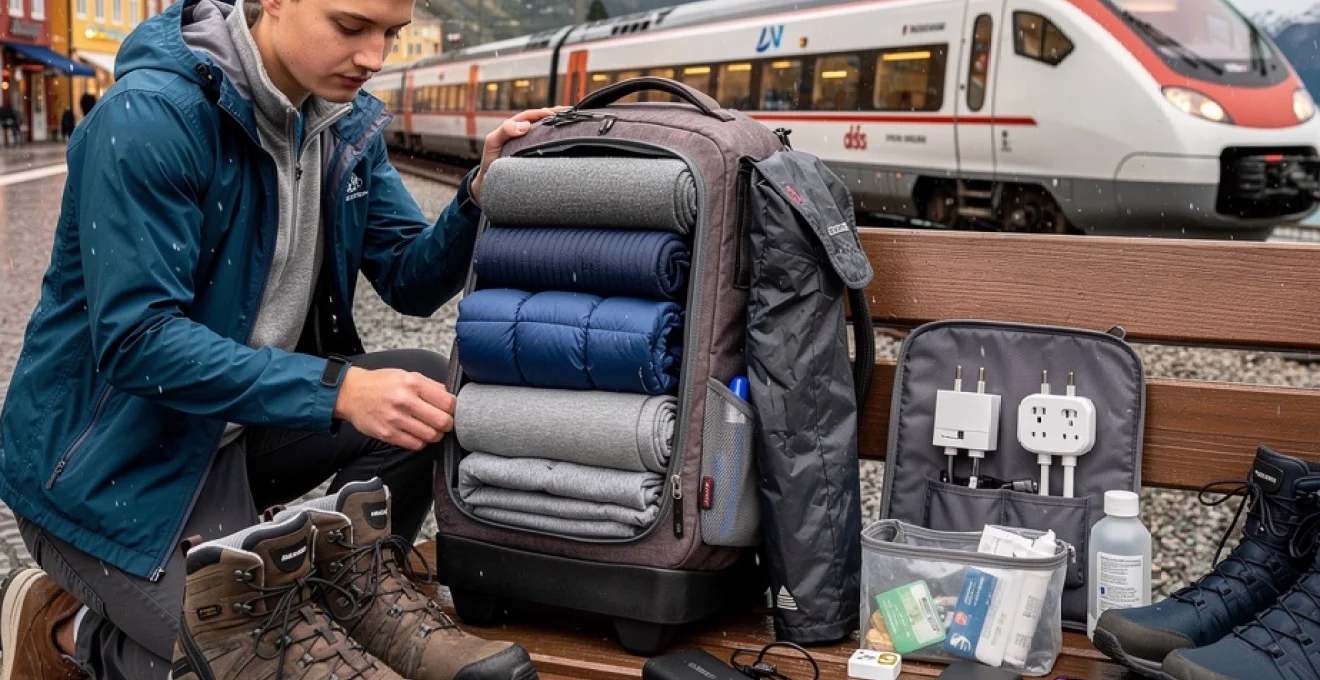
Scandinavia presents a unique challenge for travellers seeking to explore multiple Nordic countries in a single journey. The region’s dramatic weather variations, from Copenhagen’s temperate maritime climate to Tromsø’s Arctic conditions, demand strategic packing decisions. Whether navigating Stockholm’s archipelago, hiking Norwegian fjord trails, or experiencing Iceland’s volcanic landscapes, the right equipment transforms potential discomfort into memorable adventure. Understanding how to balance versatility with efficiency becomes essential when your itinerary spans urban centres, remote wilderness, and everything in between. With proper preparation, you’ll navigate Scandinavian weather patterns confidently whilst maintaining mobility across rail networks, ferries, and hiking trails that connect these remarkable destinations.
Climate-adaptive layering systems for nordic weather variability
The cornerstone of successful Scandinavian travel lies in mastering the art of layering. Nordic weather exhibits notorious unpredictability, with temperature swings of 15-20°C occurring within a single day during transitional seasons. Rather than packing bulky single-purpose garments, experienced travellers build modular systems that adapt to changing conditions. This approach proves particularly valuable when your itinerary crosses multiple climate zones, from Denmark’s relatively mild coastal environment to the sub-Arctic conditions of northern Norway and Sweden. The principle involves combining base layers, insulating mid-layers, and protective outer shells that work independently or together depending on immediate weather demands.
Merino wool base layers for temperature regulation in stockholm to tromsø routes
Merino wool base layers represent an investment that pays dividends throughout Scandinavian journeys. Unlike synthetic alternatives, merino naturally regulates body temperature whilst resisting odour accumulation—a critical advantage during extended rail journeys where laundry access may be limited. The fabric’s moisture-wicking properties prevent the clammy sensation that cotton produces when you transition from heated train compartments to chilly platforms. For routes spanning southern Sweden to Arctic Norway, 200-250 GSM weight merino provides optimal versatility. This mid-weight specification offers sufficient warmth for cool September evenings whilst remaining breathable during active daytime exploration.
Quality merino garments from established outdoor brands typically cost £60-£90 per piece, though sales can reduce this by 30-40%. You’ll need two sets minimum for a fortnight’s travel—one to wear whilst the other dries. The fabric’s quick-drying nature means overnight drying in heated accommodation works reliably, eliminating the need for multiple sets. Consider long-sleeve tops with crew necks rather than zip-necks for greater versatility beneath various outer layers.
Waterproof-breathable shell selection: Gore-Tex vs polartec NeoShell performance
Selecting appropriate waterproof outerwear determines comfort levels throughout Scandinavian exploration. Bergen receives approximately 2,250mm of annual rainfall, making it Europe’s wettest major city, whilst Copenhagen averages a comparatively modest 600mm. Your shell jacket must therefore handle sustained precipitation without sacrificing breathability during active pursuits. Gore-Tex remains the industry benchmark, offering proven waterproofing with reasonable breathability ratings of 15,000-20,000 g/m²/24hrs. However, Polartec NeoShell technology delivers superior breathability (up to 100,000 g/m²/24hrs) whilst maintaining excellent water resistance, making it preferable for high-exertion activities.
The choice ultimately depends on your activity profile. If your itinerary emphasises urban exploration with occasional hiking, traditional Gore-Tex provides dependable all-weather protection. For trips featuring extensive trekking in locations like Abisko National Park or the Lofoten Islands, NeoShell’s enhanced breathability prevents internal condensation during strenuous ascents. Look for jackets with pit zips regardless of membrane choice—these ventilation points prove invaluable for temperature regulation without removing layers. Hood design matters significantly; ensure adequate volume to accommodate insulating layers beneath whilst maintaining peripheral vision.
Insulation weight calculations for seasonal transitions across copenhagen, oslo, and reykjavík
Mid-September represents a transitional period where Scandinavian weather exhibits maximum variability. Copenhagen may still experience daytime temperatures reaching 18°C, whilst Tromsø sees averages around 8
C in the same period. Reykjavík often sits somewhere between the two, but rapid shifts brought by North Atlantic weather systems can make it feel much colder than the thermometer suggests. When calculating how much insulation to pack for a trip across Scandinavia, think in terms of combined Clo value rather than individual garment warmth. A lightweight synthetic or fleece mid-layer (around 200–300 g) combined with your base layers and shell will suffice for most urban sightseeing. For evenings by the harbour in Oslo or wind-exposed viewpoints near Reykjavík, you will appreciate an additional insulated jacket that adds warmth without excessive bulk.
We can treat your clothing system like a modular toolkit. Aim for one light fleece or grid-style mid-layer, plus one dedicated insulating piece with 60–100 g/m² synthetic fill or an equivalent down loft. This combination gives you the flexibility to handle everything from mild afternoons to unexpectedly cold nights, especially if you are travelling north of the Arctic Circle. Avoid overpacking heavy sweaters, which provide poor warmth-to-weight ratios and dry slowly in damp coastal climates. Instead, you’ll carry fewer items that work in more combinations, making your Scandinavian packing list lighter and more adaptable.
Packable down vs synthetic fill for midnight sun and polar night conditions
Choosing between down and synthetic insulation for a trip across Scandinavia depends on both climate and activity level. Down offers an exceptional warmth-to-weight ratio, compressing into a tiny package—ideal if you’re packing light for rail travel and short flights between Nordic capitals. However, traditional down loses much of its insulating ability when wet, which is a concern in persistently damp environments like the Norwegian coast or Icelandic drizzle. Hydrophobic-treated down improves moisture resistance but still demands a reliable waterproof shell in sustained rain.
Synthetic insulation (such as PrimaLoft or Coreloft) retains a greater proportion of its warmth when damp and dries faster, making it more forgiving in real-world Scandinavian weather. For shoulder-season travel where you may encounter sleet, wet snow, or sea spray, a lightweight synthetic jacket often proves more practical than an ultra-light down piece. For itineraries that include both midnight sun hiking in the far north and early winter polar night excursions, a hybrid strategy works well: a light synthetic jacket for wet, active days, supplemented by a compressible down sweater or vest for static warmth in the evenings. This combination ensures you stay comfortable whether you’re watching the northern lights in Tromsø or enjoying late sunsets in Stockholm’s archipelago.
Footwear strategy for multi-terrain scandinavian landscapes
Footwear can make or break your Scandinavian itinerary, particularly when you plan to move between cities, coastal paths, and mountain trails. Surfaces shift quickly from polished cobblestones and wet ferry decks to forest paths, boardwalks, and rocky viewpoints. Rather than packing several heavy pairs, the goal is to identify two core shoes that cover 90% of your activities: one pair for urban and light trail use, and one for more demanding hiking or winter conditions. As with clothing, your footwear strategy should adapt to mid-September variability, when you might experience everything from sun-dried trails to early frost on northern routes.
Think of your shoes as “tools with overlapping roles” rather than single-purpose items. A water-resistant, cushioned trainer-style hiking shoe can take you from city walking tours in Copenhagen straight onto easy trails around Bergen or Ålesund. A more robust boot with ankle support and aggressive outsole works for dedicated hiking days, glacier viewpoints, or icy pavements in northern Finland or Norway. By choosing models with modern materials and subdued colours, you’ll avoid the classic mistake of lugging heavy mountaineering boots through minimalist Scandinavian cafés.
Vibram arctic grip technology for bergen’s wet cobblestones and finnish ice
Scandinavian surfaces are notoriously slippery, particularly in coastal cities and during early frosts. Bergen’s wet cobblestones, polished by centuries of foot traffic and near-constant rain, demand more traction than standard trainers can offer. Vibram Arctic Grip technology, designed specifically for cold and icy conditions, uses a rubber compound and micro-structure that increases friction on wet ice and smooth surfaces. While no sole is completely slip-proof, Arctic Grip offers a significant safety advantage when you’re balancing camera gear, luggage, and steep old-town staircases.
For trips extending into northern Finland or Lapland, where black ice can appear overnight, investing in footwear with Arctic Grip or comparable winter traction is wise. You might wonder whether such specialised soles are overkill for a September holiday. In many southern areas, they may be more of a comfort than a necessity, but if your route includes early-season hiking above the treeline or coastal boardwalks in constant drizzle, the additional grip provides peace of mind. Consider at least one pair of shoes with a lugged, high-traction outsole even if you don’t opt for a dedicated Arctic Grip model.
Ankle support requirements for norwegian fjord hiking trails and swedish archipelago walks
When planning hikes in Norway’s fjords or along Swedish archipelago trails, ankle support becomes a key question. Classic advice insists on high-cut boots, but modern trail shoes with stiff soles and solid heel counters now offer enough stability for many travellers. Fjord routes often combine rocky steps, wet roots, and steep switchbacks; here, ankle rolls are more likely if you’re carrying a daypack or camera bag. If you have a history of ankle issues or intend to tackle longer, more technical hikes such as Trolltunga or Romsdalseggen, a mid- or high-cut boot with firm lateral support is a sensible choice.
For gentler coastal walks, island-hopping day trips, and gravel paths around Stockholm’s outer islands, a low-cut trail runner or lightweight hiking shoe usually suffices. The crucial factor is the stiffness and torsional stability of the sole rather than simply the collar height. Try this analogy: think of your foot like a camera on a tripod; the tripod legs (sole) need to be stable so the “head” (ankle) doesn’t wobble excessively. You can also supplement moderate ankle support with trekking poles, which reduce impact on descents and improve balance on wet rocks, allowing you to travel lighter without compromising safety.
Waterproofing standards: comparing leather vs synthetic materials for continuous moisture exposure
Continuous moisture exposure is almost guaranteed on multi-country Scandinavian trips, particularly if your route includes the Norwegian coast or Iceland. Full-grain leather boots, when properly treated with waxes or creams, offer excellent water resistance and durability. However, they are heavier, take longer to dry, and can feel overly warm during urban sightseeing or on trains. Synthetic and hybrid boots with waterproof membranes (such as Gore-Tex or eVent) dry faster and often feel more breathable, though they may not match leather’s long-term durability under intensive use.
For most travellers planning two weeks across Scandinavia in September, synthetic or mixed-material footwear with integrated waterproof liners provides the best compromise. Look for models rated to at least 10,000 mm hydrostatic head, which indicates solid resistance to prolonged rain and shallow puddles. Remember that waterproof shoes work best when paired with appropriate merino or synthetic socks that move moisture away from your skin. If you anticipate repeated immersion—stream crossings, heavy downpours, or slushy snow—pack a small bottle of waterproofing spray or wax to maintain performance, much like you would reproof a shell jacket.
Urban-to-trail versatility for seamless copenhagen to abisko national park transitions
How do you move from a design-focused café in Copenhagen to the wild trails of Abisko National Park without changing your entire outfit? The answer lies in choosing footwear that blends technical performance with understated aesthetics. Many modern hiking shoes and boots now feature neutral colour palettes and sleek profiles that don’t scream “mountain gear” when paired with jeans or travel trousers. For your main pair, prioritise cushioning, support, and traction, then select a design that you’re comfortable wearing into city restaurants and museums.
A second, lighter pair—such as packable trainers or minimalist sneakers—covers indoor days, spa visits, or evenings when you want something less structured. This two-pair system adds only modest weight but dramatically increases flexibility. Think of it as having both a Swiss army knife and a fine dining knife in your culinary kit: each excels in different settings, yet both are essential. By avoiding overly bright colours and bulky silhouettes, your footwear can move invisibly between Scandinavian urban minimalism and rugged national parks.
Electrical adaptors and power management across denmark, sweden, norway, finland, and iceland
Electrical standards are mercifully consistent across Denmark, Sweden, Norway, Finland, and Iceland, simplifying at least one element of your Scandinavian packing list. All five countries use 230 V, 50 Hz power and primarily Type C and Type F sockets, known as “Europlug” and “Schuko.” If your devices already feature two-round-pin European plugs, you may not need an adaptor at all. Travellers from North America, the UK, and other regions, however, should pack at least one quality universal adaptor with built-in surge protection to safeguard sensitive electronics on trains and in older buildings.
Because Scandinavian cities are highly digital, you will likely carry a smartphone, camera, and possibly a laptop or tablet. To manage charging efficiently, consider a compact multi-port USB-C charger that can power several devices from a single outlet—especially useful in hotel rooms and sleeper train compartments with limited sockets. A 20,000 mAh power bank ensures you stay connected during long days exploring fjords or national parks where outlets are scarce. We can think of power management like water logistics on a long hike: you want enough stored capacity to bridge the gaps between reliable “refill points” such as cafés, trains, and accommodation.
Luggage configuration for rail travel on sj, vy, and dsb networks
Rail travel forms the backbone of many multi-country Scandinavian itineraries, with SJ in Sweden, VY in Norway, and DSB in Denmark offering extensive networks. These systems are designed for passengers with luggage, but space is not unlimited, particularly during peak periods. A well-thought-out luggage configuration ensures you can board quickly, navigate narrow aisles, and store your belongings without stress. Instead of one oversized suitcase, aim for a modular setup: a primary checked-size roller or duffel and a secondary cabin-sized backpack or daypack.
This division allows you to keep essentials—documents, electronics, a light layer—accessible, while stowing bulkier items on overhead racks or in carriage luggage zones. Because connections between trains, ferries, and buses can involve short walks or platform changes, weight distribution becomes crucial. You want to be able to lift your heaviest bag onto racks unaided, especially on busy SJ or VY services where staff assistance may be limited. Think of your luggage as a mobile wardrobe and office combined; the easier it is to move, the more enjoyable your Scandinavian rail journey will be.
Dimension restrictions for scandinavian sleeper trains and bergen railway storage
Scandinavian sleeper trains, such as SJ’s night services and VY’s routes between Oslo and Bergen, impose practical rather than strict legal size limits. Standard suitcases up to around 70–75 cm in height typically fit into cabin storage spaces, but anything larger may be difficult to manoeuvre. On the Bergen Railway and other scenic routes, overhead racks and end-of-carriage luggage areas are sized with typical European luggage in mind, not oversized expedition gear. If your bag cannot be lifted above shoulder height or turned sideways in a narrow corridor, it will likely feel cumbersome on these journeys.
As a guideline, aim for checked luggage with linear dimensions (height + width + depth) under 158 cm, mirroring many airline policies. This size works well in most rail storage areas and hotel rooms across Scandinavia. For sleeper cabins, consider soft-sided bags or compressible duffels, which can be squeezed under bunks more easily than rigid suitcases. Planning bag dimensions in advance saves you from awkward late-night rearrangements in tight cabin spaces when all you want is to sleep before an early arrival into Stockholm or Trondheim.
Weight distribution techniques for backpack-roller hybrid systems
Many travellers now opt for backpack-roller hybrid bags for Scandinavian travel, combining wheeled convenience with the option to shoulder their gear on rough ground or snow. To make this system work effectively, careful weight distribution is essential. Place the densest items—shoes, toiletries, electronics—close to the wheel base or against the back panel, depending on whether you’ll more often roll or carry the bag. This reduces strain on the handle when rolling and creates a more stable load on your back when using the shoulder straps.
Reserve your smaller backpack or daypack for valuables, documents, and items needed in transit, but avoid overloading it to the point where it becomes uncomfortable on walking transfers. A balanced setup might mean carrying 60–70% of your total weight in the roller and 30–40% in the backpack. Imagine your luggage system as a see-saw: if one side is overloaded, the entire arrangement becomes harder to manage. Test your configuration on shorter local journeys before departure to identify pressure points and adjust packing strategies accordingly.
Compression packing solutions for extended nordic rail itineraries
Compression solutions—whether classic compression sacks, modern vacuum-free packing cubes, or roll-top dry bags—are invaluable for extended Nordic rail itineraries. These tools allow you to reduce the volume of bulky items like insulated jackets, mid-layers, and spare trousers, freeing up space in your main bag. For example, a lightweight down jacket can compress to the size of a grapefruit, fitting neatly into a corner of your roller. Just remember that compression does not reduce weight; it simply makes your pack more organised and easier to handle on crowded platforms.
Use compression sparingly and strategically. Over-compressing all your belongings can turn your suitcase into a dense, inflexible block that is difficult to search when you need a specific item quickly on an SJ or DSB train. A smart approach is to compress off-season backup pieces and infrequently used layers while keeping daily essentials in standard packing cubes. This way, your bag functions more like a well-organised drawer system than a single overstuffed compartment, streamlining your daily packing and unpacking as you move across Scandinavia.
Toiletries and pharmaceuticals compliant with nordic customs regulations
Toiletries and pharmaceuticals for Scandinavia require more thought than simply decanting your home routine into travel bottles. All Nordic countries follow EU-style regulations for liquids in hand luggage on flights: containers must be 100 ml or less and fit into a 1-litre transparent bag. For train-only itineraries, these restrictions are less pressing, but packing light still makes sense, especially if you move accommodation frequently. Opt for solid toiletries where possible—bar shampoo, conditioner, and soap—to reduce weight, leakage risk, and plastic waste.
Pharmaceutical regulations across Denmark, Sweden, Norway, Finland, and Iceland are broadly harmonised, but some prescription medicines that are routine elsewhere may be controlled here. Always carry medications in original packaging with printed prescriptions or a doctor’s letter, particularly for opioids, strong painkillers, or psychotropic drugs. Quantities for personal use are generally permitted, but frontier checks may ask for documentation on cross-border rail routes or flights. You’ll find that over-the-counter products like ibuprofen, antihistamines, and basic first-aid supplies are easily available in Nordic pharmacies, but prices can be higher than at home, so bringing a small personal kit is cost-effective.
Currency, payment cards, and digital wallet preparation for cashless nordic societies
Scandinavian countries are among the most cashless societies in the world, which has major implications for how you prepare your travel finances. Sweden, Norway, Denmark, Finland, and Iceland all support widespread contactless payments, and many businesses no longer accept cash at all. A combination of at least one fee-free debit card and one credit card, both enabled for contactless and international transactions, will cover almost every scenario—from metro tickets in Stockholm to coffee in rural Norwegian cafés. Before departure, notify your bank of your travel plans and enable location-based security features where available to reduce the chance of blocked transactions.
Digital wallets such as Apple Pay, Google Pay, and Samsung Pay are widely accepted, often more so than physical cards in smaller venues. If you’re wondering whether to bring local currency, a small amount (equivalent to €50–€100) can be useful for rare situations, such as coin-operated lockers or older public toilets, but many travellers now complete entire trips without visiting an ATM. Think of your digital wallet as your primary “cash,” with physical notes as backup rather than the other way around. Keep card details and emergency contact numbers stored securely in a password manager so you can act quickly if a card is lost, ensuring that your journey across Scandinavia remains focused on fjords, forests, and cityscapes rather than banking logistics.